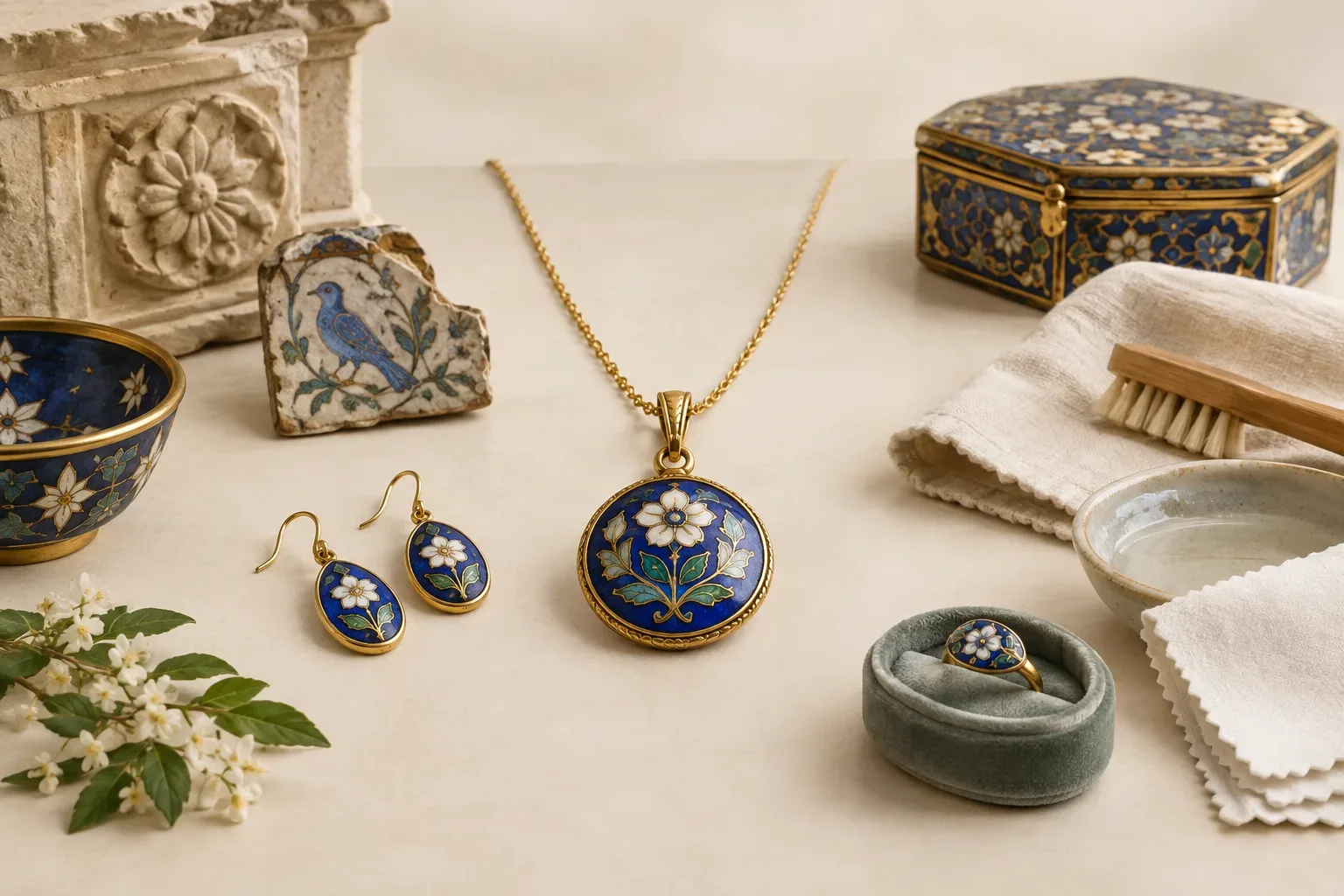
Meaning at a glance
This guide explains the documented history and changing contexts of enamel jewelry, separates historical meanings from later personal interpretations, and gives practical, conservator-minded advice for safe cleaning, storage, selection and gifting.
What the historical record shows
Museum research makes clear that enamel has a long and varied presence in personal adornment and decorative arts. The Victoria and Albert Museum presents enamel as a recurrent technique in the history of jewellery, used in different periods and cultures for decorative and technical reasons rather than a single, uniform meaning. The V&A catalogue and exhibitions emphasize changing social contexts and techniques rather than asserting a single symbolic reading for enamel across cultures.
Because enamel is a material and a technique rather than a single symbol, evidence in museum collections highlights practical and aesthetic motivations: color, surface protection, and the ability to create pictorial detail. The V&A’s research traces how makers and owners used enamel to signal taste, wealth, and technological skill in different periods, with motifs and uses shifting as fashions, workshops and technologies evolved.
Separating documented history from modern interpretations
When reading historical objects in museum collections, distinguish what the collection records document from what later commentators or contemporary wearers may feel. The V&A provides documented provenance, technique and social context for many enamel pieces, but it does not treat enamel as carrying one fixed spiritual or cultural meaning everywhere it appears.
Modern symbolic interpretations—such as assigning emotional or spiritual significance to an enamel color or a painted motif—are often valid on a personal level but should not be conflated with historical evidence unless primary sources for a specific culture or period make that connection. In short, museums document use, technique and changing fashion; contemporary symbolic readings are personal or community-specific and require separate verification.
How enamel appears in jewellery and what to look for
Enamel appears in jewellery in several technical forms and decorative roles. Museums and collections catalogues commonly identify styles such as painted enamel panels set into lockets, decorative cloisonné and champlevé surfaces, and enamel details that highlight engraved metalwork. These approaches let makers add vivid color and pictorial detail that metal alone cannot provide.
Enamel surfaces may be applied to a metal base, painted into compartments, or used as inset panels alongside gemstones or metalwork. Where gemstones are present with enamel, the stone and the enamel will often demand different care: softer stones or surface-set gems adjacent to enamel require extra caution to avoid dislodging settings or scratching surfaces. The Victoria and Albert Museum’s materials and object descriptions are a helpful reference for identifying these combinations in historical pieces.
Safe cleaning: general principles
Treat enamel as a delicate colored glass-like surface bonded to metal. The safest cleaning is conservative, using the mildest methods first. Begin with dry dusting using a soft, lint-free cloth or a soft natural-hair brush to remove loose particles. If a deeper clean is needed, use a solution of lukewarm water and a drop or two of a very mild, pH-neutral soap, applied gently with a soft cloth or a soft, dampened cotton swab.
Avoid aggressive scrubbing, abrasive cleaners, baking soda, or metal polishes on enamel areas. Do not use ultrasonic cleaners or steam cleaners on enamel that is painted, has fine painted detail, or sits next to fragile gemstones or adhesives. Excessive heat, prolonged immersion, or strong solvents can cause crazing (fine surface cracks), loss of paint, or breakdown of surrounding materials and adhesives.
Cleaning around gemstones and mixed-material settings
When enamel is combined with gemstones, take the needs of each material into account. Some gemstones are heat-sensitive or porous and can be damaged by water or solvents. The Federal Trade Commission’s consumer guidance emphasizes checking for material treatments and disclosures before purchase; if a piece has known treatments, ask the seller for cleaning and care recommendations.
Work in small, localized areas and test any damp cleaning on a hidden margin first. If a stone is cemented or has an older adhesive, avoid soaking the whole piece. Where there is uncertainty about the condition or construction—loose enamel panels, old repairs, or fragile paint—consult a qualified conservator rather than attempting invasive cleaning yourself.
Storage: protecting enamel from damage
Store enamel jewellery so it cannot rub against hard surfaces or other pieces. Ideally each item should rest in its own soft-lined compartment or pouch to prevent chips and scratches. Keep pieces away from prolonged direct sunlight, which can fade painted enamels or damage colorants over time, and avoid storing enamel in very humid or very dry conditions because extreme environmental changes can stress the bond between enamel and metal.
Avoid storing enamel jewellery near strong chemical sources such as household cleaners or perfumes. Wrap each piece in acid-free tissue if long-term storage is required, and for heirloom or high-value items consider climate-controlled storage. Regularly inspect stored pieces for signs of corrosion at metal edges, crazing of the enamel, or loosening of settings so small issues can be addressed early.
Common cleaning and storage mistakes to avoid
Do not assume all enamel is the same. Modern vitreous enamels, painted enamels, and cold enamel or polymer-based coatings behave differently. Aggressive polishing, ultrasonic cleaning or steam cleaning can permanently damage painted surfaces or loosen insets that are only superficially adhered.
Avoid household silver polishes on enameled surfaces, and do not use strong solvents like acetone near painted enamels or glued settings. Do not store enamel jewellery in bulk together where items can knock against each other, and do not expose pieces to prolonged heat (near radiators, car dashboards in summer, or direct sunlight) which can cause expansion, flaking, or discoloration.
Selecting and gifting enamel jewellery respectfully
When choosing enamel jewellery as a gift, be mindful of provenance and context. If the piece reproduces motifs from a particular culture or period, do not assume that it carries the same cultural meanings as the original unless the seller provides documented provenance. The Victoria and Albert Museum’s collections underscore how designs shift in meaning through time; what appears as a historic motif in a modern piece may be decorative rather than culturally specific.
Ask retailers about materials and treatments. The Federal Trade Commission advises consumers to seek clear disclosure of treatments and imitations for gemstones and jewellery components. If your recipient values heritage or authenticity, choose pieces with clear documentation or from makers who explain materials and construction. For sensitive contexts—religious or culturally significant symbols—ask about the maker’s background and how the motif is used to ensure your gift is respectful.
When to seek a conservator or professional jeweller
If enamel is cracked, flaking, or appears to be lifting from its metal base, or if gems are loose, seek a professional conservator or an experienced jeweller who works with historic or high-value pieces. Museums such as the Victoria and Albert Museum rely on trained conservators for restoration to avoid irreversible damage, and the same caution applies to private heirlooms and valuable modern pieces.
If you purchased a piece with unusual treatments or adhesives, consult the seller or a professional before attempting home cleaning. When in doubt, choose inspection and professional care rather than a risky do-it-yourself repair.
Frequently asked questions
Can I use ultrasonic cleaners on enamel jewellery?
No. Ultrasonic cleaners can loosen enamel panels and damage painted surfaces or adjacent settings. Use dry dusting and very mild soapy water instead, and consult a professional for stubborn grime.
Is it safe to use silver polish on enamel pieces?
Avoid metal polishes on enamel surfaces. Polishes are abrasive and may remove or dull painted enamel; clean metal parts separately and carefully, protecting enamel areas.
How should I store enamel jewellery long term?
Store each item separately in a soft-lined compartment or pouch, away from direct sunlight and extremes of humidity or temperature, and inspect pieces periodically for corrosion or loosening.
My enamel pendant has a tiny crack. Should I try to fix it?
Do not attempt adhesives or home repairs on cracked enamel. Small cracks can indicate underlying separation from the metal; seek an experienced conservator or jeweller to assess and repair safely.
Are all enamel techniques the same?
No. Techniques vary: vitreous enamelling, painted enamel, cloisonné and modern resin or 'cold' enamels have different properties and care needs. Ask the seller or a conservator about the specific technique before cleaning.
What questions should I ask when buying enamel jewellery?
Ask about materials, technique, gemstone treatments, provenance and any known repairs. The Federal Trade Commission recommends requesting clear disclosure of treatments and materials for jewellery purchases.
Sources and further reading
- Bedazzled: A History of Jewellery — Victoria and Albert Museum
- An A-Z of Gemstones — Victoria and Albert Museum
- Buying Gemstones, Diamonds, and Pearls — Federal Trade Commission