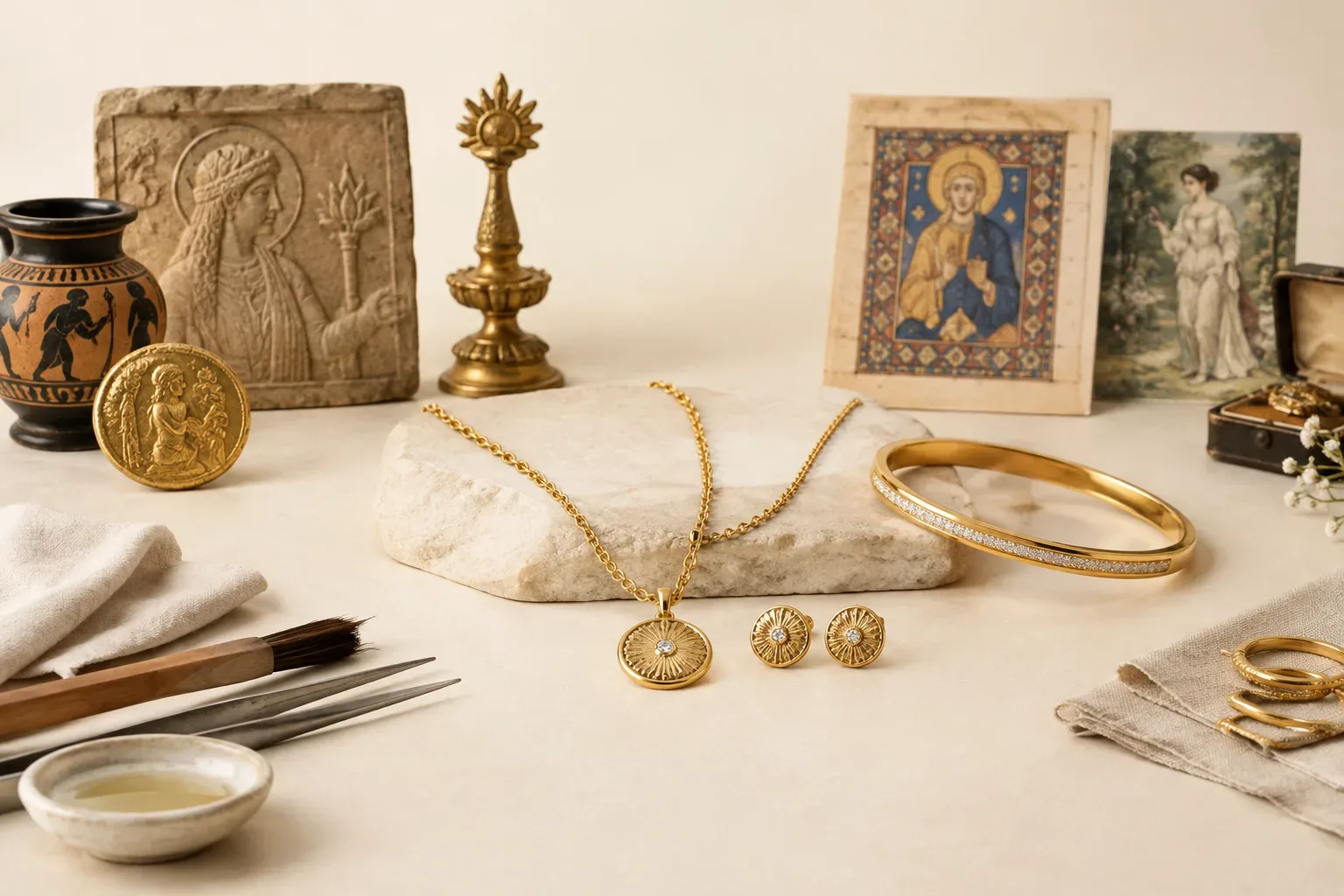
Meaning at a glance
Explain the documented history and changing contexts of gold-plated jewelry repair and maintenance, separate cultural or religious evidence from later popular interpretations, and give practical guidance for choosing and wearing such pieces.
What gold-plating is — and how sellers disclose treatments
In simple terms, 'gold-plated' describes a thin gold layer applied over a base metal to give the appearance of gold at lower cost. Related techniques include vermeil and gold-filled constructions that differ in base metal and how the gold is attached. The Federal Trade Commission (FTC) discusses material treatments and the importance of clear disclosure so buyers understand whether a piece is plated, gold-filled, vermeil, or solid gold. If you are choosing or repairing a piece, ask the seller or jeweler to explain which treatment was used and whether any treatments were applied after manufacture.
Historical evidence and changing contexts
The Victoria and Albert Museum documents how jewellery materials, techniques and meanings have changed across cultures and periods. The V&A's exhibition and resources trace shifts from the decorative and status-marking uses of precious metals in many historical societies to the mass-produced and often fashionable treatments of the modern era. Those changes include the adoption of new surface techniques, broader access to imitative finishes, and evolving ideas about personal display and taste.
Importantly, museum documentation focuses on how techniques and social contexts have changed; it does not treat modern commercial plating as equivalent in meaning to ancient goldwork. Use the V&A resources to understand documented practice and social context, and then separate that evidence from contemporary marketing or personal symbolism.
Documented historical meanings versus modern personal interpretations
Museum evidence supports the documented social role of precious metals: historically, solid gold and high-quality jewelled objects often signalled wealth, status, or ritual function. Those documented meanings should be kept distinct from modern interpretations about gold-plating. A plated piece may carry personal meaning to an owner or be presented as a symbolic gift, but that personal significance is a contemporary and individual interpretation rather than a direct continuation of historic social meanings.
Modern consumers also sometimes interpret plated pieces as ethical or budget-conscious alternatives to solid gold. That is a recent cultural preference and not a historical continuity; the V&A sources help explain the historical role of materials while the FTC guidance helps you understand modern disclosure practices.
How plating and treatments appear in jewellery
Plating appears visibly as a gold-colored surface on items whose underlying metal may be copper, brass, silver, or another alloy. Vermeil normally uses sterling silver as the base metal with a gold surface; gold-filled items have a thicker mechanically bonded gold layer; simple gold-plating is thinner and applied by electrochemical processes. These differences affect how the piece wears, what repair options exist, and how long a finish will last in everyday use.
Gemstones and other decorative elements also change how a piece should be cleaned and repaired. The Victoria and Albert Museum's A–Z of gemstones describes historic and practical contexts for stones; when stones are set into plated metal, jewelers must consider the gem's hardness and porosity before applying ultrasonic cleaners or chemical treatments.
Warning signs that a plated piece needs repair or professional attention
Look for clear visual cues: flaking or peeling of the gold surface that reveals a different color beneath, persistent dark discoloration that does not respond to gentle cleaning, or exposed base-metal areas at high-wear points such as chains and clasps. Also watch for structural signs: slow or sudden loosening of prongs or bezels that hold stones, weak or broken clasps, and stretched or kinked chains. If you develop a skin irritation in contact with a piece that previously did not cause problems, that can indicate corrosion of the base metal where plating has worn through.
Minor surface grime and everyday tarnish can often be managed at home with a soft, dry cloth and careful, minimal cleaning. Avoid abrasive cleaners, polishing cloths intended for solid gold, and household chemicals on plated surfaces because aggressive treatments can remove the thin gold layer. For any structural repair, or when plating has significantly worn away, seek a professional assessment.
When to consult a professional and what to expect
A trained jeweler can assess whether a piece needs re-plating, structural soldering, clasp replacement, or stone resetting. Re-plating may restore appearance but it will not make a plated piece equivalent to solid gold; it addresses surface finish rather than core material. Expect a professional to explain the method they will use, whether any surface prep (such as stripping old plating) is required, and whether they will use a thicker finish such as vermeil or a standard electroplate.
Ask the jeweler whether they can provide a written description of the materials and processes they will use. The FTC recommends clear disclosure of treatments and materials, so a reputable repairer or seller will be willing to explain the construction and any limitations of a repair or re-plating job.
Practical maintenance: care, cleaning and safe storage
Clean plated pieces gently after wear with a soft cloth to remove oils and surface dirt. Avoid ultrasonic cleaners and strong chemical dips on plated surfaces unless a professional advises otherwise. Remove plated jewelry before swimming in chlorinated pools or applying lotions and perfumes, because chemicals and repeated abrasion speed wear-through of the gold layer.
Store plated items separately to prevent scratching and reduce exposure to moisture and corrosive gases. Use soft pouches or lined boxes and avoid piling multiple pieces together. If travelling, keep simple care instructions with the item so recipients know how to maintain the finish.
Choosing or gifting plated jewellery respectfully
When choosing a plated piece for yourself or as a gift, match the item to the recipient's everyday life. If the wearer prefers low-maintenance, high-durability pieces, consider vermeil or gold-filled items or solid gold instead of thinly plated fashion jewellery. If the value is symbolic rather than material, make that clear in the presentation so expectations about longevity are aligned.
Include care guidance with the gift, and if the recipient may have sensitive skin, confirm whether the item is nickel-free or hypoallergenic. Ask the seller to document the construction and any warranties or repair options. For heirloom intentions, prefer constructions that can be maintained and resold or reworked by jewelers over time.
Repair options and typical interventions
Common professional repairs for plated jewellery include replacing clasps, re-soldering broken links, tightening or re-setting stones, and re-plating. Some jewelers will strip old plating and apply a fresh layer; others can convert a plated base into a more durable finish where appropriate. For valuable gemstones or vintage settings, a conservator or experienced jeweler who understands historic constructions is preferable.
When seeking repair, document the piece’s original condition, ask for a cost estimate, and discuss whether the repair will affect the item's value or future reparability. If the piece has sentimental value, ask about options to preserve as much original material as possible.
Putting meanings into context: motifs, gemstones and traditions
Motifs such as lockets, hearts, knots or religious symbols recur across jewellery history; the Victoria and Albert Museum's resources explain how motifs have been reused and reinterpreted across eras. A plated version of a traditional motif does not inherit the same social weight that a historic solid-gold or jewelled piece once carried, but it can carry personal meaning for the wearer today.
Gemstones set into plated jewellery should be treated according to their nature. Refer to the V&A's A–Z of gemstones for historical and identification context, and ask a jeweler whether a specific cleaning or repair method suits the stone and the metal. Modern personal interpretations of motifs and stones are valid as expressions of identity, but they are contemporary meanings layered on top of documented historic uses.
Final practical takeaway
Respect the differences between documentation and interpretation: use museum resources to understand historical practice, rely on regulatory guidance about material disclosure, and make practical choices about care and repair based on the construction of the piece. Gentle cleaning, careful storage, and prompt professional attention for structural problems will extend the life of plated jewellery. When in doubt, ask the seller or a reputable jeweler to explain the materials and the likely outcomes of any repair.
Frequently asked questions
How long does gold plating last?
There is no single answer; the life of plating depends on the thickness of the gold layer, the base metal, how often the piece is worn, and the wearer's activities. Gentle care and avoiding chemicals and abrasion will prolong the finish, and a jeweler can advise whether re-plating is a reasonable option.
Can I re-plate jewellery at home?
Re-plating requires specialised equipment and surface preparation to achieve a durable result. For most pieces, especially those with stones or delicate settings, it is safer to have a professional jeweler perform re-plating and any necessary preparatory work.
Is vermeil the same as gold-plated?
Vermeil is a specific technique using sterling silver as the base metal with a gold coating; simple gold-plating can use a variety of base metals and thinner gold layers. Ask the seller for a clear description—regulators like the FTC recommend disclosure of such treatments.
How should I clean gold-plated jewellery?
Wipe plated pieces with a soft, dry or slightly damp cloth and dry immediately. Avoid abrasive cloths, strong chemical cleaners, and ultrasonic cleaners unless a professional confirms they are safe for that particular item and its stones.
When will I need a professional repairer?
Seek professional help for structural problems (broken chains, damaged clasps, loose stones), when plating has visibly worn through exposing the base metal, or when you need re-plating. A jeweler can assess whether repair or conservation is appropriate and explain the likely outcomes.
Sources and further reading
- Bedazzled: A History of Jewellery — Victoria and Albert Museum
- An A-Z of Gemstones — Victoria and Albert Museum
- Buying Gemstones, Diamonds, and Pearls — Federal Trade Commission