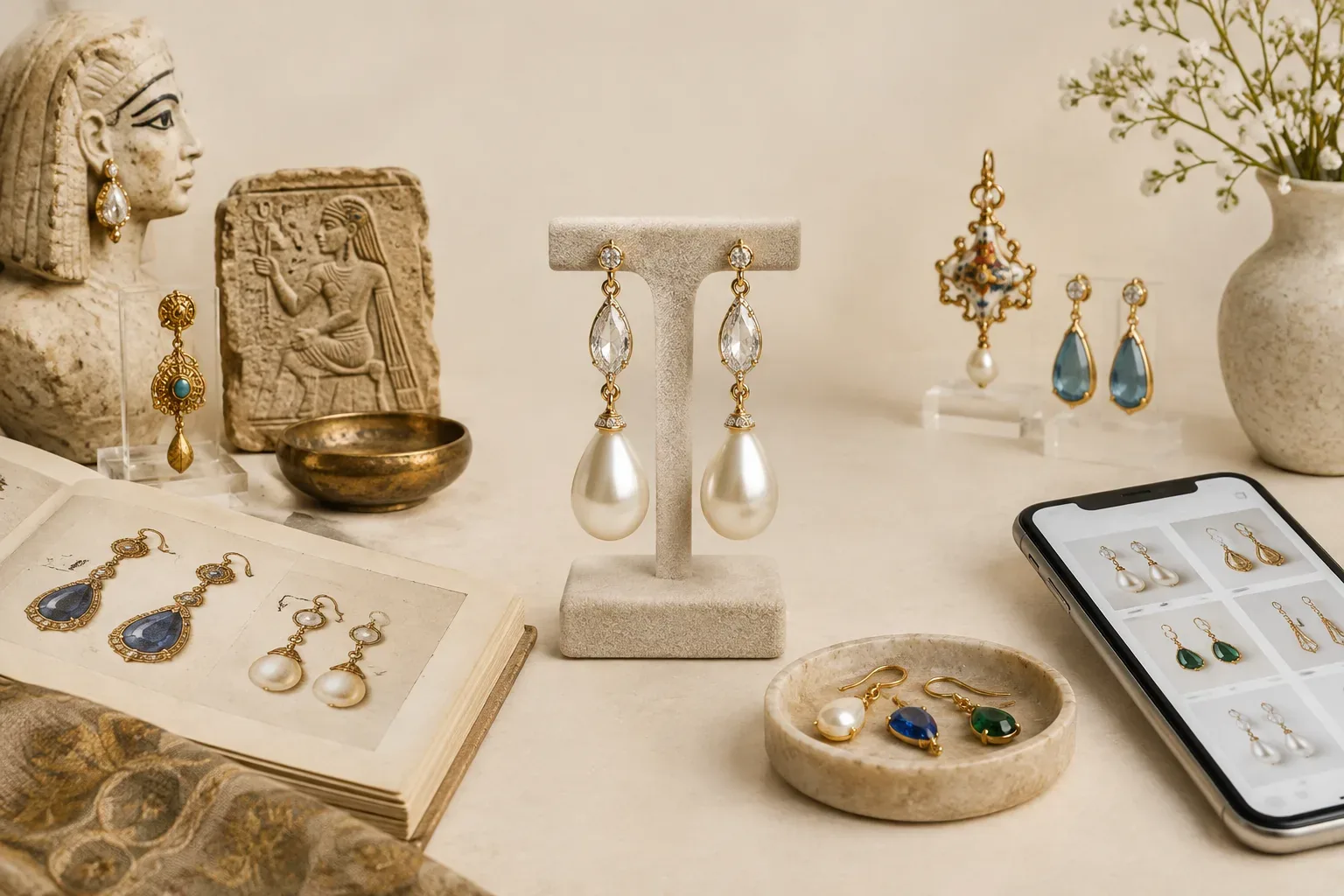
Meaning at a glance
This guide explains documented historical contexts for drop-style earrings, distinguishes verified cultural meanings from modern personal interpretations, and gives practical advice on photos, seller policies, and red flags when buying drop earrings online.
What the historical record (documented evidence) actually says
The Victoria and Albert Museum frames jewellery as an object type whose form and social meaning change across time and place. Museum resources and exhibitions on jewellery history describe how shapes such as drops, pendants, and pendulous elements recur in different cultures because they suit particular fashions, technologies, and materials rather than because a single universal symbolism applies. When a museum like the V&A discusses jewellery history it emphasizes changing social context and function rather than asserting uniform symbolic meanings across cultures.
The V&A also maintains reference material on individual gemstones that explains how different stones have been used, valued, and worked in different periods. Those resources document that materials, gem cutting, and setting techniques evolve; a gem’s appearance in a Victorian setting can have an entirely different social meaning from the same gem set into a contemporary minimalist drop earring. Treat museum documentation as descriptive of how people used and valued jewellery, not as prescribing one fixed meaning for a motif.
Separating documented historical meanings from modern personal interpretations
Where museums and scholarly catalogues record that a particular motif or stone had a particular symbolism in a specific time and place, that record is documentary evidence of a historical meaning for that culture or period. For example, museum descriptions will note when certain jewels were part of court dress or mourning practices or when specific techniques became fashionable. Those are documented contexts, and the Victoria and Albert Museum’s materials are a representative source for that kind of information.
By contrast, many meanings attached to drop earrings today are personal, regional, or commercial—that is, buyers, designers, and marketers frequently assign sentimental or symbolic meanings (love, protection, status, or trendiness) without those meanings being grounded in continuous historical practice. That modern layer is valid as a personal or contemporary cultural meaning but it is not the same as a documented historical usage. Always distinguish what a credible historical source records from what a seller or wearer feels today.
How the drop motif and gemstones appear in jewelry
In jewellery descriptions, a "drop" typically refers to any element that dangles below the earlobe, from a simple pearl drop to a multi-tiered pendant. Designs range from a single suspended pearl or facetted stone to articulated chains of stones that move with the wearer, and the form has been adapted for many metals, settings, and techniques.
Gemstones commonly used in drop earrings include pearls, diamonds, and a wide range of coloured stones. The V&A’s A–Z of Gemstones explains how different gems have unique optical qualities, cutting traditions, and historical associations, and why some gems are chosen for their lustre (pearls), brilliance (diamonds), or colour (sapphires, emeralds). Those material properties affect both the appearance in photos and the practical wear qualities of a drop earring.
Photos: what to demand and why it matters
Ask for multiple images: a clean, well-lit front view; a side profile to show length and thickness; a close-up of the setting and any hallmarks; and a photo of the earring worn or on a standard-sized model to show scale. Sellers who provide these views make it easier to judge proportion, how the piece moves, and whether the finish matches the description.
Look for consistent lighting and colour accuracy. Jewellery can appear dramatically different under warm incandescent light than under daylight-spectrum lighting; when colour is important, request a daylight-balanced image or confirmation of the lighting used. If the seller uses stock photos that look identical across multiple listings, ask for a current, unique photo of the actual piece you’ll receive.
Seller policies and documentation to check
Check the return policy carefully and confirm who pays return shipping and who bears risk in transit. A clear returns window and conditions for refunds or exchanges are essential when you cannot see the item in person.
For gemstone, diamond, and pearl claims, request written disclosure of treatments and any grading or certification. The U.S. Federal Trade Commission’s consumer guidance explains that sellers should disclose gem treatments, synthetic or imitation materials, and whether a diamond has been laboratory-grown or treated. For higher-value purchases, ask for a laboratory report from a recognized gemological lab and retain written records of any seller statements about origin or treatment.
Red flags and when to walk away
Red flags include listings that omit metal type or fineness, use only stock or poor-quality photos, lack a clear return policy, or offer unbelievably low prices compared with typical market values. Another warning sign is when a seller refuses to confirm whether gems are treated or synthetic or provides inconsistent answers about weight and dimensions.
Also be cautious when a listing claims religious or cultural significance without supporting provenance. If a motif is described as sacred, rare, or culturally specific, ask for documented evidence or provenance. Lack of provenance for apparently historic pieces, or overly generic provenance claims, are reasons to pause.
Practical selection guidance for buyers and gifters
Consider weight and length relative to the wearer’s comfort and hairstyle. Long, heavy drops may look dramatic but can pull on earlobes; lighter materials and articulated links often achieve a dangling look without excessive weight. Where possible, ask the seller for the exact weight in grams and measure of drop length to compare with other earrings you or the recipient already wear.
Respect cultural context when choosing a motif. If the design references a contemporary cultural or religious symbol, do some basic research to understand whether wearing it is appropriate in your context. When in doubt, pick a neutral or clearly contemporary design, and if you intend to gift something with cultural meaning, frame it respectfully and explain why you chose it.
For gift purchases, check the seller’s gift-wrapping, return window, and whether they can include a certificate or provenance note. If you need a surprise, verify an easy, unconditional return policy so the recipient can exchange size, metal, or style without awkwardness.
Practical steps after purchase
When your package arrives, inspect the item immediately against the listing photos and any written claims. Verify hallmarks, compare measurements and weight, and test closures gently to ensure they function. If the item differs materially from the listing or is damaged, contact the seller and document the discrepancy with photos and timestamps.
For valuable gemstones or older pieces described as antique, consider an independent appraisal if authenticity or value matters to you. Keep all receipts, exchange messages, and any authentication documents in case you need to file a dispute through your payment provider or marketplace.
When to seek specialist help
If a piece is presented as a historic or museum-quality object, ask for clear provenance and condition reports; if in doubt seek an independent conservator or appraiser familiar with antique jewellery. The distinction between romanticized narrative and documented provenance is sometimes subtle and best evaluated by a professional when price or cultural sensitivity is high.
For medical concerns such as metal allergies, consult a healthcare professional if you have a history of reactions; otherwise prefer known hypoallergenic metals such as surgical stainless steel, platinum, or high-karat gold and ask about plating thickness when nickel or base-metal-plated items are offered.
Final thoughts
Drop earrings are a long-lived form that can carry many layers of meaning—historical, social, aesthetic, and personal. Rely on reputable documentary sources like museum collections and gemstone reference guides for historical context, and use consumer-protection guidance for material disclosures and seller transparency.
When buying online, rigorous attention to photos, explicit policy terms, and clear disclosure about materials and treatments will protect you more than relying on marketing copy. Treat historical or cultural claims with care and do additional research when symbolism matters to you or the person you are gifting.
Frequently asked questions
What photos should I ask for before buying drop earrings online?
Request a front view, side profile showing length and thickness, a close-up of the setting and any hallmarks, and a photo of the earring worn or on a standard model for scale. Ask about the lighting used so you can judge colour accurately.
How can I verify gemstone treatments or authenticity?
Ask the seller for written disclosure of treatments and any laboratory reports. For higher-value stones, request an independent lab report from a recognized gemological laboratory and keep written records of seller statements.
What return policy is reasonable for online earring purchases?
A clear returns window with explicit conditions, who pays return shipping, and whether items must be unworn and in original packaging is reasonable. For gifts, a longer, unconditional return window is preferable.
What are common red flags in listings?
Red flags include poor or stock photos, missing metal/fineness details, absence of a clear returns policy, inconsistent measurements, and refusal to disclose treatments or origin information.
How do I avoid allergic reactions to earring metals?
Choose known hypoallergenic metals like platinum, high-karat gold, or surgical stainless steel. If an item is plated, ask about plating thickness and base metal; when in doubt, test or consult a medical professional if you have a history of reactions.
Is it appropriate to wear culturally specific motifs?
If a motif references a specific culture or religion, research its meaning and provenance. When symbolism matters, seek documented context and consider whether the wearing of that motif is respectful in your setting.
Sources and further reading
- Bedazzled: A History of Jewellery — Victoria and Albert Museum
- An A-Z of Gemstones — Victoria and Albert Museum
- Buying Gemstones, Diamonds, and Pearls — Federal Trade Commission