Meaning at a glance
This article explains the documented history and changing contexts of drop earrings, separates historical meanings from modern interpretations, shows how motifs and gemstones appear in drop designs, and provides a clear, practical quality checklist focused on construction, comfort, and durability along with respectful selection and gifting guidance.
Quick answer
A reliable drop earrings quality checklist focuses first on solid construction (secure joins and settings, appropriate metal and finish), then on comfort (weight, length, and backing style), and finally on durability (stone security, corrosion resistance, and repairability). Historical evidence shows that drop earrings and their motifs have shifted meanings and uses across cultures; separate documented cultural functions from contemporary personal symbolism, inspect gemstones for treatment or imitation disclosures, and choose styles and materials that match the wearer’s lifestyle and sensitivities.
Historical evidence and precise cultural contexts
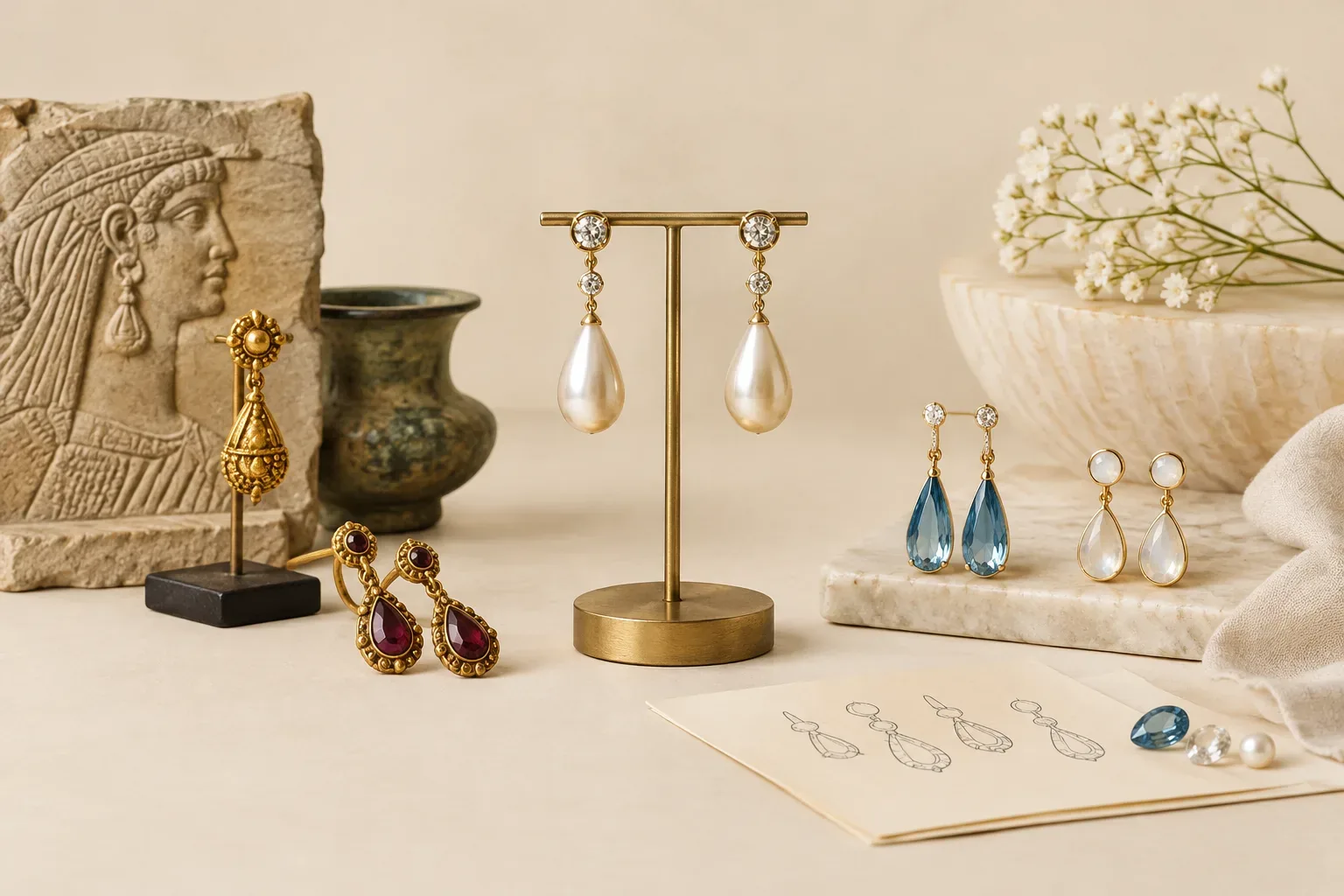
Museum documentation demonstrates that earrings, including drop styles, appear across many cultures and periods and were used for a variety of social and aesthetic reasons. The Victoria and Albert Museum describes how jewellery practices and forms changed with social context, showing examples in its collections and exhibitions from ancient Mediterranean and Egyptian objects through medieval European jewellery, Ottoman and Mughal court pieces, and the fashions of 19th- and 20th-century Europe. These records support the view that drop forms—elements that hang below the lobe—are not a single invention but a recurring shape adapted by different makers and societies.
Documented historical meanings versus modern personal interpretations
Documented meanings from museum and curatorial sources tend to be social or functional: jewellery signalled status, identity, trade relationships, and occasionally protective or amuletic intent depending on the culture and piece, as explained by the Victoria and Albert Museum. Those are historical readings supported by object provenance, worn contexts, and contemporaneous records. Modern personal interpretations—such as reading a teardrop motif as grief or a particular gemstone as a universal talisman—are often meaningful to individuals but are contemporary layers that should not be presented as historically universal. Treat historical attributions as context-specific and recorded by curators or makers, and treat personal symbolism as valid for the wearer without assuming it reflects the original cultural meaning.
How motifs, gemstones, and traditions appear in drop earrings
Motifs in drop earrings take many forms: geometric beads, pendants, chains, or shaped metalwork that extend beneath the ear. Museums like the Victoria and Albert Museum document examples where artisans used symbolic shapes in particular settings—pendants that reference religious imagery, floral forms tied to fashion trends, and courtly motifs reflecting a patron’s identity. Gemstones are integrated as bezel-set drops, suspended cabochons, faceted briolettes, or stringed pearls. The V&A’s A–Z of Gemstones discusses how specific stones have been cut and set historically and how their appearance has been adapted in different cultures, which helps when assessing whether a stone is a traditional cut or a later imitative treatment. Historical traditions also shape construction: some cultures favored articulated links for movement, while others emphasized heavy, single-piece drops; those structural choices affect modern wearability and durability.
Construction checklist: things to inspect before you buy
Examine how the drop attaches to the post, hook, or wire. A soldered loop or a well-formed jump ring that sits inside a reinforced cap reduces the chance of separation. Check the connection points for visible solder seams and for smooth finishes that will not catch on fabric. Look closely at stone settings: prongs should be even and press against the stone without gaps; bezels should hug the gemstone and show consistent metal thickness. When movement is part of the design, inspect the articulation joints for tightness—too loose and links will open; too stiff and the earring will not hang naturally. Consider metal weight and gauge; delicate drops often use thinner wires and finer chains while heavier stones require sturdier posts and reinforcement to avoid bending.
Comfort checklist: how to judge wearability
Assess perceived weight by handling the earrings or asking for a weight specification; heavier drops can pull on the lobe and may require support such as a wider post or an earring jacket at the back. Consider length relative to the wearer’s hairstyle and daily activities—longer drops can tangle in scarves or hair. Check backings and fastenings: friction backs, screw backs, and locking lever-backs offer different levels of security and comfort; choose a closure that the wearer can manage and that suits their earlobe thickness. Examine any sharp edges, solder points, or rough finishes that could irritate skin or catch on clothing. If the wearer has metal sensitivities, confirm the base metal and look for allergy-friendly options such as high-karat gold, platinum, or well-specified plated systems intended for sensitive skin.
Durability checklist and care considerations
Check for hallmarks or metal content marks that indicate the alloy; these provide a baseline for corrosion resistance. Inspect plating at high-wear zones—edges, posts, and backs—for uniformity; thin plating wears faster in those places. Ask about stone treatments and imitations: the Federal Trade Commission advises sellers to disclose treatments, enhancements, and imitations of gemstones and pearls, so request written confirmation if that matters to you. Confirm whether settings are designed for repair—items that are heavily glued or permanently riveted are harder to restore than those with soldered joints and removable stones. Consider whether replacement parts are standard (for example, common post diameters and ear-wire gauges) so future repairs are practical.
Selection and respectful gifting guidance
When choosing or gifting drop earrings, match materials and scale to the wearer’s lifestyle. For everyday wear, select designs with secure fastenings, moderate weight, and durable settings. For special-occasion pieces, prioritize craftsmanship and documented stone disclosures so the recipient can care for and insure the item if they wish. Respect cultural meanings: if a motif or gemstone is strongly associated with a particular religion, region, or historical practice—based on museum or scholarly documentation—ask whether the recipient would appreciate or prefer avoiding such symbolism. Use the V&A’s contextual materials to inform those choices rather than relying on generalized assumptions. When in doubt, choose a neutral, high-quality construction and include a short note describing why you chose the piece and any care recommendations; that communicates thoughtfulness without imposing interpretation.
Final practical tips
Request close-up photographs of the connection points and stone settings when buying online. Ask the seller for metal content marks, treatment disclosures, and any repair history. If possible, try similar weights or lengths in person before committing to long drops. Keep the receipt and care instructions with the piece and arrange for a professional inspection of prongs and joints every year for frequently worn drops. For heirloom or antique drops, consult museum guidance on conservation and be prepared for different care needs than modern manufactured jewellery.
Frequently asked questions
What are the most important construction features of durable drop earrings?
Prioritise secure attachment points between the drop and the post or wire, consistent and properly formed prongs or bezels around gemstones, and soldered or reinforced joints for moving parts. Also check that the post gauge and backing are robust enough for the earring’s weight.
How can I tell if a gemstone in a drop earring has been treated or is an imitation?
Ask the seller for written disclosure. The Federal Trade Commission advises that treatments, enhancements, and imitations should be disclosed. When buying from a reputable dealer or jeweller, request documentation or a lab report if the stone’s authenticity or treatment status matters to you.
Are antique drop earrings less wearable than modern ones?
Antique drops often have historical construction methods and may require more careful handling and different conservation approaches. They can be worn, but check settings, and consider professional maintenance before frequent use.
What backing types are best for comfort with drops?
Comfort depends on weight and activity. Locking lever-backs and screw backs offer high security for heavier drops, while friction backs are lightweight and convenient for moderate-weight designs. Choose a closure the wearer can manage comfortably.
How often should I have drop earrings inspected or repaired?
For frequently worn pieces, a professional inspection of prongs, settings, and connections once a year is a useful baseline. Inspect visually at home more often and address any loosening or damage promptly to avoid loss of stones.
How should I gift drop earrings respectfully when motifs have cultural meanings?
Research the motif’s documented cultural associations using reliable sources such as museum documentation, and consider whether the recipient would appreciate or prefer to avoid cultural or religious symbolism. When uncertain, choose a neutral design or ask the recipient about their preferences beforehand.
Sources and further reading
- Bedazzled: A History of Jewellery — Victoria and Albert Museum
- An A-Z of Gemstones — Victoria and Albert Museum
- Buying Gemstones, Diamonds, and Pearls — Federal Trade Commission