Meaning at a glance
Eternity rings have a long visual history in jewellery but modern uses and meanings are recent; because a full eternity has stones around the band it is often difficult or impossible to resize, so precise measurement, attention to band width, profile, and setting type matter. This guide explains the historical record as presented by the Victoria and Albert Museum, clarifies disclosure expectations from the Federal Trade Commission, separates documented symbolism from later popular interpretation, and gives practical steps for selecting, measuring, and gifting an eternity ring.
Direct answer — the measurement that matters most
Short answer: because many eternity rings have stones set continuously around the band, the most important measurement is an accurate finger circumference at the time of purchase combined with informed choices about band width, inner profile, and whether you need a full or half eternity. Documented jewellery history shows that ring styles and materials change meaning over time, but for size and fit the physical constraints of continuous settings are the practical reality you must accommodate.
What the historical record actually shows
Museum scholarship makes clear that rings and gem-set bands have long served both decorative and social functions, and that styles change with technology and taste rather than carrying single fixed meanings. The Victoria and Albert Museum describes the long development of ornament and the changing social contexts in which rings and gem settings were used, and places gemstones and mounting techniques in specific periods and styles rather than ascribing one universal message to any ring.
Specific historical uses of ring forms vary by culture and period. Archaeological and museum collections show that simple metal bands, signet rings, and gem-set rings appear in many regions at different times. The idea of a continuous, repeated motif is not unique to one culture, but the V&A’s coverage emphasizes how jewellery techniques and fashions evolved across Europe, Asia, and elsewhere rather than implying a single, continuous symbolic meaning.
Documented meanings versus modern interpretations
Documented meanings recorded by museums and historians typically describe where and when a piece was worn and how materials and techniques signalled status or affiliation. The V&A frames meanings in context: a gem’s use can indicate wealth, trade connections, or a particular style period rather than a single, trans-historical symbolic meaning.
In contrast, many modern interpretations—particularly marketing language that assigns a single symbolic meaning to ‘eternity’—are contemporary constructs. While modern buyers often see an eternity ring as symbolising unbroken commitment or a milestone such as an anniversary, those associations are modern interpretations layered onto an older technical and aesthetic tradition. It’s important not to present the modern symbolic meaning as historically universal.
How the eternity motif, gemstones, and setting traditions appear in jewellery
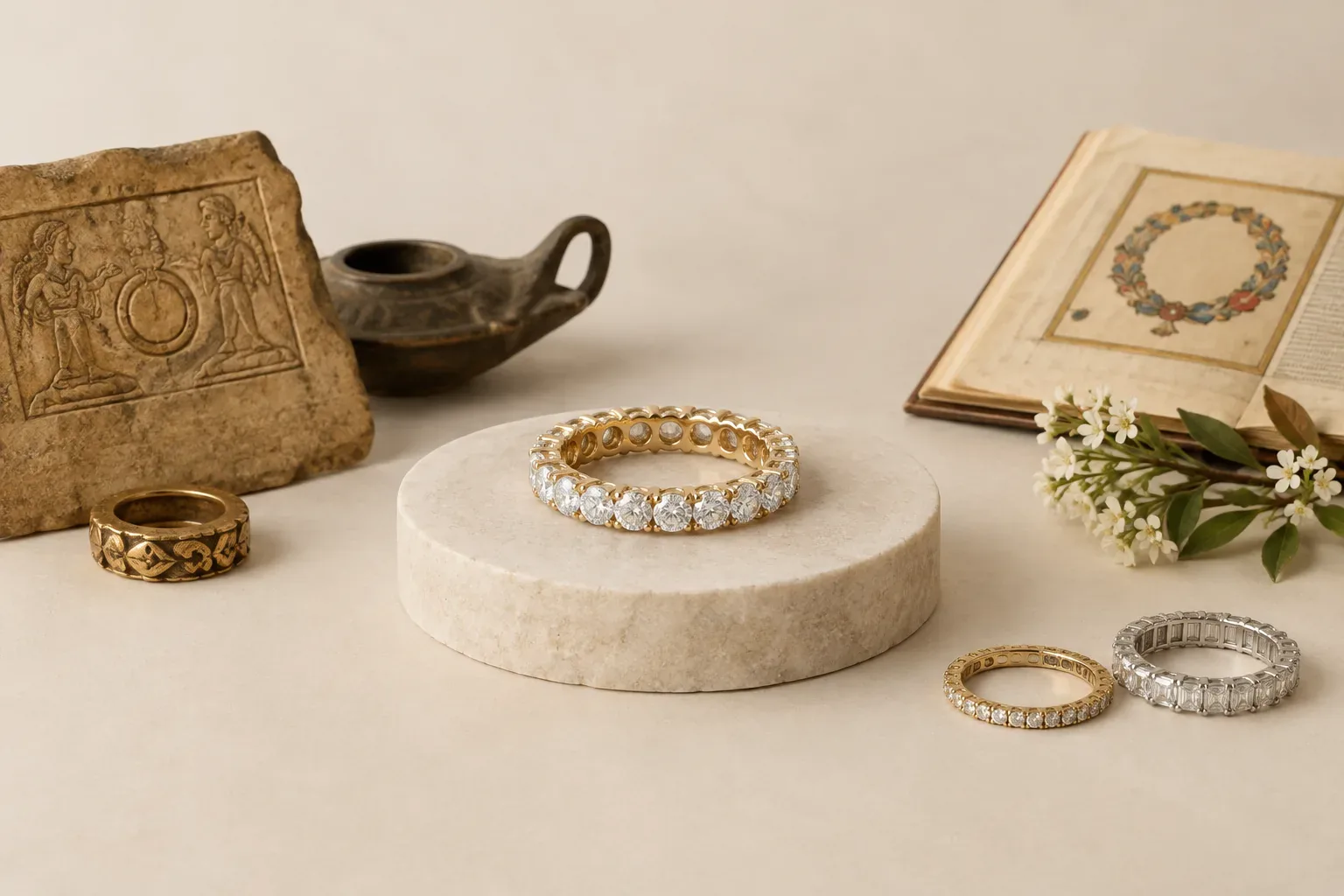
In contemporary jewellery the word 'eternity ring' most often describes a band set with a continuous or repeating line of gemstones. That motif appears in two common versions: a full eternity, where stones encircle the complete band, and a half eternity, where stones occupy only the visible half of the shank. Different settings produce different looks and affect comfort and resizing options: channel, shared-prong, pavé, and bezel settings are all used for eternity styles.
The choice of gemstone is both aesthetic and practical. Diamonds are the most common modern choice because of hardness and brilliance, but sapphires, rubies, and other gems are also used. The Victoria and Albert Museum’s resources on gemstones give historical context for gem usage and identification, showing that tastes and availability have shifted with trade and lapidary technology. For practical purposes, harder gems are less likely to chip if set around the band, while softer stones require protective settings.
Measurements and fit: the technical considerations
Accurate finger circumference is the baseline measurement. Have a qualified jeweller measure the finger at different times of day and in the season in which the ring will be worn, because temperature and fluid balance affect size. Measure the intended wearing finger rather than an estimate based on other rings or hands.
Band width and profile change perceived fit. Narrow bands feel looser; wide bands require a slightly larger circumference to feel comfortable because they cover more of the finger. Comfort-fit inner profiles are rounded and can make a snug band feel more forgiving. When choosing an eternity ring, factor the exact millimetre width of the shank into the sizing decision.
Full versus half eternity matters for resizing. A half-eternity ring with plain metal at the underside can usually be adjusted up or down by a jeweller. A full eternity ring, with stones encompassed all the way around, is often impossible to resize without cutting or re-setting stones; repairs are more complex and may require removing and re-setting gems, which changes cost and risk. Decide beforehand whether permanence in sizing is acceptable or whether future resizing might be necessary.
Practical guidance for choosing, ordering, and gifting
If you are buying in secret as a gift, gather the wearer’s current ring size from a recent measurement of a similar finger, and if possible buy from a jeweller with a flexible return, exchange, or resizing policy. For surprise gifts consider a half-eternity or a design with a plain metal interior that allows resizing.
When ordering, specify the exact width and profile you prefer and ask the retailer for a measurable ring mandrel size in millimetres rather than only a named US or UK size. Ask whether the setting type will permit later resizing. If choosing coloured gemstones or non-traditional materials, confirm the gem’s hardness and whether the setting protects the stones.
Respect cultural and personal meanings. Many people today choose eternity rings for anniversaries, birth milestones, or personal reasons, but meanings vary greatly by individual and culture. Do not assume a ring signals a religious or marital status unless you know the recipient’s context and wishes.
Buyers’ protections, disclosures, and care considerations
Material disclosure matters: the Federal Trade Commission provides guidance that sellers should disclose treatments, whether gems are laboratory-grown, and any imitations or enhancements. Ask for written confirmation of metal type, gem origin (natural or lab-grown), and any treatments or fillings used in stones before you buy.
Care and storage affect future fit and condition. Regular maintenance—prong checks, cleanings, and occasional stone tightening—prolongs an eternity ring’s life. Because full eternity rings are harder to repair, plan for periodic inspection by a professional jeweller, particularly if the ring is worn daily.
Final considerations and respectful gifting etiquette
When gifting an eternity ring, consider timing, size certainty, and the recipient’s preferences for gemstone type and band profile. If symbolic meaning is important to you or to the recipient, discuss it openly rather than relying on assumed historical meanings. Use museum resources to learn about historic uses if you want a historically informed gift, but remember that the current symbolic language around ‘eternity’ is largely modern.
In summary, the practical constraints of continuous stone settings determine much of the sizing advice: measure carefully, choose settings and widths with resizing needs in mind, and request full disclosure about materials and treatments at purchase.
Frequently asked questions
How should I size a finger for an eternity ring?
Get measured by a professional jeweller at different times and in different temperatures, and base your purchase on the measurement for the intended wearing finger. Provide the jeweller with the desired band width and profile so the size can be adjusted to account for how wide bands sit on the finger.
Can a full eternity ring be resized?
Full eternity rings with stones all the way around are often impossible or impractical to resize without removing and re-setting stones, so treat sizing as final. Half-eternity rings or designs with a plain metal underside are easier to adjust.
Does band width affect fit?
Yes. Wider bands feel tighter and typically need a slightly larger size than narrow bands. Ask your jeweller how the specific width you want should influence the numeric size.
What gemstones are best for an eternity ring?
Harder gemstones such as diamonds, sapphires, and rubies are commonly used because they resist scratching and chipping when set around a band. The Victoria and Albert Museum provides historical context for different gem uses, but choose based on both durability and the wearer’s preference.
Should I ask about treatments or lab-grown stones?
Yes. The Federal Trade Commission advises buyers to request disclosure of treatments, enhancements, and whether stones are natural or lab-grown. Get written confirmation of any such facts before purchase.
What if I need to gift a surprise eternity ring?
Consider a half-eternity or a ring with a plain interior so resizing is possible, buy from a retailer with a fair return or resizing policy, and try to obtain the recipient’s most recent ring size for the intended finger.
Sources and further reading
- Bedazzled: A History of Jewellery — Victoria and Albert Museum
- An A-Z of Gemstones — Victoria and Albert Museum
- Buying Gemstones, Diamonds, and Pearls — Federal Trade Commission