Meaning at a glance
This guide explains the documented history and changing contexts of the eternity-ring motif as reported by museum scholarship, clarifies which meanings are historically recorded versus modern personal layers of meaning, and gives practical, respectful advice on choosing materials, quality, and what to ask a seller before you buy.
What the historical record shows — and who says so
If you want the documented history of jewelry forms, the Victoria and Albert Museum (V&A) is a standard reference. The V&A's surveys and exhibitions describe jewelry across multiple cultures and periods, including ancient, classical, medieval, early modern and modern European contexts. Those resources emphasize that styles, materials and social meanings for rings and bands have changed over time rather than being fixed.
The V&A's treatment of gemstones likewise focuses on how particular stones were identified, sought after and worked in different eras. Their A–Z of Gemstones discusses the use, trade and cultural context of specific gems and can help a buyer understand which stones have historical associations and which became popular for other reasons at particular times.
Museum literature typically documents tangible evidence — surviving objects, inventories, portraits, and written records — and interprets those items in their historical context. That is not the same as later popular narratives about single, universal meanings for a particular motif. When you read claims about a specific symbolic origin for an eternity ring, check whether the claim is supported by museum evidence or is a modern marketing narrative.
Separating documented historical meanings from modern interpretations
Documented meanings are the ones you can trace to historical sources: inventories, legal records, portraits, or contemporaneous writings. The V&A shows that rings and continuous bands have had a variety of functions and significances throughout history, from status and wealth to memory and identity, depending on time and place.
Modern interpretations — including the widespread idea that an eternity ring always symbolizes unbroken romantic fidelity or marks a particular anniversary milestone — are contemporary social meanings. They grow from modern marketing, changing bridal customs, and personal storytelling rather than from a single, continuous historical tradition. These newer layers of meaning are valid for people who adopt them, but they should not be presented as the only or original meaning unless historical documentation connects the motif to that idea in the culture in question.
How the eternity motif and gemstones appear in jewelry
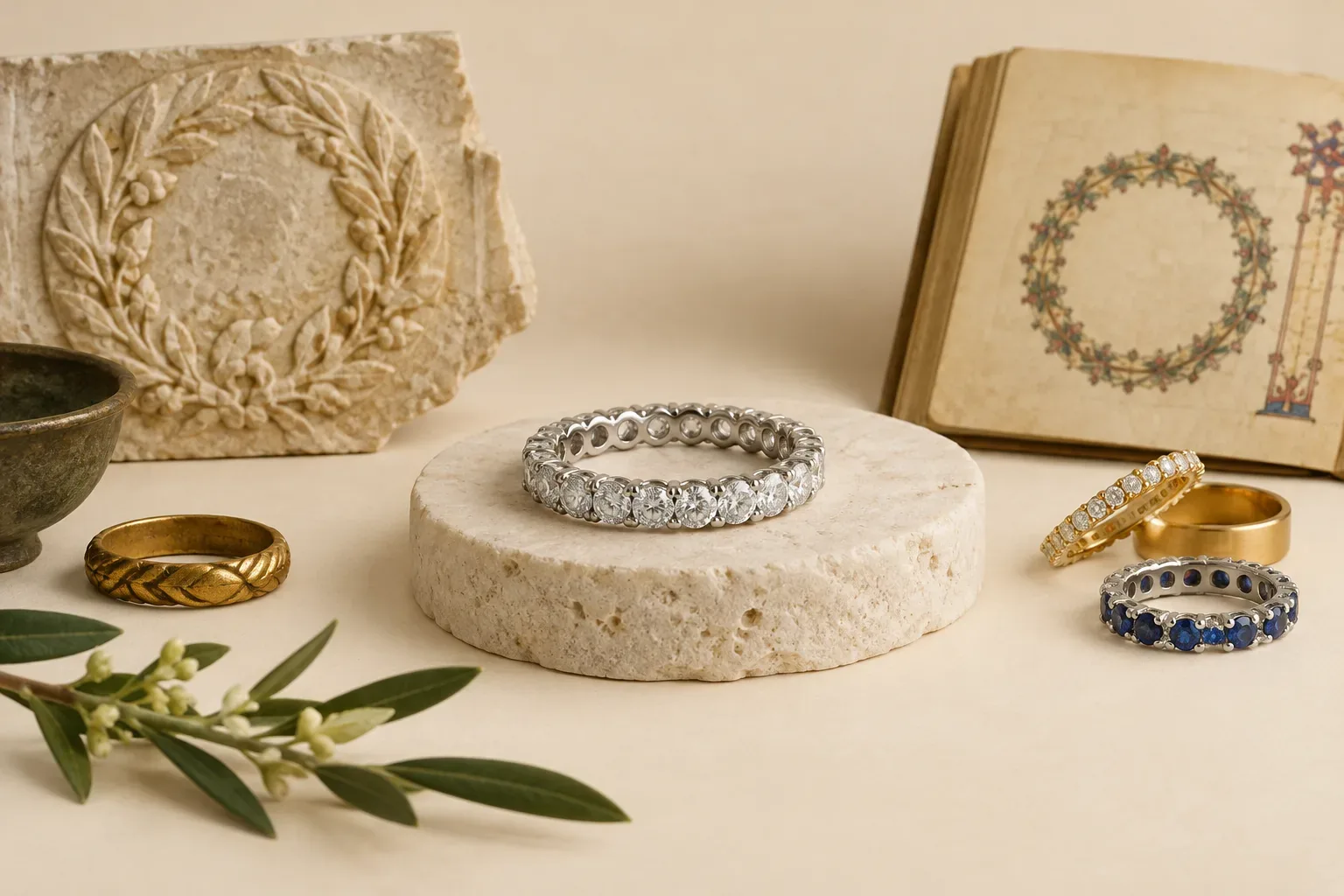
In modern jewellery, the word 'eternity' usually describes a band set with a continuous row of gemstones around the full circumference or part of it. Jewelers achieve that look in several ways: full eternity bands have stones all the way around, while half-eternity bands have stones on the visible top half. Settings vary — prong, channel, and bezel are common — and the setting you choose affects the look, the security of the stones, and how comfortably the ring wears.
Gemstones used in these bands range from diamonds to colored stones. The V&A's A–Z of Gemstones explains historical preferences and uses for specific gems, which can help you decide whether a given stone suits daily wear, ceremonial use, or historical replication. For everyday wear, consider a stone with established durability and a setting that protects the gem.
In historical jewelry across cultures the visual effect of repetition or an unbroken band could appear in metalwork, enamel, or repeated gemstones. Museum examples often mix precious metals and stones with symbolic or decorative purposes, and the presence of repeated motifs does not by itself prove a universal meaning across different cultures or periods.
Material and quality considerations
Choose materials with the intended use in mind. Metals such as gold and platinum are traditional choices for their resistance to corrosion and for established craft traditions, though the V&A documents a wide range of metals and alloys used through history. The metal you select affects price, weight, and how easily the piece can be resized.
When evaluating the stones, ask the seller for clear identification and documentation. The Federal Trade Commission (FTC) advises buyers to request disclosure about treatments, enhancements, and whether a gem is natural, lab-grown, or an imitation. Treatments can affect durability, appearance and long-term value, so full disclosure is important for an informed purchase.
Consider also how the stones are set. Secure settings reduce the risk of loss; some settings expose more of the stone and are more likely to snag. If you expect the ring to be worn constantly, choose a low-profile, protective setting and a durable stone if possible.
Price questions: what affects cost and value
Price reflects several factors: the quality and carat-weight of stones, the total amount of precious metal, the complexity of the setting, and brand or maker. When stones are continuous around the band, more matching stones are required, and matching high-quality stones raises labor and material costs. Historical jewelry in museums often reflects luxury markets of its time; the V&A displays items that were costly in their original contexts and that now have heritage value.
Ask sellers to explain how the stones were graded and whether any matching processes were used. For consumer protection around descriptions of gemstones and treatments, the FTC provides practical guidance: sellers should make truthful, non-misleading disclosures about treatments, origin claims, and whether stones are natural or synthetic.
Sizing, wearability and care
Because eternity bands can be difficult to resize when stones occupy the full circumference, get an accurate size before ordering a full eternity ring. Jewelers can offer half-eternity or custom profiles to allow future sizing, and the V&A's documentation of historical practice shows that practical concerns have long shaped how rings were made and worn.
Care depends on materials and settings. Regular inspection by a qualified jeweler minimizes the risk of losing stones. For treated stones or less-durable gems, follow the jeweler's care instructions and avoid exposure to chemicals or hard knocks that could damage the setting or the stone's surface.
Respectful selection and gifting guidance
When gifting an eternity ring, be explicit about the intended meaning, because modern interpretations vary. If your intention is romantic, ceremonial, commemorative, or purely aesthetic, say so; receivers may interpret the gift differently depending on their cultural background and personal values. Clear communication avoids unintentional pressure or confusion.
Consider timing and context. Some people treat an eternity ring as a partner gift marking a particular anniversary or the birth of a child; others prefer it as a decorative or heirloom piece. Ask whether the recipient prefers a full or half-eternity shape for comfort and whether they have metal allergies or strong style preferences.
When buying for a collector or someone interested in historic styles, use museum resources such as the V&A's histories and A–Z to choose period-appropriate materials and motifs, but do not assume that a historical design carries a single fixed meaning for every person.
Practical checklist before you buy
Confirm the metal type and the possibility of future resizing. Request written information about the stones, including whether they are natural, lab-grown or treated, and ask about any warranties or maintenance plans. For consumer disclosure on gemstone treatments and imitations, consult the FTC guidance and insist on clear answers from the seller. Try the ring (or a sample profile) for comfort and look at it in different lighting if possible.
If provenance or historical authenticity matters to you, consult museum resources and specialists rather than relying solely on seller claims. Museums document how forms and motifs shift over time, and that context can help you make an informed choice when you want to reference a particular period or style.
Final thought
An eternity ring buying guide is most useful when it balances documented historical context with clear, practical buying advice. Use museum scholarship to understand what can be historically documented about forms and gemstones, use consumer-protection guidance to check treatments and disclosures, and then choose materials, setting and message in a way that respects the wearer’s preferences and cultural context.
Frequently asked questions
What is the difference between a full and half eternity ring?
A full eternity ring has stones set continuously around the entire band, while a half eternity ring has stones set on the top half only. Full eternity rings are typically more difficult to resize because stones sit all the way around the band, so consider sizing implications before you buy.
Are there historical sources that say eternity rings always meant eternal love?
Museum scholarship, such as the Victoria and Albert Museum's histories, shows that continuous bands and repeated motifs have had different meanings in different cultures and periods. The specific modern idea that such rings universally signify unbroken romantic fidelity is a recent, culturally specific interpretation rather than a single documented historical fact.
How can I be sure the gemstones are natural and not treated or imitation?
Ask the seller for written disclosure about the stones. The Federal Trade Commission advises buyers to request clear information about whether gems are natural, lab-grown, treated, or imitations, and to ask for certifications or laboratory reports when appropriate.
What setting should I choose for everyday wear?
For everyday wear choose a low-profile, secure setting that protects the stone edges and reduces snagging. Channel and bezel settings often offer more protection than exposed prong settings, but personal comfort and the stone's hardness are also important considerations.
Can an eternity ring be resized later?
Resizing a full eternity ring is difficult because the stones run around the entire band. Half eternity rings or custom designs that leave a plain section of metal allow easier future resizing. Discuss sizing and future plans with the jeweler before purchase.
Sources and further reading
- Bedazzled: A History of Jewellery — Victoria and Albert Museum
- An A-Z of Gemstones — Victoria and Albert Museum
- Buying Gemstones, Diamonds, and Pearls — Federal Trade Commission