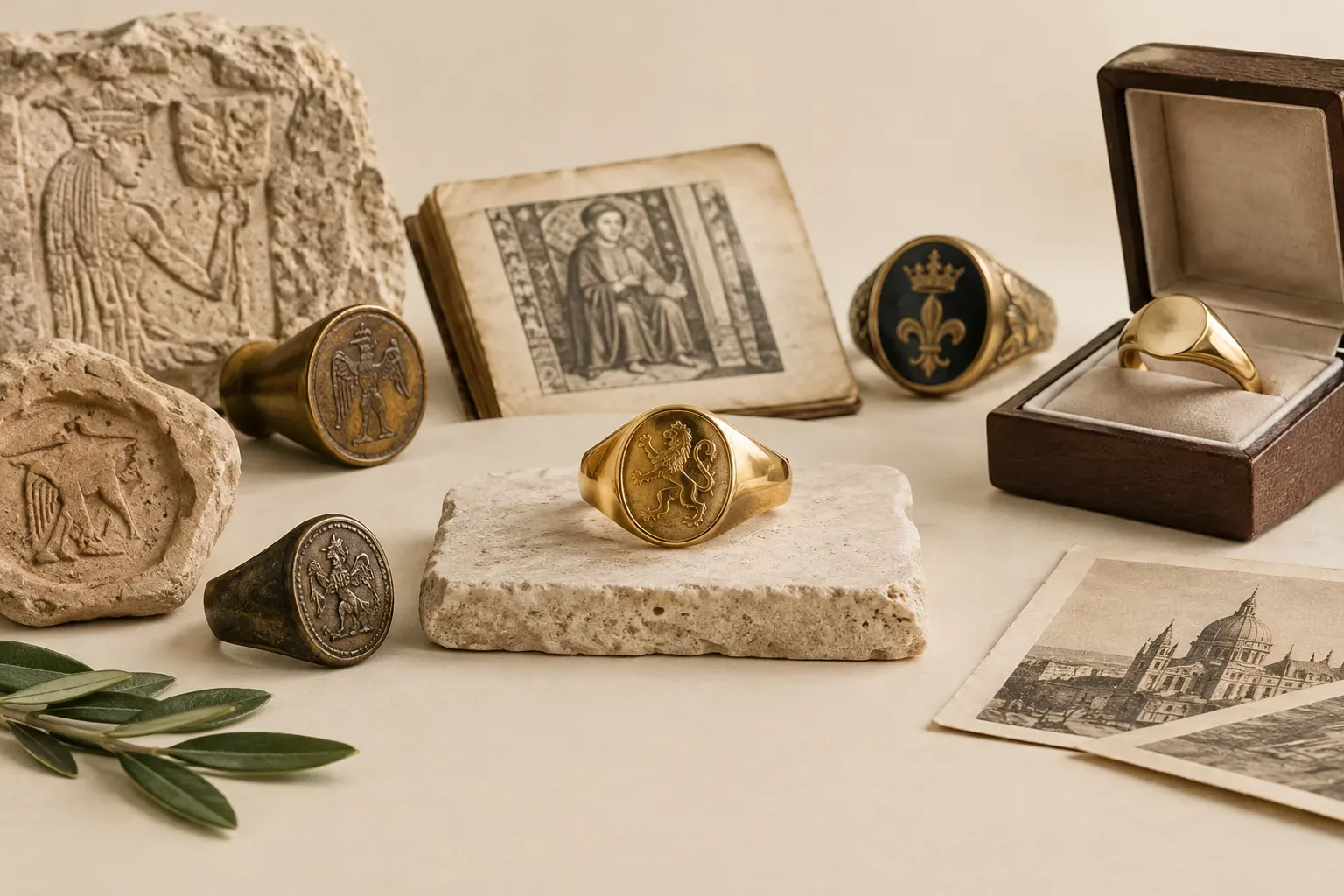
Meaning at a glance
This guide explains the documented history and changing contexts of signet rings using museum evidence, separates historical meanings from modern personal interpretations, and gives practical advice for choosing, buying, and gifting signet rings online, including what photos and policies to demand and which red flags to avoid.
Quick answer
A signet ring online shopping guide should combine respect for the ring's documented history, careful inspection of photos and seller policies, and attention to provenance and material disclosures. Use museum-based evidence to understand historical uses and meanings, treat modern personal interpretations as distinct, and insist on clear photos, hallmarks, and treatment or imitation disclosures before you buy.
What the historical evidence says (and where it comes from)
Museums and published museum material are the best surviving evidence for how signet rings were used in different places and periods. The Victoria and Albert Museum frames jewellery as a changing social practice and documents how objects such as rings moved in meaning over time and between cultures. Their work shows that rings with engraved faces—what we now call signet rings—appear repeatedly in many cultures as functional objects as well as identity markers.
The V&A's historical overview links engraved gems and rings to several distinct contexts: Ancient Mediterranean societies where engraved intaglios could seal documents, Byzantine and medieval European uses where family, civic, or office insignia were impressed into wax, and later European court and legal traditions where a ring might signify office or family status. The V&A also documents changes in materials and techniques across periods, which helps explain why gemstones such as carnelian, onyx, and chalcedony appear frequently on engraved rings.
Separating documented historical meanings from modern personal interpretations
Documented historical meanings derive from the preserved objects, museum records, and contemporary accounts that describe how rings were used. For example, evidence compiled by the Victoria and Albert Museum shows that engraved rings could function as seals, to mark documents or packages, and that particular motifs could identify a person, family, or office in a concrete administrative or legal role.
Modern personal interpretations—such as reading a signet ring chiefly as a romantic heirloom, a fashion statement, or as carrying a specific spiritual power—are valid personal meanings but are not the same as the ring's documented historic function. The V&A emphasizes changing social uses of jewellery, meaning a ring once used to authenticate documents may today be worn primarily for memory, status, or style. When researching a ring motif, distinguish firmly between what contemporary records show and how people choose to interpret or reassign meaning today.
How motifs, gemstones, and traditions appear on signet rings
Motifs on historical signet rings were usually engraved as intaglio (carved into the surface) so the design left a raised impression when used as a seal. Common motifs included personal initials, family heraldry, civic symbols, and mythological or religious images tied to the owner's identity or profession. The same approach continues in modern signet rings, where engraved initials, bespoke symbols, and crest designs are most common.
Gemstones historically used for intaglio and signet faces were often durable, fine-grained stones such as carnelian, onyx, and chalcedony because their structure takes engraving cleanly. The Victoria and Albert Museum's guide to gemstones explains how different stones have been valued and used across periods for both their appearance and workability. Today, signet rings may use engraved gemstones, metal engraving, or cast motifs, and contemporary makers sometimes replicate historic techniques while changing scale, metal, or finish.
Traditional practices around wearing and handing on signets also vary by culture and period. Museums record examples where rings passed down in a family retained legal or symbolic significance, while in other contexts the ring was more of a personal tool for sealing. Contemporary wearers might adopt any of these associations or none at all; that contemporary choice is a modern meaning layered on top of documented practice.
Photos and product images: what to insist on when buying online
Demand clear, well-lit photos that show the ring from multiple angles, including a close-up of the engraved face, the hallmarks or maker's marks inside the band, and any wear or damage. Images that include a scale reference, such as a ruler or a coin, help judge size. If a ring is antique or pre-owned, ask for high-resolution images of the mounting from the side and underside so you can check for repairs, solder lines, or replacement stones.
Avoid listings that use only stock photos or that show a low-resolution single image. If the seller provides a professional condition report or independent appraisal, read it carefully and compare its language to the pictures. Where possible, request short video clips of the item turned slowly under light; a video can reveal facets of wear, surface polish, and how engraving reads in different angles.
Seller policies and documentation to require
Before committing to a purchase, review the seller's return policy, shipping insurance, and authenticity guarantees. For materials and treatments, the Federal Trade Commission advises that sellers must not misrepresent gemstones, treatments, or imitations; ask the seller to declare any known heat treatments, dyeing, glue or other restorations, or whether the gem is a simulant. Request details of metal purity or hallmarks and any accompanying paperwork such as a gem report or hallmark verification.
For vintage or antique signets, provenance—clear information about the object's history of ownership—adds value and may clarify whether a motif is original or later-added. If a seller cannot or will not comment on provenance, or refuses to document treatments, consider that a legitimate reason to pause. Ensure shipping includes tracking and insurance, especially for higher-value rings, and check whether returns are buyer-paid or seller-paid.
Common red flags when shopping for a signet ring online
Red flags include listings with only stock imagery or photos that appear reused across multiple listings; descriptions that are vague about metal purity, gemstone identity, or treatments; missing or unreadable hallmarks; and prices that are implausibly low for the stated materials. Sellers who discourage questions, refuse to provide additional images, or avoid clear return terms should be treated with caution.
Other warning signs are mismatched descriptions and photos, inconsistent measurements, or a refusal to ship with insurance for costly items. For antiques, a complete absence of provenance or a seller who alternately claims modern manufacture and historic origin is a serious concern. Use these signals to assess risk and whether you should seek a second opinion from an independent jeweller or appraiser.
Practical and respectful selection and gifting guidance
When selecting a signet ring as a personal purchase or a gift, consider wearer preference, cultural context, and scale. Ask whether the recipient prefers a bold modern signet or a subtle historic-looking band. Respect cultural associations: a motif that has specific civic, familial, or religious meaning in one culture may be sensitive if used without understanding. If you are unsure about cultural appropriateness, consult resources or the recipient before commissioning or gifting a symbolically charged design.
For sizing, know the recipient's ring size or choose a ring design that can be resized without harming an engraved motif. If the ring is a reproduction of an historical design, communicate that clearly to the recipient so they understand whether the piece is a modern interpretation, an heirloom, or an authentic antique. For gifts intended as family heirlooms, keep documentation and any appraisals or certificates with the ring to preserve provenance for future generations.
Care, resizing, and when to seek professional advice
Engraved faces and carved gemstones can be more fragile than plain flat rings. Ask the seller about any previous repairs and whether the ring has been resized in the past. Resizing can alter hallmarks or disturb engraving, so always use a jeweller experienced with signets or antique jewellery for adjustments. For gem identification, grading, or treatment verification, request an independent report from a recognised lab when the value justifies it.
If you intend to use a signet ring as a wearable daily object, discuss with the seller the metal type and finish, and whether they recommend polishing or protective coatings. When in doubt about authenticity, provenance, or required care, a reputable jeweller or museum conservator can advise on the safest course of action.
Frequently asked questions
What photos should I always request when buying a signet ring online?
Ask for high-resolution images that show the engraved face in close-up, clear shots of the inside band to read hallmarks or maker's marks, side and underside views to check setting integrity, and a scale reference such as a ruler or coin. If possible, request a short video showing the ring turned under light to assess wear and the way the engraving reads from different angles.
How can I tell if a gemstone on a signet is treated or an imitation?
Request the seller to disclose any known treatments or whether the stone is a simulant, as required by consumer protection guidance from the Federal Trade Commission. If the listing lacks that information, ask for a gem lab report or independent appraisal for higher-value purchases, and avoid buying until you have a clear disclosure.
Are hallmarks necessary for an online purchase of a signet ring?
Hallmarks are important evidence of metal purity and can help verify origin. Ask for legible photos of any hallmarks and, where possible, corroborating documentation. Absence of hallmarks is not always a deal-breaker for vintage or pre-1900 pieces, but it does increase the importance of provenance and professional assessment.
What are the main red flags that suggest I should not buy a listed signet ring?
Avoid listings with only stock photos, vague material descriptions, missing hallmarks, no clear return policy, sellers who refuse to answer questions or provide additional images, pricing that is implausibly low, or inconsistent information about provenance or age.
How should I handle cultural motifs I’m not familiar with when selecting a ring as a gift?
Be respectful and do your research. If a motif has cultural, civic, or religious significance, consult reliable sources or ask the intended recipient about acceptability. If you cannot confirm the motif’s meaning or cultural weight, consider choosing a neutral design or commissioning a bespoke design with the recipient’s input.
Sources and further reading
- Bedazzled: A History of Jewellery — Victoria and Albert Museum
- An A-Z of Gemstones — Victoria and Albert Museum
- Buying Gemstones, Diamonds, and Pearls — Federal Trade Commission