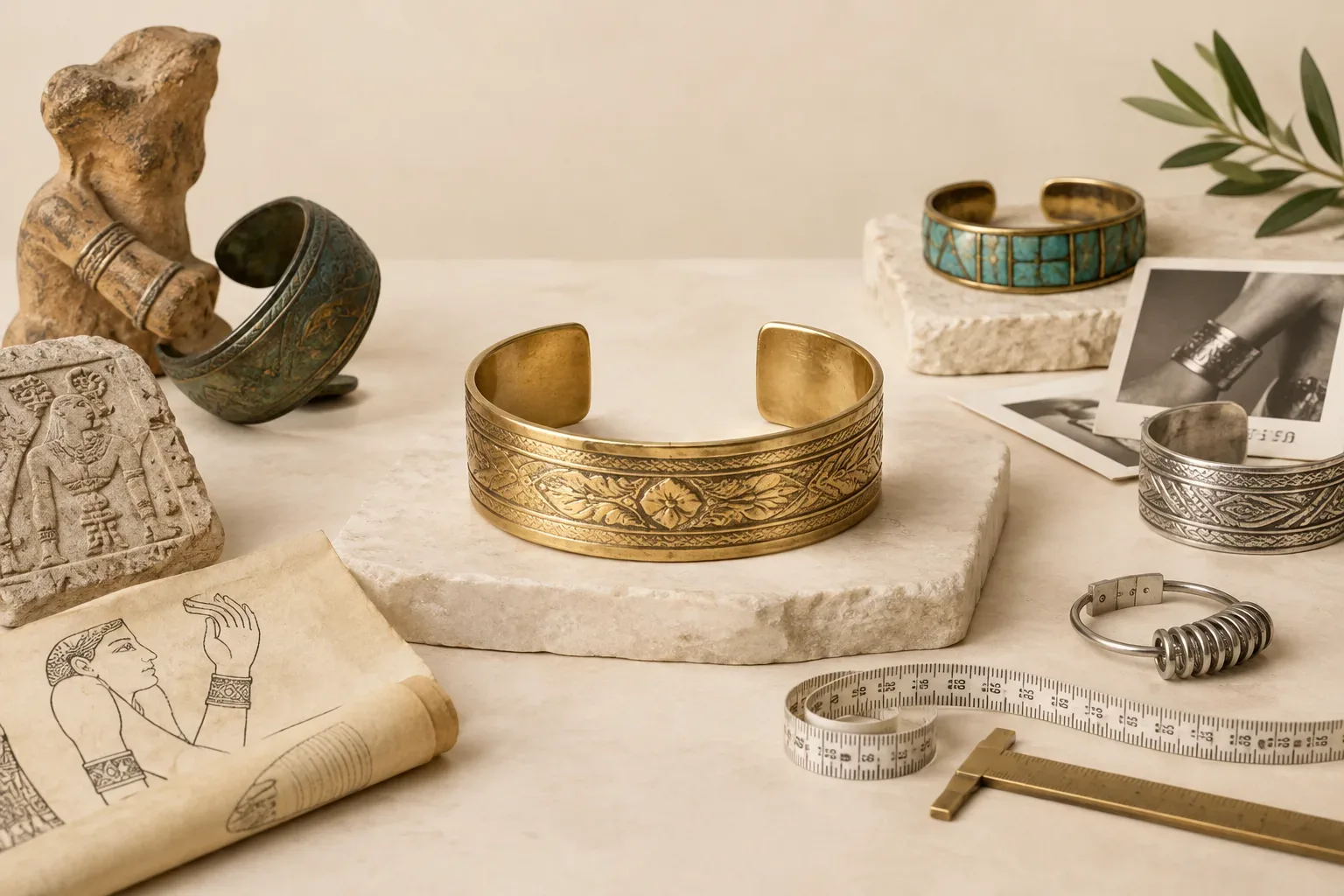
Meaning at a glance
This guide explains the documented history and changing contexts of cuff bracelets using museum sources, separates recorded cultural meanings from later popular interpretations, describes how motifs and gemstones appear in cuff design, and gives step-by-step, respectful advice for selecting, measuring, and gifting cuff bracelets today.
Short answer
Measure the wearer’s wrist circumference and the widest part of the hand, convert circumference to the cuff inner diameter if needed, and plan for an appropriate gap and extra allowance depending on cuff width and stiffness; historically, cuff forms appear across many periods and cultures, so choose motifs and materials with awareness of their origins and documented use. This article combines museum-based historical context with practical modern sizing and gifting guidance.
What the historical record shows (and where the evidence comes from)
Bracelet forms that we now call cuffs appear repeatedly in the material collections and catalogues held by museums. The Victoria and Albert Museum presents a broad history of jewellery showing that stiff, open-ended bracelets and windable metal bands were made and worn in many periods and regions, including ancient collections and later European fashions described in their exhibition and resources on the history of jewellery.
When discussing origins and social meanings, it is important to credit the museum record rather than modern generalizations. The V&A’s survey materials document changes in form and function over time: examples range from rigid metal bands and hinged bracelets in antiquity to decorative and symbolic cuff styles in later European eras. These objects are best understood in their specific archaeological, documentary, and collection contexts rather than as a single continuous tradition.
Documented historical meanings versus modern personal interpretations
Museums, including the Victoria and Albert Museum, record the contexts in which bracelets were made and worn: in many cases bracelets functioned as status markers, personal adornment, components of ceremonial dress, or textile fasteners depending on time and place. Those are documented uses based on object provenance, design, and historical records in museum collections.
Modern wearers and designers often layer new meanings onto cuff forms—personal identity, fashion statements, or contemporary symbol systems. These modern interpretations are valid personal meanings but should be kept distinct from the documented, historically specific uses recorded by museums. Treat historical claims as contextualized facts about particular objects and periods rather than universal or unchanging symbolism.
How motifs, gemstones, and traditions appear in cuff bracelets
Motifs in cuff design appear in technique and theme: engraving, repoussé, granulation, enamel, and applied mounts all change the visual weight of a cuff. The V&A’s collections and interpretative material show how makers used these techniques across different eras to achieve pictorial, geometric, or natural forms on metal bands.
Gemstones have a documented history in decorative metalwork. The Victoria and Albert Museum’s A–Z of Gemstones explains how particular gems were chosen for color, rarity, or local availability and how setting techniques changed through time. When you see a cuff with cabochons or inlaid stones, that appearance follows long-standing jewellery-making practice of combining metal form with gem surface to create emphasis and status.
When assessing motifs or gem use for their cultural origin, consult museum records and maker statements. Many motifs have local histories and meanings; museums document those contexts, whereas contemporary designers may adapt or recontextualize motifs for aesthetic reasons.
Measurements that matter: how to measure for a cuff
Start with the wrist circumference: measure around the wrist at the bony point where a bracelet would normally sit. Record that number in millimetres or inches. For a cuff, you will likely add a small allowance to this measurement so the bracelet can pass over the hand or sit comfortably without pinching.
Measure the widest part of the hand with fingers together and thumb tucked slightly in, because a cuff must either pass over that width or have an opening wide enough to slip on. If you cannot measure the hand directly, measure or estimate the knuckle circumference of the index and little finger together and add to wrist circumference as an approximation.
Convert circumference to inner diameter if the cuff is described by diameter. Use the formula diameter = circumference ÷ π. For example, a 160 mm wrist circumference corresponds to an inner diameter of about 50.9 mm. Many makers provide either inner diameter or circumference—use the conversion so you can compare.
Decide on the gap and allowance based on cuff width and stiffness. For narrow, flexible cuffs you can add about 10–15 mm (roughly 3⁄8 to 5⁄8 inch) to the wrist circumference for a comfortable but secure fit. For wider, rigid cuffs you may need 15–25 mm (about 5⁄8 to 1 inch) or more extra, because a broader surface resists passing over the knuckles and may feel tighter on the forearm. These are practical modern guidelines, not historical rules.
Practical tips on fit, material, and adjustability
Check how the cuff closes and how much the opening allows for entry. Hinged cuffs and those with clasps often offer more predictable fit; open-ended cuffs rely on gap size and slight flexibility. If a cuff is marked as adjustable, expect only small bends to avoid weakening the metal or damaging plated finishes.
Material matters for fit and comfort. Solid precious metals and thick alloys will resist bending and require accurate sizing. Softer metals such as 9–14k gold or sterling silver can be adjusted slightly, but repeated bending weakens work-hardened metal. Plated items or those with glued-in gemstones can be damaged by bending. If you are unsure about treatments or simulated stones, follow consumer guidance and ask the seller for disclosure; the U.S. Federal Trade Commission advises that sellers should disclose material treatments and imitations, and buyers should request information when it’s important to them.
Comfort considerations include weight, interior finish, and whether a cuff edges will rub the skin. A padded or rounded internal rim will sit more comfortably than a sharp-edged band. If a bracelet will be worn during activity or occupational use, err on the looser side to avoid catching or pressure.
Selection and respectful gifting guidance
When choosing a cuff as a gift, prioritize correct size, adjustable options, and reversible or neutral motifs if you are uncertain about symbolic meaning. If you want to select a piece with a culturally specific motif, research its origin carefully and consult reliable sources. Our internal guide 'How to Research the Meaning of a Jewelry Symbol' can help you start that research.
If you cannot measure the wrist, choose an adjustable cuff with a return or exchange policy. Include a gift receipt and guidance on resizing limits so the recipient can exchange for comfort. If the design includes gemstones, consult museum resources such as the V&A’s A–Z of Gemstones for historical context and follow the Federal Trade Commission’s consumer guidance on asking sellers about treatments, imitations, or enhancements.
Respect personal and cultural boundaries. Avoid assuming that a motif is universally appropriate; many designs have local or ritual significance best understood through documented sources. When in doubt, opt for motifs that are clearly decorative or for a simple, elegant metal cuff that emphasizes fit and finish over potentially charged imagery. For more general advice on choosing meaningful jewelry, see our related gift guide.
Concluding guidance
A good cuff fit combines accurate measurement, awareness of cuff width and stiffness, and respectful attention to the cultural history of motifs. Use museum resources to understand the documented uses and meanings of particular designs, consult consumer guidance about materials and gemstone treatments, and choose adjustable or exchange-friendly options when buying a gift. That approach keeps size and comfort practical while respecting the historical and cultural evidence preserved in museum collections.
Frequently asked questions
How do I measure my wrist for a cuff bracelet?
Measure the wrist circumference at the bony point where a bracelet normally sits. Also measure the widest part of your hand with fingers together; the cuff must either pass over that width or have a large enough opening. Convert wrist circumference to inner diameter if the cuff is specified by diameter using diameter = circumference ÷ π.
How much extra room should a cuff have for a comfortable fit?
For narrow or flexible cuffs add about 10–15 mm (roughly 3⁄8 to 5⁄8 inch) to wrist circumference for a comfortable fit; for wider, rigid cuffs plan on 15–25 mm (about 5⁄8 to 1 inch) or more. Use these as practical guidelines and adjust slightly for individual comfort.
Can I bend or adjust a cuff to make it fit better?
Some cuffs can be adjusted slightly, but repeated bending weakens the metal and may damage plated finishes or settings. If a cuff is advertised as adjustable, expect only small changes; for solid or set pieces, seek professional resizing from a jeweller.
What should I ask a seller about gemstones and materials?
Ask whether stones are natural, treated, synthetic, or simulations, and whether metal is solid or plated. The Federal Trade Commission advises buyers to request disclosure about material treatments and imitations when they matter to the purchase.
How do I choose a cuff as a gift if I can’t measure the recipient?
Choose an adjustable cuff with a generous opening or a hinge and a flexible return/exchange policy. Prefer neutral motifs and avoid culturally specific symbols unless you have confirmed that the recipient appreciates them.
Sources and further reading
- Bedazzled: A History of Jewellery — Victoria and Albert Museum
- An A-Z of Gemstones — Victoria and Albert Museum
- Buying Gemstones, Diamonds, and Pearls — Federal Trade Commission