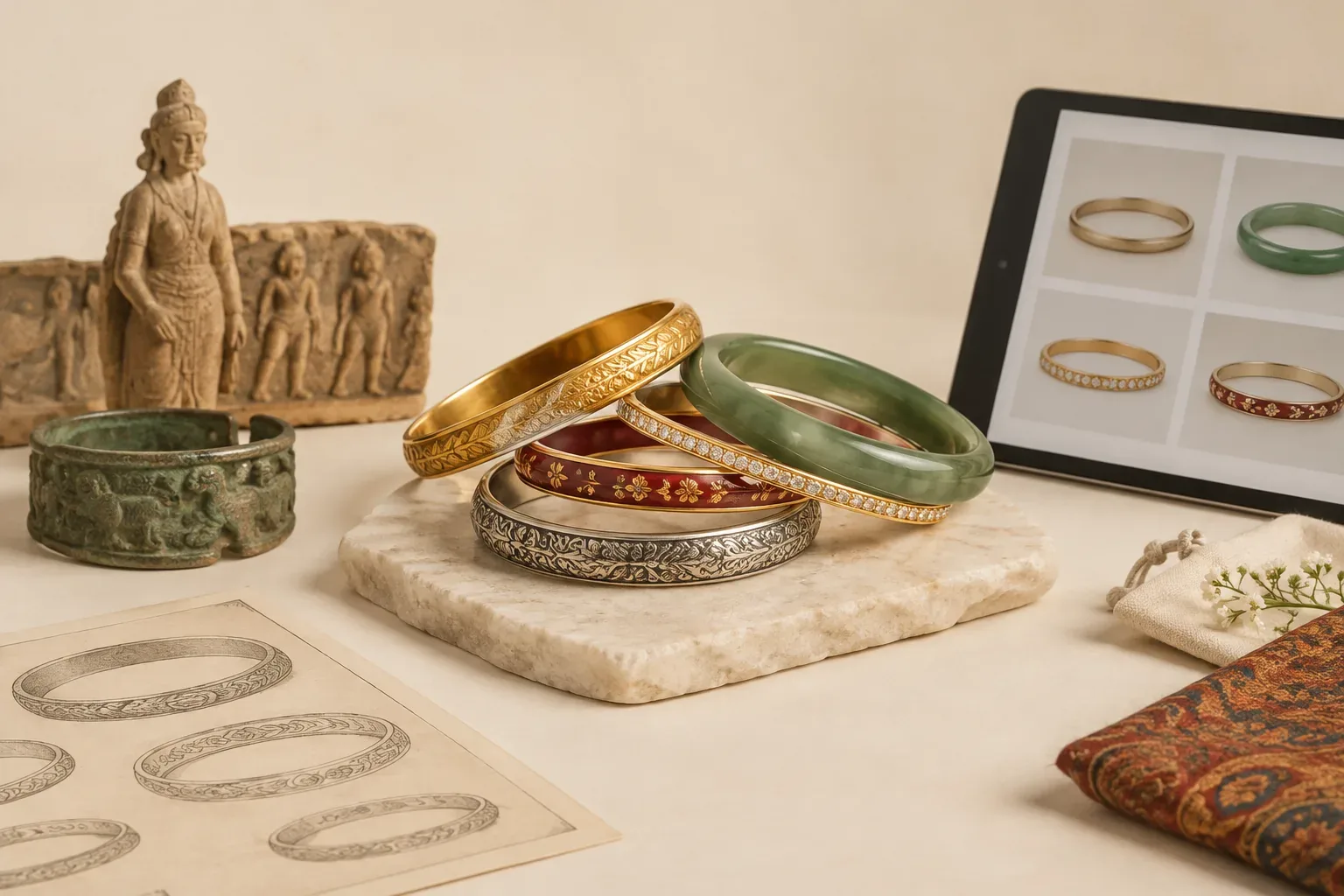
Meaning at a glance
This guide explains the documented history and shifting contexts of the bangle or rigid bracelet as recorded by museum scholarship, separates cultural and religious evidence from later popular meanings, and gives practical, respectful advice for choosing, inspecting, and gifting bangles purchased online.
What the historical record actually shows
Museum collections and exhibitions document that the bangle—or rigid bracelet that slips over the hand or closes around the wrist—occurs in many periods and places rather than originating with a single culture. The Victoria and Albert Museum describes how rigid bracelets and armlets appear in ancient Egyptian jewellery, classical Greek and Roman collections, South Asian traditions, and later European fashions, and it treats these forms as part of a long, global history of personal adornment rather than a single continuous meaning.
When consulting history, use museum attributions and catalogue entries because they identify provenance, materials, and likely dates. The V&A’s historical overview places many bangle forms in social and technological contexts: some are archaeological finds, some are courtly or high-fashion objects, and some are mass-produced items of domestic dress. Those contexts matter for how the object was used and perceived in its original time.
Documented meanings versus later or popular interpretations
When a museum catalogue or exhibition label states that a bangle was associated with a particular rite, social class, or trade, that is documentary evidence based on provenance and historical context. The V&A explicitly links objects to those kinds of social histories where the evidence supports it. Use those attributions when you want to know what an object meant in its original time and place.
Modern commercial descriptions and social-media posts often add newer, personal or symbolic meanings—for example, claiming that a particular bangle guarantees luck, protection, or a specific cultural status. Those contemporary interpretations reflect current fashions and personal beliefs rather than historical consensus. Treat modern symbolism as personal or trend-based unless a museum source or primary historical text explicitly supports it.
How bangle motifs, gemstones, and traditions appear in jewelry
Bangles are defined primarily by form: a rigid, often circular bracelet that slips over the hand or closes on the wrist. They can be plain metal, hollow, gem-set, engraved, enamelled, or composed of multiple thin rings worn together. Museum documentation describes this variety and links materials and techniques to technology and fashion of an era, showing how the same form can carry very different meanings depending on manufacture and context (Victoria and Albert Museum).
Gemstones and ornament are catalogued separately from the form of the bangle. The Victoria and Albert Museum’s guide to gemstones explains how certain stones were prized in different periods, how they were cut and set, and how treatments or imitations entered the market. In practical terms, gem-set bangles use the same design choices as other jewellery: choice of stone, setting security for a rigid bracelet, and the impact of treatments or enhancements on value and care.
Photos: what to expect and how to inspect online images
High-quality photos are your first line of evidence when buying a bangle online. Expect sharp, well-lit images showing the front, back, inside, and details of any hallmarks, clasps, engravings, or stone settings. A true-to-scale image with a ruler or a model hand provides crucial information about diameter and fit. Sellers who provide documentary photographs—close-ups of hallmarks and any condition issues—are usually more trustworthy than those with only stylized or single-angle shots.
Use photos to check for repairs, visible solder lines, missing stones, or worn plating. For gem-set bangles, request macro images of each stone to inspect for chips, recutting, or obvious filling. If the product page lists a gemstone treatment, ask for laboratory reports or detailed seller documentation.
Policies: mandatory disclosures and buyer protections
The Federal Trade Commission requires clear disclosures about treatments, imitations, and whether a gemstone is natural, treated, or synthetic. When a seller provides that information up front, it reduces uncertainty; when a seller does not disclose treatments or uses vague language, that is a clear reason to ask follow-up questions. The FTC guidance is a practical standard to use for whose responsibility it is to identify treatments or simulated stones in online listings.
Other important policies include a straightforward returns policy, an authenticity guarantee or certificate for higher-value items, and reliable shipping and insurance options. A generous returns window and a clear condition-of-sale statement let you verify the bangle in hand and return it if it materially differs from the listing.
Red flags and seller behaviors to avoid
Red flags include fuzzy or stock photos, missing hallmark or dimension information, no disclosure about material or gemstone treatments, unrealistic prices that are too good to be true, and sellers who refuse to answer specific questions about condition or provenance. Be cautious when listings omit measurements, give weight but not diameter, or use only lifestyle images that hide detail.
Other warning signs are new sellers with no verifiable reviews selling high-value items without third-party authentication, marketplaces that do not mediate returns, and listings that explicitly state all sales are final without room for inspection. Use the FTC’s consumer guidance on buying gemstones, diamonds, and pearls as a baseline for what disclosures sellers should make.
Practical and respectful selection and gifting guidance
Start by defining the wearer’s preferences: is a rigid slip-on bangle practical given hand size and activity? Measure hand width (or ask the recipient) to avoid fit issues. Choose durable settings for everyday wear and softer or more symbolic pieces for occasional use. When selecting gemstones, use museum-oriented reference (such as the V&A’s gemstone guide) to understand how certain materials were historically used and how that affects modern durability and care.
Respect cultural traditions. If a bangle form or motif has an explicit cultural or religious use in a living community, research authoritative sources or ask a knowledgeable member of that community before gifting. Do not assume symbolic meanings are universal; treat modern symbolic attributions as personal or trend-driven unless historical documentation supports them. When in doubt, choose a neutral, well-made piece or discuss the idea with the recipient.
Authentication, documentation, and when to seek help
Ask for hallmarks, maker’s marks, or a certificate for high-value items. For gemstones, request full disclosure of whether a stone is natural, lab-grown, or treated; sellers who cannot provide that information should trigger further scrutiny. If you are unsure about a claim of age, provenance, or material, consult a professional appraiser or request a laboratory report for expensive purchases.
Museums like the Victoria and Albert Museum document how jewellery was made and used, and their catalogues can be a valuable reference when evaluating claims about historical styles or techniques. Use those catalogues and the FTC’s consumer guidance together: one provides historical context and the other establishes practical standards for disclosure and consumer protection.
Final checklist before you buy
Confirm measurements and fit, check high-resolution photos including hallmarks, verify material and gemstone disclosures per FTC guidance, confirm a reasonable return window and shipping insurance, and consider cultural context when the piece references a living tradition. Where uncertainty remains, ask for additional documentation or choose a seller who offers third-party authentication.
Frequently asked questions
How do I measure my hand for a slip-on bangle?
Measure the widest part of your hand (usually across the knuckles) with your fingers together and thumb tucked slightly; compare that measurement to the internal diameter provided by the seller or request the internal diameter and an image showing the bangle on a model hand for scale.
What should a seller disclose about gemstones and treatments?
The seller should state whether a gemstone is natural, lab-grown, or simulated and disclose any known treatments or enhancements; the Federal Trade Commission advises clear disclosure of treatments and imitations for consumer protection.
Are hallmarks enough to prove metal purity?
Hallmarks are useful evidence of metal content and maker, but they can be forged or absent; for expensive items, ask for documentation, a reputable dealer’s guarantee, or an independent assay if authenticity is critical.
When should I request third-party authentication?
For high-value purchases, items claimed to be antique with important provenance, or stones with ambiguous treatment disclosures, request a laboratory report or an appraisal by an independent, credentialed specialist before completing the purchase.
How do I avoid cultural appropriation when gifting a bangle?
Research authoritative sources about the motif’s contemporary cultural significance and, if possible, consult members of that community; when uncertain, choose a neutral design or ask the recipient for their preferences rather than assuming symbolic appropriateness.
Sources and further reading
- Bedazzled: A History of Jewellery — Victoria and Albert Museum
- An A-Z of Gemstones — Victoria and Albert Museum
- Buying Gemstones, Diamonds, and Pearls — Federal Trade Commission