Meaning at a glance
Alexandrite is the rare, color‑change variety of chrysoberyl; its discovery in 19th‑century Russia is documented by major institutions, and modern symbolic meanings should be kept separate from the gem’s physical properties, buying considerations, and care needs.
What alexandrite is and how its color change works
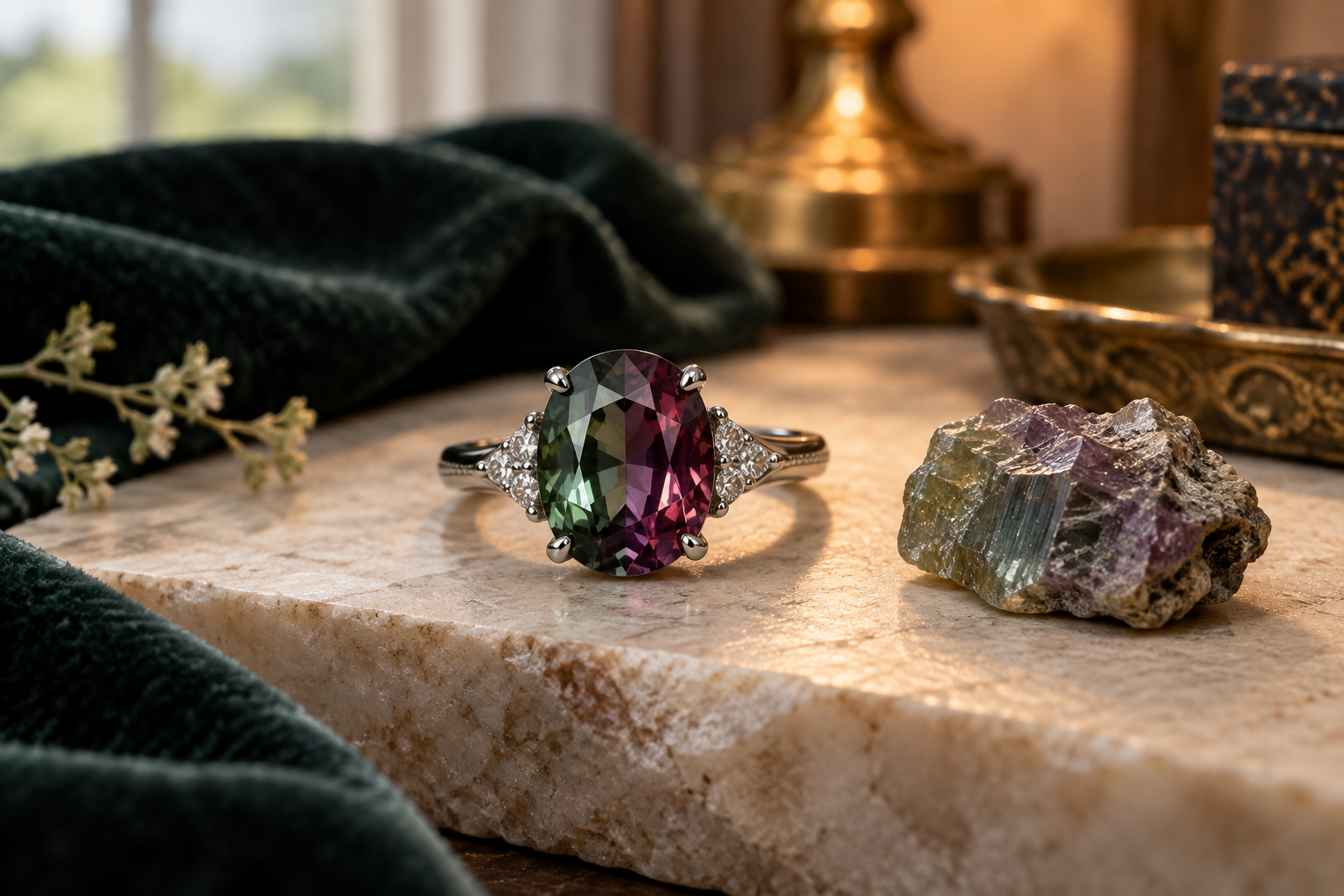
Alexandrite is a gem variety of chrysoberyl. The color change that gives alexandrite its identity is an optical effect: under some light sources the gem appears green to bluish‑green, and under others it shifts to red, purplish‑red, or raspberry. The color appearance depends on the light source and the way the stone absorbs and transmits different wavelengths of light. This lighting dependency is a defining characteristic noted by gemological authorities.
Documented history and precise provenance
The earliest recorded discovery of alexandrite took place in the nineteenth century in what is today the Ural Mountains region of Russia. Both the Gemological Institute of America and the Smithsonian National Museum of Natural History document the gem’s nineteenth‑century Russian origins. Those institutional records form the sound historical basis for saying that alexandrite was first identified in Russia during that period.
Because the historical record recorded by these institutions centers on that discovery location and era, references to a Russian provenance should be limited to that documented context. Later occurrences of alexandrite have been found elsewhere, but the nineteenth‑century Russian discovery is the primary documented origin recounted by the major museum and gemological references.
Documented historical meanings versus modern personal interpretations
Documented historical evidence for alexandrite focuses on its mineral identity, optical properties, and early provenance. Institutional accounts emphasize its discovery and its gemological rarity in fine, large material. Those are the historically documented points supported in the scientific and museum record.
Modern symbolic meanings—ideas that alexandrite brings good luck, signifies personal transformation, or carries particular emotional powers—belong in the realm of contemporary personal or cultural interpretation. Such meanings have become popular in recent decades because the stone’s dramatic color change lends itself to metaphors of duality and change, but they are not a single, universal historical fact. When you encounter claims that alexandrite guarantees a particular effect, treat those as personal belief or modern symbolism rather than documented historical truth.
How alexandrite appears in jewelry
Jewelry makers work with alexandrite in much the same way as with other faceted gems, with attention to cuts and settings that show off its color change. Because the color shift is lighting dependent, faceted cuts that emphasize color and clarity are common. Alexandrite is set in rings, pendants, earrings, and brooches, where the wearer and viewer can see the stone in different lighting conditions.
Because fine, large alexandrite is rare, jewelers often use smaller stones or pair alexandrite with complementary gems and metals to create visually balanced pieces. Designers may position alexandrite as a central focal stone or as an accent to emeralds, diamonds, or colored sapphires, depending on color balance and the desired stylistic effect. In any design, the setting material and the surrounding stones are chosen to support the gem’s shifting colors rather than to obscure them.
Choosing alexandrite: practical selection and gifting guidance
Decide what matters most to you: the strength of color change, color balance, clarity, carat weight, and provenance. Because the color change is the defining trait, view candidate stones under more than one light source—typically a daylight‑balanced light and an incandescent or warm light—to assess how pronounced the shift is. A stone that appears distinctly different under those two conditions demonstrates the effect more clearly than one with only a subtle shift.
Ask for documentation from a reputable gemological laboratory when purchasing higher‑value alexandrite. Independent lab reports help confirm that the stone is natural alexandrite and describe its optical behavior, treatments, and other significant characteristics. Because very fine, larger alexandrite crystals are uncommon, expect significant price variation based on color change strength, size, and clarity.
When gifting, frame the stone’s qualities honestly. If you are presenting alexandrite for its symbolic resonance, say explicitly that the symbolic meaning is a personal or modern interpretation. If provenance or a lab report is part of the gift’s value, include that paperwork so the recipient understands the gem’s characteristics. Respect budget and taste: smaller alexandrite stones set in thoughtful designs can be more wearable and meaningful than an awkwardly large, highly priced specimen.
Care and handling
Chrysoberyl varieties such as alexandrite are relatively hard and durable compared with many other gem materials, but no gemstone is indestructible. Clean alexandrite pieces gently with a soft cloth and warm, soapy water to remove dirt and skin oils. Rinse and dry thoroughly. For routine maintenance, avoid exposing the gem to harsh chemical cleaners and sudden, heavy blows that could chip the stone or damage a setting.
For higher‑value alexandrite jewelry, have any prongs or settings checked periodically by a professional jeweler to ensure the stone is secure. If you are unsure about specialized cleaning methods—ultrasonic or steam cleaning, for example—consult the jeweler or laboratory report before proceeding. Care procedures should protect both the gem and the metal setting.
Final considerations
Alexandrite offers a distinctive visual experience because of its color change, and its nineteenth‑century Russian discovery is the primary documented historical fact emphasized by both the Gemological Institute of America and the Smithsonian National Museum of Natural History. Beyond those documented points, personal meanings and cultural associations vary, so treat symbolic claims as contemporary interpretation rather than universal history.
Whether you are buying for beauty, rarity, symbolism, or as a keepsake, prioritize clear viewing under multiple lights, independent documentation for higher‑value pieces, and reasonable care practices to preserve the stone and its setting. A well‑chosen alexandrite can be a memorable piece of jewelry that invites conversation about both its science and its story.
Frequently asked questions
How does alexandrite change color?
Alexandrite’s color change is an optical effect based on how the stone absorbs and transmits different wavelengths under various light sources; under daylight‑balanced light it tends toward greenish tones and under incandescent or warm light it shifts toward red or purplish tones.
Is alexandrite rare and expensive?
Fine alexandrite, especially larger stones with a strong color change, is uncommon and can command high prices; rarity increases with clarity, carat weight, and the distinctness of the color change.
Was alexandrite first found in Russia?
Yes. The earliest documented discovery traces to the nineteenth century in Russia, a point recorded by institutions such as the Gemological Institute of America and the Smithsonian National Museum of Natural History.
Is alexandrite suitable for everyday wear?
Alexandrite is relatively hard and can be worn regularly, but like all gems it benefits from reasonable care: protect it from sharp blows, clean it gently with warm soapy water, and have settings checked periodically.
How should I verify an alexandrite purchase?
For higher‑value stones, request an independent gemological report that describes the stone’s identity, any treatments, and optical behavior; view the stone under different lighting to judge the color change yourself before purchasing.
Sources and further reading
- Alexandrite — Gemological Institute of America
- Alexandrites — Smithsonian National Museum of Natural History