Meaning at a glance
Explain the documented history and changing contexts of chain necklaces, separate cultural or religious evidence from later popular interpretations, and provide practical guidance for evaluating photos, store policies, and red flags when buying chain necklaces online.
What the historical record actually shows
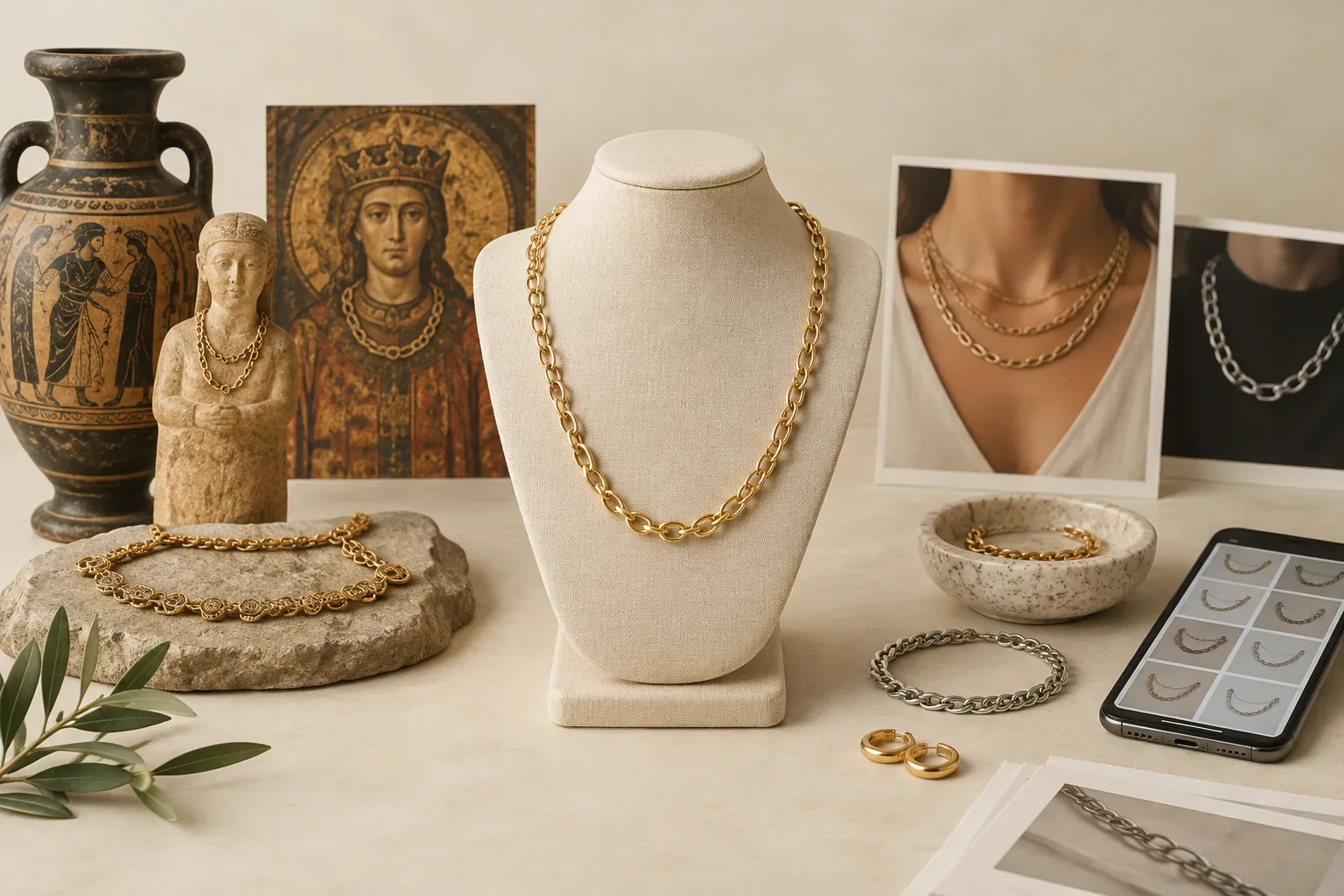
The best-available general account of jewellery history from the Victoria and Albert Museum describes chain necklaces as among the enduring forms of personal ornament that recur across many societies and periods. The V&A's coverage treats chains as both utilitarian—used to suspend pendants, lockets, or reliquaries—and as decorative statements whose styles, thicknesses, and materials changed with technology, fashion, and social status.
Because chain techniques and styles circulated widely, the same basic form appears in very different cultures: fine link chains in courtly European dress, heavy metal collars in some Near Eastern and African contexts, and suspension cords or beaded strings used in other societies. The V&A places these changes in a social and technological context rather than presenting a single, unchanging 'meaning' for the chain.
Documented cultural or religious uses (separate and precise)
When tracing documented uses, specify the culture or period. For example, museum collections and catalogues described by the V&A treat chains as part of European dress and portrait jewellery from medieval through modern times, where they functioned to display status, hold functional objects such as pendants or reliquaries, or carry portraits and mementos. Other regions incorporated metallic chains in ways specific to local material culture and technology; the form is widespread, but the precise social role depends on time and place.
The V&A and comparable museum records are careful to attribute specific practices to particular periods or cultures rather than assuming a universal symbolic meaning. Use those kinds of sources to confirm when a chain was part of a liturgical costume, a courtly fashion, or everyday ornamentation rather than assuming any single spiritual or cultural interpretation applies to all chain necklaces.
Documented history versus modern personal interpretations
Separate documented history from later or personal meanings. Museum documentation establishes that chains were used practically and decoratively across contexts; the symbolic associations people attach today—commitment, protection, identity, or trend-based associations—are often modern interpretations that layer onto or diverge from historical uses.
Modern influencers, fashion brands, and communities frequently reassign symbolic value to chain styles (for example, linking a specific link style with subcultural identity). These contemporary meanings can be meaningful to the wearer, but they are not the same as historically documented uses unless supported by period evidence. Treat modern symbolism as personal or cultural practice that may be recent rather than as evidence of historical intent.
How chain necklaces, motifs, and gemstones appear in jewellery
In jewellery practice, the chain itself can be the principal design element or a practical support for pendants, lockets, charms, or gemstones. Chains are described by their link type (for example, curb, cable, rope, Figaro), thickness, and finish. Those physical features affect both appearance and durability: finer links read as delicate, while heavier links create a bolder silhouette.
Gemstones and motifs appear on chains in many ways. Gemstones may be set in pendants that hang from the chain, be integrated into spacers or station settings along a chain, or be mounted as a clasp element. The Victoria and Albert Museum's resource on gemstones explains historical choices of stones and how gem types were selected and set across periods, and it is a useful reference for identifying common gemstones and their historical context.
Motifs borrowed from religion, heraldry, or popular culture are often attached as pendants or charms. When purchasing online, note that motifs can be mass-produced or handcrafted; provenance, maker information, and detailed photos will help you understand whether an item is a faithful reproduction, a studio piece, or a mass-manufactured fashion item.
How to evaluate product photos: what to demand
Photos are your primary evidence for condition, scale, and detail. Good listings include multiple views: a clear front view, close-ups of the clasp and hallmarks, detailed images of any gemstones or joins, and at least one photo showing scale such as the chain on a model or next to a ruler. Lighting should be neutral enough to show color accurately; photos shot in strong colored light or with heavy filters can mislead about metal tone and gemstone hue.
Ask for or expect high-resolution images that allow zooming without pixelation. For gemstone pieces, request straight-on and angled photos to judge facets and potential wear. If the seller offers video, use it: a short clip showing the chain draped and the clasp operating gives additional confidence about flexibility, weight, and finish. If an item has a hallmark or maker's mark, insist on a clear close-up so you or a jeweller can verify authenticity.
Policies to check before you buy
Documentation practices and disclosure obligations are important. The U.S. Federal Trade Commission recommends that sellers disclose treatments, imitations, and the essential nature of gemstones and metals. Look for explicit statements about metal content (for example, '14K gold' with a listed weight or plating thickness), gemstone identity and whether stones are treated, the presence of synthetic or imitation materials, and any certification provided with the item.
Return, repair, and authentication policies are equally critical. A reasonable return window, transparent shipping and insurance terms, and a clear contact channel for post-sale questions indicate a seller willing to stand behind their product. For higher-value purchases, check whether an independent laboratory report accompanies significant gemstones and whether the seller accepts authenticated returns if an independent test contradicts listing claims.
Online shopping red flags
Be skeptical of listings that lack clear photos, material disclosures, or a return policy. Blurry or heavily edited images, inconsistent descriptions (for example, the title claims 'solid gold' while the description says 'gold plated'), or hallmarks shown in photos that do not match the written description are immediate concerns.
Other red flags include pressure tactics such as countdown timers or claims of 'one available' without verifiable inventory, prices that are implausibly low for the stated material and gemstone quality, and sellers who refuse third-party authentication for high-value stones. Also be cautious when a seller's reviews or presence are minimal and there is no verifiable contact or business address.
Practical selection and gifting guidance
Match chain type and length to the intended wearer and purpose. For everyday wear choose sturdier links and secure clasps; for delicate pendants choose a finer chain that complements but does not overpower the focal piece. Consider hypoallergenic metals or plated layers if the recipient has sensitive skin and verify the base metal under plating when possible.
When gifting, consider presentation and provenance. If the gift has a symbolic element drawn from a particular culture or religion, research documented meaning and, when appropriate, respect cultural context by consulting reliable sources or the recipient. If you are unsure whether a motif is culturally sensitive, choose a neutral design or discuss preferences with the recipient before purchasing.
For heirloom or investment purchases, prioritize documented provenance and third-party certification for gemstones. Keep communications and receipts that specify material, weight, and any certifications; these records matter for insurance and future resale.
After purchase: verification and care
Once you receive the piece, verify what you were promised. Compare the delivered item against photos, check hallmarks, and test gemstone identity via a reputable jeweller if the item was marketed as expensive or rare. Keep all certificates and the seller’s contact information in case follow-up is needed.
For care, follow the jeweller's instructions if provided. Different metals and gemstone settings need different cleaning and storage; a jeweller can advise whether a chain should be repaired, re-soldered, or resized. Proper care will preserve both the aesthetic and financial value of the piece.
Frequently asked questions
What photos should I insist on when buying a chain necklace online?
Demand multiple high-resolution images: a clear front view, close-ups of the clasp and any hallmarks, detailed shots of gemstones or joins, and at least one image showing scale such as the chain worn on a model or beside a ruler. Video of the chain draped and the clasp operating is also very helpful.
How can I tell if a gemstone in a pendant is treated or synthetic from an online listing?
Look for explicit disclosure in the listing about treatments or whether stones are natural, synthetic, or simulants. Sellers should describe common treatments and provide certificates for high-value stones. If the listing is silent, ask the seller for documentation and consider a third-party appraisal after purchase.
What seller policies are most important for jewellery purchases?
Check for clear material and treatment disclosures, a reasonable return window, transparent shipping and insurance terms, and a way to contact the seller. For expensive pieces, verify whether independent authentication is accepted and whether the seller will support authenticated returns.
Are hallmarks a guarantee of metal purity?
Hallmarks are useful indicators but not absolute guarantees. They help identify claimed metal content and maker, but hallmarks can be misrepresented. For high-value purchases, have a reputable jeweller or testing service confirm metal content if authenticity is critical.
When is it appropriate to be concerned about a very low price?
Be cautious when a price is far below market norms for the stated metal and gemstone quality; it could indicate plating rather than solid metal, synthetic stones sold as natural, or misrepresented condition. Expect verifiable disclosures and documentation before accepting an unusually low price.
Sources and further reading
- Bedazzled: A History of Jewellery — Victoria and Albert Museum
- An A-Z of Gemstones — Victoria and Albert Museum
- Buying Gemstones, Diamonds, and Pearls — Federal Trade Commission