Meaning at a glance
Pearls are organic gem materials formed by mollusks; a trustworthy guide distinguishes natural, cultured, imitation, saltwater, and freshwater pearls while placing purity or bridal meanings in historical context.
What pearls are and how types differ
Pearls form when certain mollusks deposit layers of nacre around an irritant or inserted nucleus. The Gemological Institute of America (GIA) describes pearls as organic gem materials produced by mollusks and explains the key distinction between natural pearls, which form without human intervention, and cultured pearls, which are the result of human-guided nucleation inside a living mollusk.
Practically, most pearls on the market are cultured rather than naturally occurring because natural pearls are rare. Cultured pearls come in several major categories: traditional saltwater types such as Akoya, South Sea, and Tahitian, and many freshwater varieties produced by different freshwater mussel species. Imitation pearls are man-made beads often coated to look like nacre and should be identified as costume or simulated pearls rather than natural gem material.
How pearl categories appear in jewelry
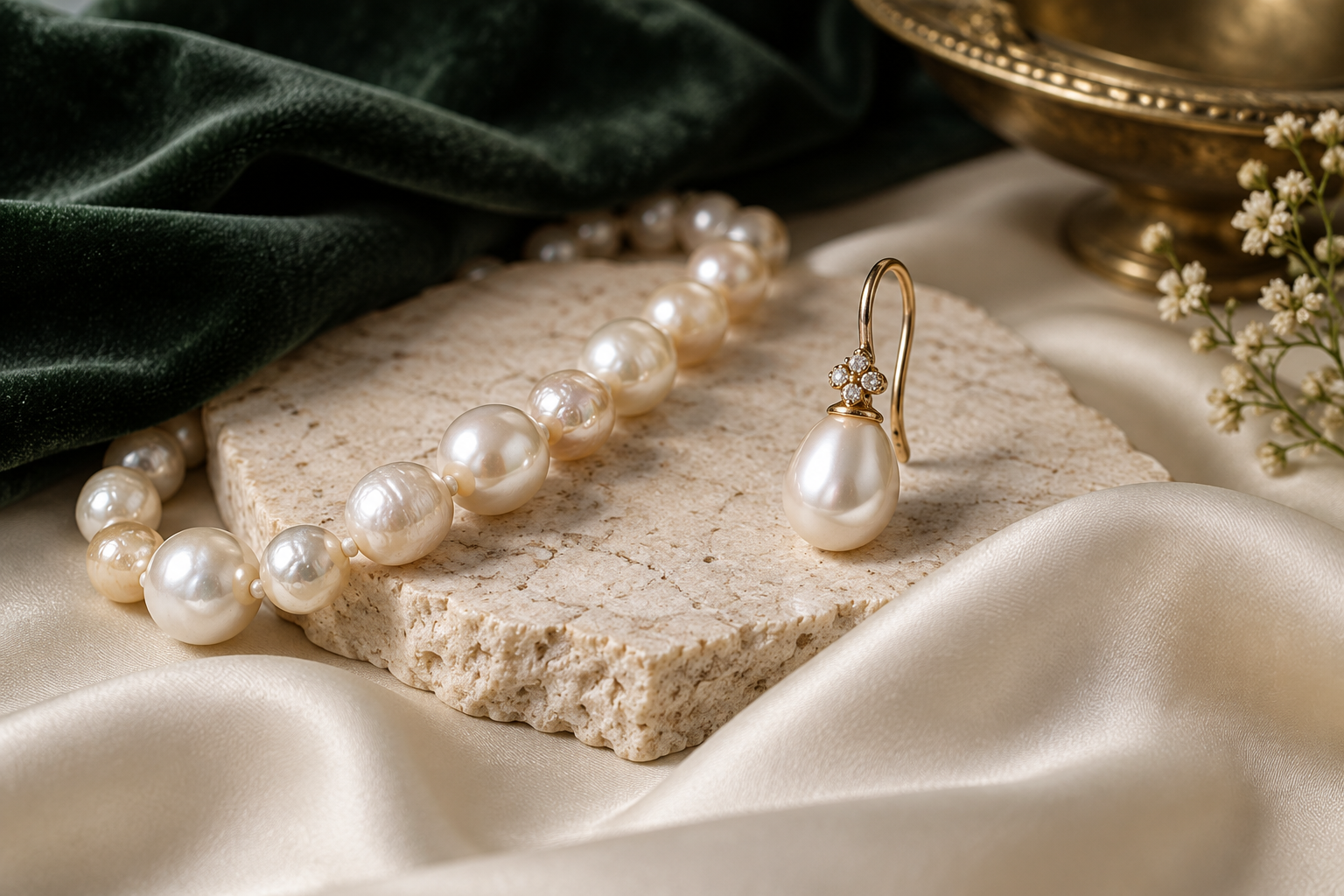
Saltwater and freshwater pearls appear across many forms of jewelry. Classic single-strand pearl necklaces and graduated strands remain common uses for round, well-matched pearls. Baroque and irregular pearls are prized for unique pendants, drop earrings, and statement rings where a singular shape is part of the design rather than requiring precise matching.
Seed pearls—very small natural or cultured pearls—appear historically in fine embroidery, brooches, and delicate necklaces and continue to be used as pavé-like accents in contemporary pieces. The Metropolitan Museum of Art documents seed-pearl necklaces in its collection, which demonstrates how small pearls were historically incorporated into decorative jewelry.
Historical evidence and precise cultural or period attributions
Documentation shows pearls have been collected and worn across many periods. The GIA provides technical context for understanding how pearls were valued and used over time, noting that both natural and cultured pearls have been important in jewelry traditions as technologies and tastes evolved.
Museum collections, such as items cataloged by the Metropolitan Museum of Art, provide concrete artifacts that anchor pearl use to particular fashions and periods; seed-pearl necklaces in museum holdings illustrate a documented practice of using very small pearls in historic European and American dress jewelry. When discussing civilizations or eras (for example, antiquity, medieval, Renaissance, or 19th-century dress jewelry), rely on museum-documented pieces or institutional histories for precise attribution rather than assuming a uniform meaning across cultures.
Documented historical meanings versus modern interpretations
Where history is documented, museums and gemological authorities focus on social and economic uses—pearls often signaled wealth, status, and access to trade networks because natural pearls were rare and difficult to obtain. Institutions like the GIA and museum collections provide the material evidence for these claims through surviving objects and technical analysis.
Modern symbolic associations—such as viewing pearls as a universal symbol of purity or a default bridal gem—are contemporary cultural interpretations and personal meanings rather than universal historical facts. Some cultures or times did attach specific symbolic values to pearls, but those meanings varied by place, period, and social context. Treat purity or bridal symbolism as a modern or contingent association unless a specific historical source documents the meaning for a given culture or period.
How pearl motifs and traditions translate into design
Designers work with pearl characteristics to create motifs that emphasize color, luster, and shape. Matched round pearls produce the traditional strand necklace look valued for symmetry and formality. Contrastingly, baroque pearls create organic, sculptural motifs where irregular surfaces and asymmetry are the focal point. Seed pearls are often used as delicate accents to form floral or filigree motifs, reflecting techniques preserved in historic jewelry and reported in museum collections.
Pearl settings in rings and religious or symbolic jewelry often use protective metalwork—bezels, cups, and prongs shaped to shield the nacreous surface—because pearls are softer and more vulnerable than many gemstones. Contemporary pieces also use pearls as accents alongside colored gemstones or as single focal beads on minimalist chains.
Practical guidance for selection and gifting
Begin by deciding whether the recipient would prefer the classic, matched look of a pearl strand or something modern and individual like a baroque drop or pearl-accent pendant. For traditionalists and formal gifts, choose well-matched round pearls with strong luster and minimal surface marks; for fashion-forward wearers, consider unique shapes and mixed-metal designs.
Set a clear budget and know that cultured saltwater types such as Akoya, Tahitian, and South Sea typically command higher prices per millimeter than many freshwater cultured pearls, because of size, nacre quality, and rarity. If longevity and heirloom potential matter to you, prioritize thick nacre and high luster—attributes used by professional graders and captured in the GIA’s standard factors for evaluating pearl quality.
When gifting an engagement or bridal-related piece, discuss expectations: pearls are a meaningful alternative to diamond rings for some people but are softer and more vulnerable to daily wear. If the recipient intends to wear the piece daily, consider protective settings, hard-wearing design, or reserving pearls for necklaces and earrings rather than a frequently worn ring.
Assessing quality: the standard factors
Pearl quality is commonly evaluated using a set of key factors that jewelers and gemological laboratories apply. The Gemological Institute of America summarizes pearl assessment with criteria that include size, shape, color, luster, surface quality, nacre (thickness and quality), and matching when pearls are used together in strands or matched sets. Size and luster strongly influence visual impact; nacre thickness affects durability; surface marks and shape affect grading and price.
Ask sellers for documentation about type (natural vs cultured), species or origin (for cultured pearls), and any testing or certification. Trustworthy vendors will explain whether a pearl is saltwater or freshwater cultured, provide measurements, and disclose treatments or coatings used to enhance appearance.
Care and maintenance
Pearls require gentle, chemical-free care. Clean them after wear with a soft, damp cloth to remove body oils and perfumes, and allow them to dry fully before storing. Avoid exposing pearls to household chemicals, hair sprays, cosmetics, or chlorine, all of which can dull nacre or damage the surface.
Store pearl necklaces flat or in a separate soft pouch to prevent scratching from harder gems or metals. Have beaded pearl necklaces restrung periodically—frequency depends on wear, but annual or biennial inspections are common for frequently worn strands. For valuable or historic pieces, seek a professional jeweler experienced with pearls for cleaning, repairs, and appraisal.
Buying, testing, and certification
For high-value purchases, request independent testing or certification that clarifies whether a pearl is natural, cultured, or treated. Sellers should disclose whether pearls are dyed, coated, or assembled over a bead nucleus. The GIA provides guidance and descriptions that help buyers understand distinctions and what documentation to seek.
If considering natural pearls, be aware they are rare and command premium prices; many reputable dealers and labs can offer detailed reports. For everyday wear and lower budgets, high-quality cultured freshwater pearls can be an excellent choice.
Final considerations
Pearls combine biological origin, cultural history, and a wide stylistic range. Use documented institutional sources for historical claims and treat symbolic meanings like 'purity' or 'bridal' as contemporary or personal associations unless a specific historical source ties that meaning to a particular place and time. With informed selection and simple care, pearls can be a lasting and expressive part of a jewelry wardrobe.
Frequently asked questions
What is the difference between a natural and a cultured pearl?
A natural pearl forms without human intervention when a mollusk secretes nacre around an irritant; a cultured pearl forms when technicians intentionally introduce a nucleus into a mollusk to stimulate nacre deposition. The Gemological Institute of America (GIA) explains this distinction and how it affects rarity and pricing.
How can I tell if a pearl is imitation?
Imitation pearls are typically man-made beads coated to look like nacre and often lack the depth of luster and subtle surface growth lines of real nacre. A reputable dealer or gemological laboratory can test and document whether a bead is natural, cultured, or imitation.
Are pearls suitable for engagement rings?
Pearls can be used in engagement rings, but they are softer than many gemstones and more vulnerable to scratches and chemicals. If choosing a pearl for daily wear, select a protective setting, accept that maintenance will be needed, and consider the recipient’s lifestyle.
How should I clean and store pearl jewelry?
Wipe pearls gently with a soft, damp cloth after wearing to remove oils and scents, avoid contact with household chemicals and cosmetics, let them dry fully before storing, and keep them separate from harder gems to prevent scratching. Have pearl strands restrung periodically.
What quality factors should I ask about when buying pearls?
Ask about size, shape, color, luster, surface quality, nacre thickness and quality, and matching if pearls are in a set. These are the standard factors used by professionals such as the GIA to evaluate pearl quality.
Do pearls have a single universal symbolic meaning?
No. While modern cultures often associate pearls with purity or bridal traditions, symbolic meanings vary by place and period. Treat such meanings as contemporary or personal unless a specific historical source documents that symbolism for a particular culture or era.
Sources and further reading
- Pearl Description — Gemological Institute of America
- Seed Pearl Necklace — The Metropolitan Museum of Art