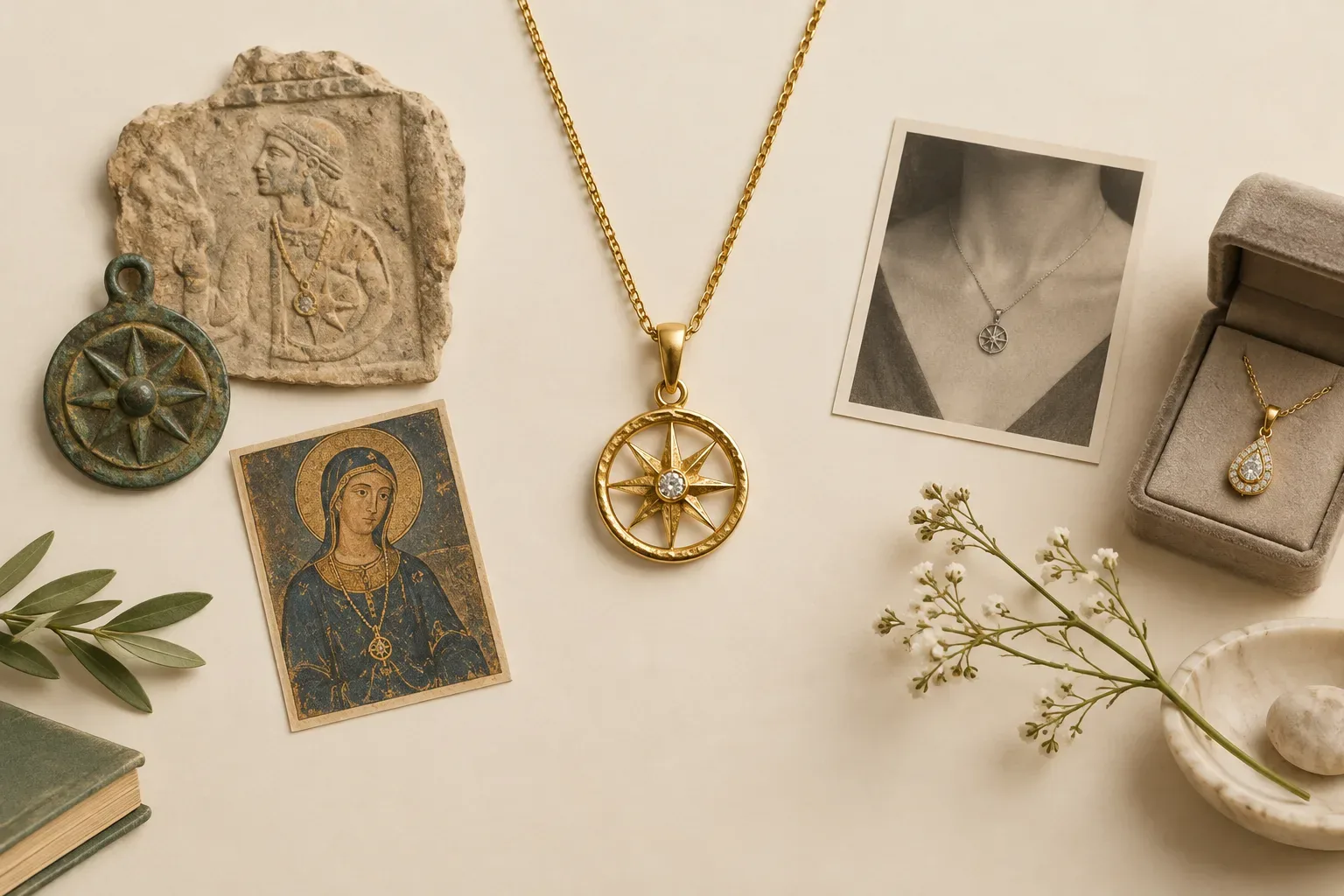
Meaning at a glance
This guide explains the documented history and changing contexts of pendant necklaces citing museum scholarship, separates cultural or religious evidence from modern personal meanings, and gives concrete advice on photos to request, seller policies to check, authenticity red flags, and respectful selection and gifting guidance.
What museum evidence shows about the history of pendants
Museum collections and curators treat pendants as a long‑running category that appears in many cultures for diverse reasons. The Victoria and Albert Museum (V&A) places pendants and other forms of jewellery in social and technological contexts, showing that small objects worn at the throat, chest, or on a chain have been adapted for display, memory, protection, status, and ornament across time and place. The V&A’s materials emphasize how the role and meaning of jewelry change with fashion, technology, and social practice rather than remaining fixed.
In museum accounts, pendants appear in contexts such as ancient personal adornment, classical intaglios and cameos set for display, religious and reliquary objects in Byzantine and medieval Europe, and sentimental lockets and brooches in the modern period. The V&A frames these as examples of shifting uses and meanings rather than a single continuous symbolism, and it documents how techniques, materials, and decorative motifs evolve with trade, lapidary advances, and fashion.
Distinguishing documented cultural evidence from later interpretation
When evaluating claimed meanings for a pendant motif, separate two categories: the historical, documented uses recorded by museums and scholars, and modern symbolic or personal interpretations that developed later. Museum documentation focuses on how an object was used and made in its original context, for example indicating whether a pendant functioned as a reliquary, a status item, or a keepsake. These are evidence‑based claims about historical practice as presented by the V&A.
Modern interpretations—such as assigning particular healing powers to a gemstone or declaring a motif ‘protective’ for all wearers—are contemporary attributions. They may reflect revivalist fashion, marketing, or individual belief. Those modern readings are legitimate personal meanings for wearers but are not equivalent to documented historical fact. Avoid presenting contemporary spiritual or commercial claims as universal truths; instead, treat them as personal or cultural interpretations that arose after the original production contexts described by museums.
How motifs, gemstones, and traditions appear in pendant jewelry
In structural terms, pendants appear as a suspended element attached to a chain or cord by a bail. Motifs commonly used historically and today include portrait cameos, gemstone drops, religious symbols, lockets, and elaborate enamelled designs. The V&A’s accounts and collections illustrate these types and show how artisans used metalworking, stone carving, enamel, and setting techniques to create pendants tailored to different functions, whether display, commemoration, or devotion.
Gemstones and organic materials appear in pendants in many ways: as a central set stone, as an intaglio or cameo, or as inlaid beads. The V&A’s A–Z of Gemstones provides context on how certain stones were favoured in different periods for reasons of fashion, trade, availability, and lapidary technique. For example, pearls and coloured gems have long been used for visible status and decorative effect, while carved stones were often used for portrait miniatures or seals.
From a modern shopping perspective, pendants may combine traditional motifs with contemporary materials: cast bases with plated finishes, synthetic or treated gems, and mixed‑metal constructions. Understanding the original techniques and materials documented by museum collections helps you recognize authentic craftsmanship and assess whether a reproduction or reinterpretation is faithful to historical methods.
What photos to request and why they matter
Good photography is the single most important practical tool when buying pendants online. Ask sellers for clear, well‑lit images that show the pendant worn on a model or flat with a scale reference such as a ruler or a coin, close‑ups of the front and back, a side view of the profile and bail, and a detailed image of any hallmarks or maker’s marks. Multiple angles help you judge proportion, thickness, setting quality, and wear to prongs or finishes.
Request macro images of gemstones or enamel so you can inspect for surface damage, noticeable glue, or large filling cavities. If a pendant is advertised as antique, ask for magnified photos of joins and solder seams because modern repairs and re‑polishing can change value and authenticity. Also ask about lighting conditions for the photos; natural daylight images usually give the best sense of true colour for stones and metals.
Seller policies and documentation to check before buying
Before completing a purchase, check the seller’s return and refund policy, shipping and insurance options, and stated packaging and delivery timelines. A reliable seller will clearly display a return window, contact details, and terms for damaged or misrepresented items. For gemstones and diamonds, the U.S. Federal Trade Commission (FTC) advises that sellers disclose treatments, synthetics, or imitations. Look for explicit statements about whether a stone is natural, lab‑created, dyed, heat‑treated, or otherwise enhanced.
Also ask whether the seller provides certificates or lab reports for high‑value stones and whether the metal content is hallmarked or tested. For pieces described as antique, request provenance information when available. A transparent seller will share testing reports, point‑of‑sale documentation, or conservation notes where relevant.
Common red flags and how to spot them
Be cautious if the listing uses only a single small stock photo or if the images are inconsistent in angle and lighting. Listings that omit close‑ups of hallmarks or do not show the pendant on a scale are riskier because they hide proportion and condition. Extremely low prices for named gemstones or for items described as high karat gold are often too good to be true.
Other red flags include evasive answers to direct questions about treatments and origin, no or very limited return policy, high pressure to buy quickly, and sellers who refuse to provide additional photos or independent third‑party reports. According to the FTC, failure to disclose material treatments, synthetics, or imitations is a consumer‑protection concern, so insist on clarity before paying for a piece described as natural or untreated.
Practical and respectful selection and gifting guidance
When selecting a pendant as a gift, start with the recipient’s existing style and any cultural or religious meanings they observe. If a motif has clear religious or cultural associations, consider whether the recipient identifies with that tradition and avoid appropriation by purchasing sacred symbols as a fashion statement for someone outside the culture. If you are unsure, choose a neutral design or ask discreetly about preferences.
For materials and durability, prefer solid metal stamps and tested gemstones for everyday wear, and consider chain strength and clasp type for pendants. If you are buying an heirloom‑style or antique piece, discuss conservation versus restoration; many collectors prefer minimal invasive work to preserve patina. For higher‑value purchases, request a written appraisal or a lab report and insure the piece during shipment. Finally, include a thoughtful note about the meaning you attach to the gift while acknowledging that wearers may interpret symbols personally and differently.
Summary and next steps
Use museum scholarship to ground historical claims and the FTC’s guidance to evaluate material disclosure. Request multiple detailed photos, insist on clear seller policies and treatment disclosures, and watch for red flags such as missing hallmarks, unverifiable provenance, or aggressive sales tactics. Respect cultural meanings when selecting motifs, and prioritize durable materials and transparent documentation when buying a pendant online.
For related reading on sentimental forms and symbol research, see our guides on meaningful jewelry and the history of lockets, or consult the V&A materials and the FTC consumer advice for a deeper practical and historical view.
Frequently asked questions
What photos should I ask for when buying a pendant online?
Ask for clear front and back views, side profiles showing thickness and the bail, macro images of any gemstones or enamel, a scale reference such as a ruler or coin, and a photo of any hallmarks or maker’s marks. Also request an image of the pendant worn on a model or chain to judge proportion.
How can I tell if a gemstone is natural, treated, or lab‑created?
Reliable sellers disclose treatments and origin. For high‑value gems, request a laboratory report. The FTC advises that sellers must disclose treatments and synthetics; if a seller is evasive about treatment, consider it a red flag. Macrophotography can sometimes reveal evidence of filling or dye but is not a substitute for professional testing.
What seller policies are most important to check?
Verify the return and refund policy, shipping insurance and timelines, authentication or certification statements for gemstones, disclosure of treatments, and the seller’s contact information. For antiques, ask about provenance and any conservation history.
Are religious or cultural symbols appropriate to give as gifts?
Some symbols have specific religious or cultural meanings that may be sensitive. If the recipient practices or values that tradition, the gift can be meaningful. If they do not, avoid using sacred or culturally specific motifs as fashion statements. When in doubt, choose a neutral design or ask discreetly.
What are common red flags that a pendant listing is unreliable?
Red flags include very few or low‑quality photos, no close‑ups of hallmarks, unusually low prices for named precious materials, refusal to provide additional images or documentation, unclear return policy, and evasive answers about a gem’s origin or treatment.
Sources and further reading
- Bedazzled: A History of Jewellery — Victoria and Albert Museum
- An A-Z of Gemstones — Victoria and Albert Museum
- Buying Gemstones, Diamonds, and Pearls — Federal Trade Commission