Meaning at a glance
Leather jewelry explained: this article distinguishes documented historical uses of organic materials in jewelry from modern symbolic or fashion meanings, describes common leather compositions and how leather is incorporated with metal and gemstones, and explains labeling and disclosure expectations for materials and treatments so buyers can choose and gift with confidence.
Quick answer
Leather jewelry explained in one sentence: museum surveys show that organic materials—including various leathers and other hides—have long appeared alongside metal and stone in jewellery, while modern uses and symbolic meanings have shifted by context; buyers should ask sellers about species, tanning, surface treatments and any simulants or enhancements because disclosure of material treatments and imitations is a recognized consumer protection concern. (Thesis adapted from the Victoria and Albert Museum and the U.S. Federal Trade Commission.)
Composition: what ‘leather’ can mean in jewelry
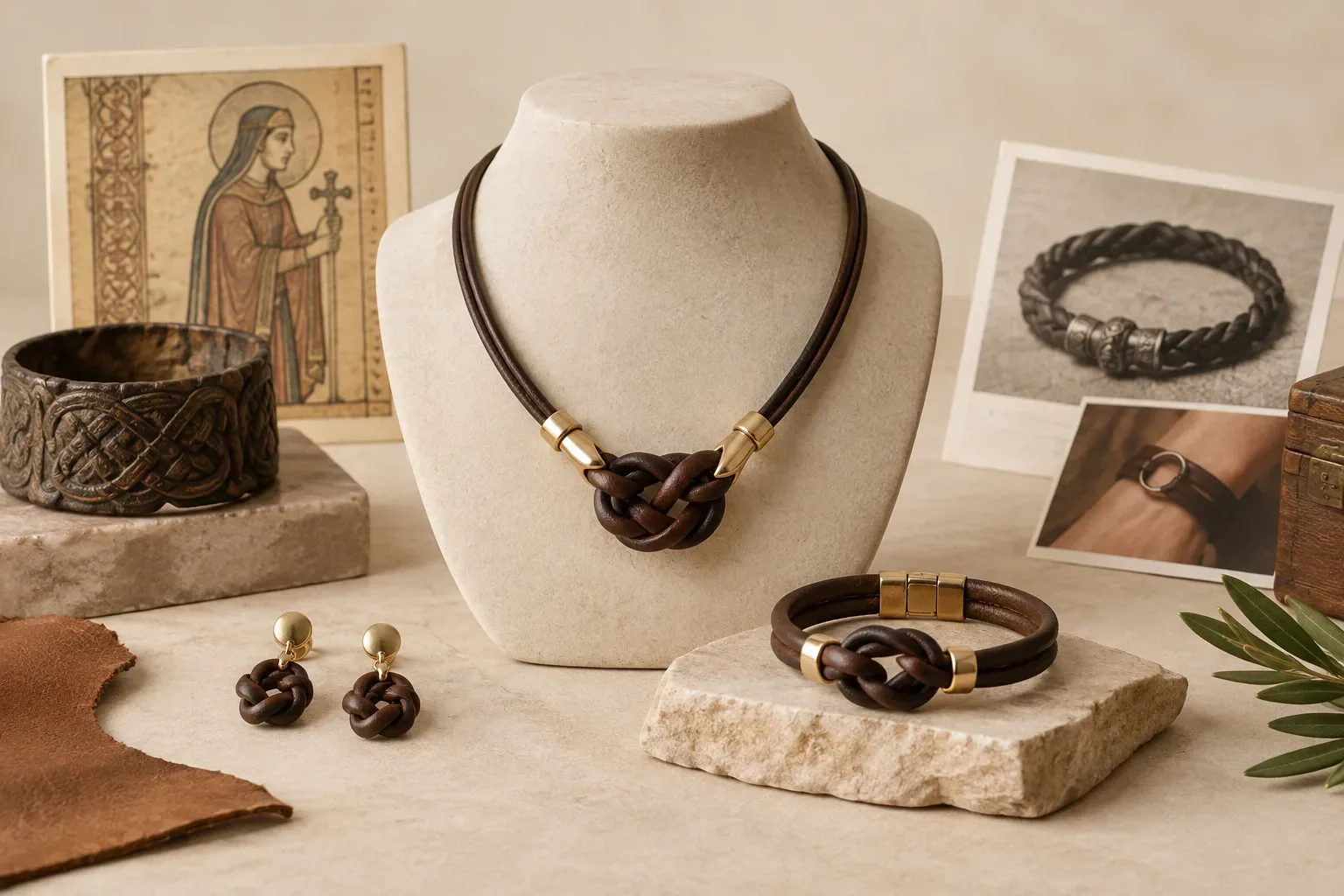
When a piece is described as leather jewelry, the term covers a range of animal hides and processing methods rather than a single material. Leather used in jewellery can be thinly split hide used as a cord, suede or nubuck for a soft band, woven strips, braided or plaited straps, or leather used as a backing or inlay behind metal and stone settings. The look and performance depend on species, thickness, tanning method and surface finishes.
Tanning and surface treatments change leather’s color, flexibility and durability. Dyed or sealed finishes provide color and water resistance; waxed or oiled finishes create a matte or aged appearance. Some contemporary manufacturers apply coatings or laminates to mimic exotic skins or to increase abrasion resistance. The U.S. Federal Trade Commission’s guidance on gemstones, diamonds and pearls highlights the broader principle that sellers must be clear about treatments and imitations when they affect a product’s identity or value, and that principle applies equally to leather as a material in jewellery.
Historical evidence: how museums document leather and organic materials
Surveys and exhibitions of jewellery history at institutions such as the Victoria and Albert Museum show that makers have used a wide range of materials across periods and places. The V&A frames jewellery as a field where styles, materials and social meanings change over time and between cultures, and its collections include examples that pair organic components with metals and stones. Those institutional accounts document usage and changing social contexts rather than a single, fixed symbolism.
Because museum catalogues emphasize provenance, technique and changing tastes, they are a useful basis for understanding how and when organic materials like leather were used in necklaces, bracelets and mountings. The V&A’s interpretations focus on craftsmanship and historical context; they do not treat any single material as universally symbolic, and they caution that meanings evolve with fashion and social practice.
Documented historical meanings versus modern personal interpretations
Historic evidence recorded by museums tends to describe how objects were made and used, and occasionally to note socially or ritually significant contexts. Where the V&A identifies meanings, those meanings are tied to specific times, places or practices. For leather elements, historical documentation more often records function—cordage, protection, or a material option—than a single symbolic meaning.
Modern wearers and designers frequently attach personal, subcultural or fashion-based meanings to leather jewellery: for some, leather evokes ruggedness or casual style; for others it may signal a connection to particular communities or aesthetics. Those contemporary associations are legitimate personal or group meanings, but they are not the same as the documented, contextualized meanings that appear in museum records. Always keep the distinction clear: museum evidence establishes how leather was used and understood in particular historic contexts, while modern symbolism is personal, cultural and variable.
How leather and related motifs appear in jewellery
Leather commonly appears as the structural element of an object: cords for pendants, bands for bracelets or chokers, braided straps, or as backing and inlay for metalwork and carved elements. Designers often combine leather with metal findings, clasps and settings to create hybrid pieces; gemstones may be set into metal bezels that are attached to leather bands or used as focal points that contrast with leather’s texture.
The Victoria and Albert Museum’s A–Z of Gemstones explains how stones are identified and used in jewellery, emphasising that the setting and surrounding material influence perception and use. In leather jewellery, gemstones are typically presented in metal settings fastened to or threaded onto leather rather than being pierced directly through hide. Because gemstones and their mounts have their own historical practices and treatment concerns, the V&A’s work on gemstones is a useful reference for understanding how stone and leather interact in a piece’s construction and appearance.
Hallmarks, labels and legal disclosure
Leather itself is not eligible for the kind of metal hallmarks applied to precious metals. However, any metal components attached to leather jewellery—clasps, findings or mounted settings—may carry official marks denoting metal type, maker or assay where local laws require them. For the non-metal parts, consumer protection and honesty in marketing rest on accurate labelling rather than hallmarking.
The U.S. Federal Trade Commission’s consumer guidance on buying gemstones, diamonds and pearls provides a clear precedent: sellers must disclose material treatments, imitations and any modifications that affect identity or value. Applied to leather jewellery, that means reputable vendors should tell buyers whether a band is genuine leather or a bonded or reconstituted leather product, whether the leather is from a particular species (when relevant to regulations or conservation concerns), and whether surface treatments or laminates are present. If gemstones or metals have been enhanced, those treatments should also be disclosed following the same consumer-protection spirit.
Selecting and gifting leather jewellery: practical, respectful guidance
Decide what matters first: durability, appearance, ethics or symbolism. If you want long wear, choose a construction with quality metal fittings and a well-finished leather band. If animal origin or tanning method matters for ethical, environmental or religious reasons, ask the seller for specifics. Reputable makers and retailers will be willing to say whether leather is vegetable-tanned, chrome-tanned, dyed or sealed and to note the animal origin when that is relevant to cultural sensitivities or regulation.
When the piece includes gemstones or precious metals, request written information about treatments, imitations or enhancements. Ask whether any attached metals are hallmarked and, if so, what the marks mean. If you are gifting across cultural or religious lines, be mindful that materials and styles can carry different resonances in different communities; a respectful choice begins with asking whether the recipient has preferences or restrictions regarding animal-based materials.
For sustainability-minded buyers, inquire about sourcing and production methods. Some makers use leather remnants or vegetable tanning to reduce environmental impact; others use synthetic substitutes to avoid animal products altogether. If you are unsure about the authenticity or treatment of a leather item, favor vendors who provide clear labels, provenance information, and care instructions.
Care, maintenance and conservation notes
Leather jewellery’s longevity depends on the tannage, finish and how it is worn. Simple care—keeping pieces dry, avoiding prolonged exposure to perfumes and lotions, and wiping bands with a dry soft cloth—helps maintain appearance. For finished or dyed leather, follow the maker’s instructions; some finishes are sealed and tolerant of light moisture, while others will show wear more quickly.
Museum conservation practice, as reflected in historical collections, shows that organic materials require particular attention when stored or displayed to avoid acidity, humidity damage and pest risks. If you have a historic or heirloom leather piece, consult a conservation professional rather than attempting aggressive cleaning or repair.
Putting history and meaning into context
The Victoria and Albert Museum’s approach to jewellery history reminds us that materials carry different meanings in different places and times. Leather’s documented roles in historic objects are primarily practical or stylistic within particular cultures and periods; modern symbolic associations are layered on by contemporary fashion, identity and individual choice. Recognizing that difference helps buyers, wearers and givers treat leather jewellery with both historical awareness and present-day sensitivity.
If you want to learn more about how to research a jewellery symbol or to explore related topics, see our guides on choosing meaningful jewellery and the history of specific types such as lockets and other sentimental pieces. These resources build on museum documentation and consumer guidance to help you make informed and respectful choices.
Frequently asked questions
Is leather jewellery the same as faux leather or bonded leather?
Not necessarily. Sellers may use genuine leather, bonded or reconstituted leather, or fully synthetic materials that mimic leather. The U.S. Federal Trade Commission’s consumer guidance emphasises that sellers should disclose treatments, imitations and modifications that affect identity or value. If the product label or seller does not make the material clear, ask for written confirmation.
Does leather jewellery carry hallmarks like gold or silver?
Leather itself does not receive metal-style hallmarks. Any attached metal components—clasps, findings or settings—may be hallmarked where local law requires it. For the leather portion, accurate labelling and seller disclosure are the consumer safeguards to look for.
How can I tell if a leather piece has been treated or coated?
Visual inspection can suggest treatments—very uniform colour, glossy or plastic-feeling surfaces, or a laminated edge may indicate a coating or laminate—but definite identification typically requires seller information or professional testing. The FTC’s guidance highlights that sellers should reveal treatments that materially affect a product’s identity or value.
Are there cultural or ethical concerns to consider when giving leather jewellery?
Yes. Different communities and individuals have varying views on animal-derived materials. If the recipient might have religious, cultural or ethical sensitivities, ask them or the seller about animal origin and tanning methods, or consider alternatives such as plant-based or synthetic materials.
How should I care for leather jewellery?
Follow the maker’s care instructions. In general, avoid prolonged exposure to water, strong sunlight and chemicals such as perfumes or lotions. Wipe with a soft, dry cloth after wear. For historic or fragile leather, consult a conservation professional rather than attempting aggressive cleaning.
What should I ask the seller before buying leather jewellery?
Ask whether the leather is genuine and what species it comes from, how it was tanned and finished, whether any coatings or laminates are present, and whether attached stones or metals have been treated or hallmarked. Request written details if possible; transparent sellers will provide provenance and treatment information.
Sources and further reading
- Bedazzled: A History of Jewellery — Victoria and Albert Museum
- An A-Z of Gemstones — Victoria and Albert Museum
- Buying Gemstones, Diamonds, and Pearls — Federal Trade Commission