Meaning at a glance
This article explains the documented history and changing contexts of the fossil shell motif, distinguishes historical meanings from modern personal interpretations, describes how fossil shells appear in jewelry, and gives practical guidance for choosing and wearing fossil-shell pieces responsibly.
What the historical record shows
Collections, catalogues, and exhibitions at institutions such as the Victoria and Albert Museum document that natural objects and naturalistic motifs—including shells—have been used and adapted in jewellery design across periods and cultures. The V&A’s surveys of jewellery history emphasize changing social contexts: the same motif can mean different things depending on fashion, technology, and social function rather than a single timeless meaning.
Museum evidence tends to describe materials and form, provenance, and the social uses of jewellery (for example, portrait jewels, mourning pieces, or status items) rather than prescribing a single symbolic interpretation. When interpreting fossil shells in historical pieces, historians reconstruct purpose from object type, findspot, patron, and contemporaneous records. The V&A’s work on gemstones and jewellery underscores that motifs are often adopted for aesthetic, technological, or trade reasons as much as for symbolic ones.
Which cultures and periods used shell imagery (documented evidence)
The V&A’s broad surveys note that shells and marine motifs appear repeatedly in European jewellery histories and in other material cultures, showing up in decorative arts from antiquity through modern revival styles. Museum catalogues commonly identify shell imagery on cameos, intaglios, and metalwork as part of classical revival tastes, natural history interests, or decorative vocabulary rather than as evidence of uniform religious meaning.
In modern and historic periods recorded by museums, shells were sometimes adopted because they were fashionable, because of artistic interest in natural forms, or because collectors and patrons were fascinated by natural history. These documented drivers—fashion, art-historical revival, and collecting—are the kinds of evidence historians use to explain why shell forms recur in jewellery, as opposed to later popular claims that assign single symbolic meanings to every example.
Documented meanings versus modern interpretations
Where museum records and archival documents exist, they typically link a jewellery object to a context such as mourning, commemoration, status display, or aesthetic taste. For these documented meanings, the source is the object’s provenance and period documentation described in museum resources such as those provided by the V&A.
Modern interpretations are different in kind: contemporary wearers and designers often attach personal, spiritual, or ecological meanings to fossil shell motifs. Those modern meanings are valid as personal symbolism but are not the same as historically documented uses. For example, a 19th‑century brooch with a shell motif identified in a museum catalogue may have been fashionable in its time; a modern wearer might choose a similar motif today to express a love of the sea or concern for deep time. Both readings can coexist, but they should be stated as distinct: one is supported by historical documentation, the other is a contemporary, personal meaning.
How fossil shells and shell motifs appear in jewellery
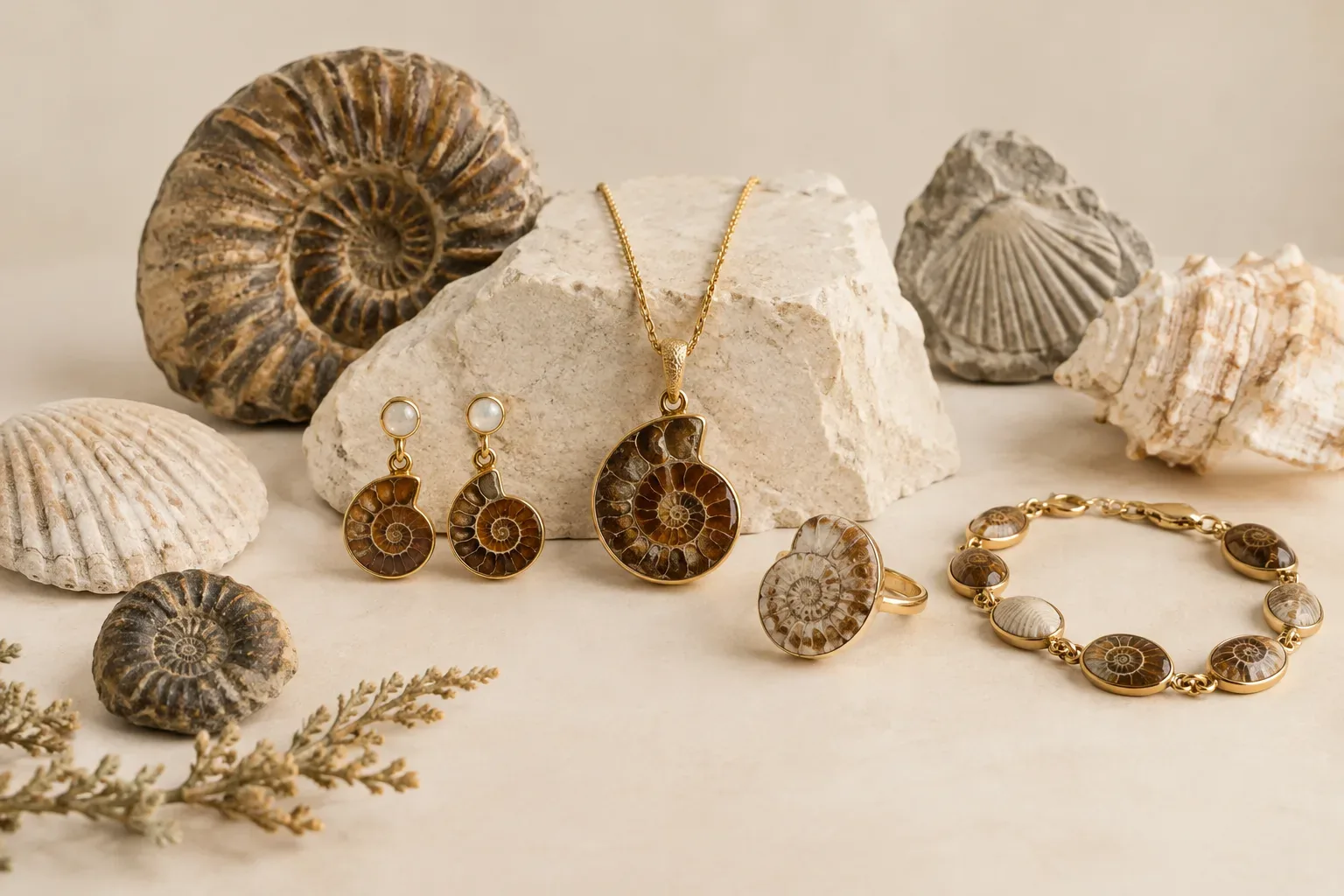
In jewelry practice, the term "fossil shell" can refer either to actual fossilized material (for example, a cross section of a fossil shell polished and set) or to a shell-shaped motif rendered in metal, enamel, or carved stone. Museums catalogue both uses: natural specimens set as cabochons or focal stones, and artistic motifs inspired by shell shapes.
Design techniques include cutting and polishing fossilized material for use as beads, cabochons, or inlays; carving shell and shell-like fossils into cameos and intaglios; and using metalwork to reproduce shell curves as decorative motifs on brooches, pendants, and rings. The V&A’s guides on gemstones and jewellery technologies explain that makers have repeatedly adapted new materials and techniques to produce these effects, and that the visual language of nature is a persistent element of jewellery design across periods.
Responsible selection: provenance, treatments, and authenticity
Ask for clear provenance and material information. The Federal Trade Commission’s guidance on buying gemstones, diamonds, and pearls emphasizes the buyer’s right to accurate disclosure about material treatments, synthetics, and imitations. Although that guidance does not list every possible fossil material, its principles apply: sellers should disclose whether a piece contains genuine fossil material, stabilized or treated fossils, composites (for example fossil fragments bonded to backing), or imitation materials.
Seek documentation for high-value items. Museum-standard catalogues and reputable dealers will describe the material, treatment history if any, and where a specimen was collected or acquired. For fossil shells, provenance can matter both scientifically and legally: reputable sellers will be able to explain how the specimen was obtained and whether it was prepared or altered in ways that affect value or conservation.
Respectful selection and cultural sensitivity
Be attentive to cultural context and avoid assuming a motif carries the same meaning across cultures and periods. Museums like the V&A caution against reading a single, timeless meaning into historical motifs. If a design references a specific cultural or religious tradition, ask the maker or seller about that reference and whether it was made in collaboration with or permission from the originating community.
When gifting fossil-shell jewellery, consider the recipient’s values and any cultural associations they may hold. A piece chosen for its geological story may delight someone who values natural history, while someone else may prefer a design tied to a family or cultural motif. Explain the piece’s material and provenance when you give it, so the recipient can understand both its natural history and any cultural references.
Care, wear, and the ethics of fossil material
Fossil material can be porous, brittle, or sensitive to chemicals and temperature changes, depending on mineralization. Ask the seller for care recommendations for the specific fossil used in a piece. General caution and gentle cleaning will reduce risk, and professional repairers with experience in fossils or natural-material jewellery can advise on conservation-friendly care.
Consider the conservation and ecological dimensions. Responsible collectors and makers balance appreciation for natural specimens with concern for over-collecting and the protection of palaeontological sites. When possible, buy from dealers who document lawful, ethical collecting practices and who can confirm that pieces were obtained without harming protected sites or cultural heritage.
Design contexts and contemporary expressions
Contemporary jewellers use fossil shells for a range of aesthetic and conceptual reasons: to reference deep time, to celebrate natural texture and form, or to recycle historical materials into modern design vocabularies. The V&A’s materials on gemstone and jewellery history highlight how makers reuse and recontextualize motifs so that the same visual language can convey different messages in a new era.
If you are commissioning or buying a new piece, ask the maker about their approach: do they prioritize natural specimen integrity, conceptual narrative, or a strictly decorative outcome? That conversation clarifies whether the piece is meant as a scientific specimen, a personal emblem, or a fashion object.
Practical buying and gifting checklist
Before purchase, request clear material identification and any treatment disclosures. Confirm whether the fossil is whole, stabilized, composite, or a cast/replica. For higher-value pieces, ask for written provenance or a dealer’s statement. If the piece references a specific culture, ask about collaboration or permissions. Consider the recipient’s tastes and the care demands of the material. Finally, choose a reputable dealer or maker who can answer questions about conservation, ethics, and long-term care.
Final thoughts
Fossil shell jewellery often invites layered meanings: museum documentation explains how the motif has been used for diverse social functions across periods, while contemporary wearers attribute personal and ecological significance. Treat historical meanings as contextually grounded and supported by provenance, and accept modern interpretations as personal or cultural choices. With careful sourcing, clear disclosure, and respectful gifting, fossil shell jewellery can be both a beautiful object and a thoughtful bridge between natural history and personal meaning.
Frequently asked questions
Are fossil shells considered gemstones?
Fossil shells are natural materials sometimes used like gemstones in jewellery, but whether they are marketed as gemstones depends on the material, treatment, and the seller’s disclosure. The Victoria and Albert Museum’s guides discuss how natural materials can be used in jewellery, and the Federal Trade Commission recommends sellers clearly disclose treatments, stabilisation, or imitation status.
How can I tell if a fossil shell is genuine?
Ask the seller for provenance, material identification, and any treatment records. Reputable dealers and museum-standard catalogues will describe whether a specimen is a whole fossil, stabilized, composite, or a cast/replica. The FTC’s consumer guidance stresses accurate disclosure for gems and similar materials.
Is fossil shell jewellery appropriate to give as a cultural gift?
It depends on the context. If a design explicitly references a living culture or religious tradition, ask whether the maker has appropriate permissions or community collaboration. Museum resources show that motifs can have varied meanings across cultures, so approach cultural references with respect and seek information from the maker.
How should I care for fossil shell jewellery?
Care depends on the fossil’s mineralization and treatment; many fossil materials are more fragile than hard gemstones. Ask the seller for care instructions, avoid harsh chemicals, and consult a professional conservator or jeweller experienced with fossils for repairs and long-term care.
What should I ask a dealer before buying fossil shell jewellery?
Request material identification, disclosure of any treatments or composite construction, provenance information, and guidance on care. For higher-value purchases, ask for written documentation or a dealer’s statement. These steps align with the FTC’s recommendations for transparent disclosure in gemstone purchases.
Sources and further reading
- Bedazzled: A History of Jewellery — Victoria and Albert Museum
- An A-Z of Gemstones — Victoria and Albert Museum
- Buying Gemstones, Diamonds, and Pearls — Federal Trade Commission