Meaning at a glance
Leaf fossil jewelry meaning blends documented histories of natural-history collecting and Victorian-era sentimentalism with modern personal and ecological interpretations; choose and wear pieces with attention to authenticity, disclosure, and cultural respect.
Quick answer
The leaf fossil jewelry meaning has two linked strands: historically, jewelers and collectors folded plant fossils into wearable objects as part of the broader rise of natural-history collecting and Victorian sentimental tastes (as documented by the Victoria and Albert Museum), while modern wearers often read the motif as a personal sign of deep time, continuity with nature, or environmental concern. This article separates what is documented by museum and consumer-protection sources from later, personal interpretations, and explains how the motif appears in jewelry and how to choose and wear it responsibly.
Historical evidence and cultural contexts
Museums and curators describe jewelry history as a sequence of changing social meanings and materials rather than a single, stable symbolism. The Victoria and Albert Museum frames jewellery history around social context, fashion, and collecting practices, and its catalogues and exhibitions trace how natural specimens entered decorative culture. In particular, European collectors and makers in the 18th and 19th centuries incorporated natural-history objects — minerals, shells, and plant fossils — into cabinets of curiosity, wearable pieces, and sentimental jewellery, linking scientific interest with display and personal memory (Victoria and Albert Museum).
Separate from the use of physical fossils, many cultures long used leaf forms as decorative and symbolic motifs in metalwork, textile and gem carving. Those uses are distinct from wearing a fossilized leaf as a specimen: leaf shapes can represent fertility, renewal, or particular mythic associations within a specific cultural tradition, but those symbolic meanings vary across place and time. When discussing leaf fossil jewelry meaning we must distinguish documented evidence for the physical use of fossils in European collecting and jewellery from the broader, older tradition of leaf motifs in decorative arts (Victoria and Albert Museum; An A-Z of Gemstones).
The museum record most directly documents the European phenomenon in which natural-history collecting and Victorian sentimental tastes converged to make plant fossils and petrified materials fashionable as curiosities and as components for brooches, lockets, and pendants. An A-Z of Gemstones provides context for how mineralized organic materials — including petrified wood and other fossilized plant remains — are treated and classified for decorative use, establishing the material basis for many such pieces (Victoria and Albert Museum; An A-Z of Gemstones).
Documented meanings versus modern interpretations
Documented historical meanings: museum research shows that the inclusion of fossils in jewellery was closely tied to collecting culture, scientific curiosity, and the sentimental vogue of certain European periods. Fossils and petrified materials often signalled erudition, curiosity about natural history, or the intimate, memory-laden tastes of collectors and their social circles. These historical meanings are grounded in exhibition records, catalogues and the contextual study of jewellery as social expression (Victoria and Albert Museum).
Modern personal interpretations: contemporary wearers often project new meanings onto leaf fossil jewelry that are not documented in historic records. Common modern readings include connection to "deep time," ecological awareness, ancestral continuity, or a symbolic link to renewal and resilience. Those contemporary meanings are valid personal attributions but are not universal and do not replace historically documented contexts. Distinguishing the two — what historical records show and what individuals now feel — helps keep interpretation honest and culturally respectful.
How the motif, gemstone, or tradition appears in jewelry
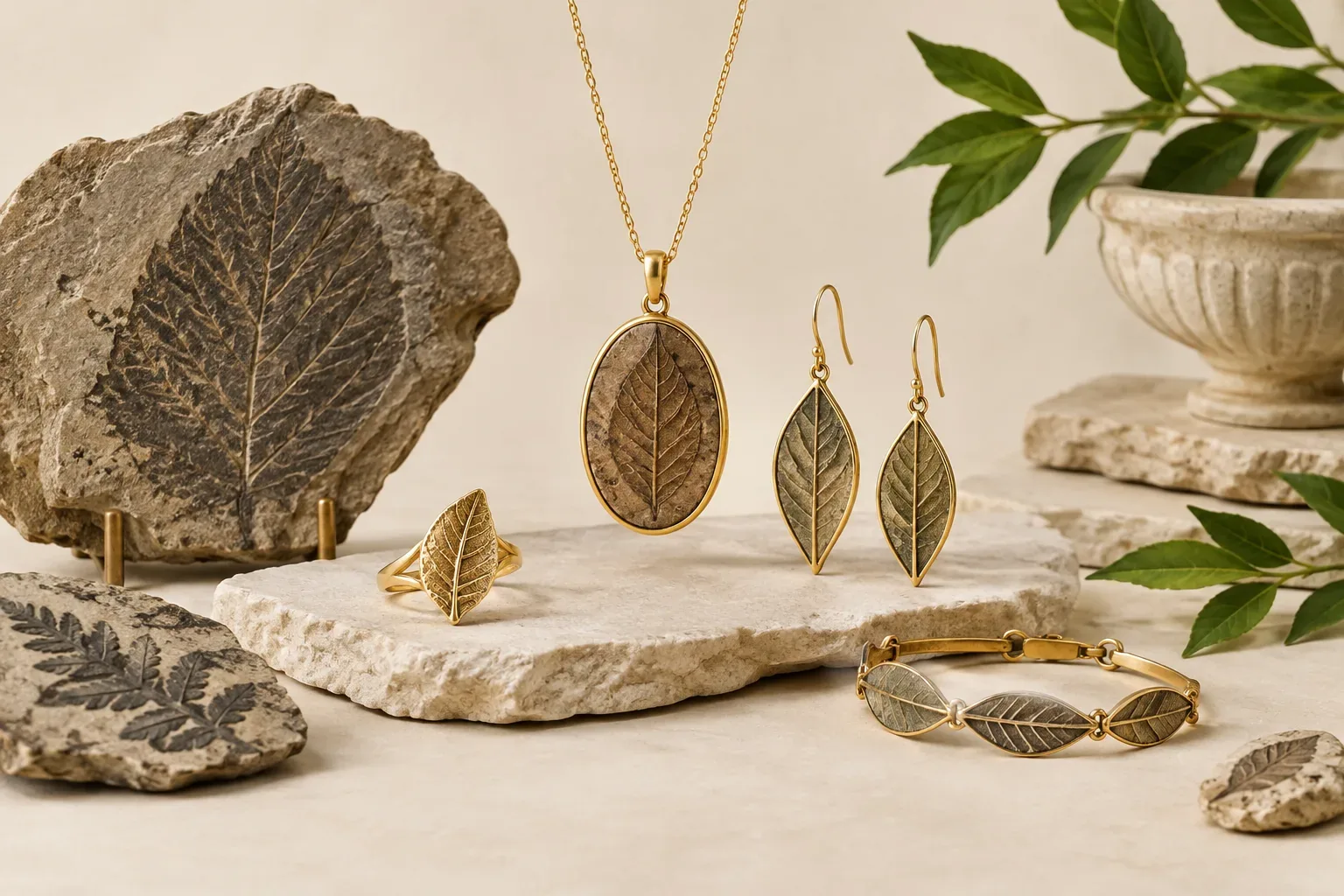
Fossilized plant material can appear in jewelry in several ways. Pieces may mount a fossil leaf or a slab of matrix that preserves leaf impressions as a pendant or brooch; jewelers also use polished cabochons of petrified wood or fossiliferous stone that include plant remains. In other instances, the leaf motif is rendered in metal, enamel, or carved into conventional gem materials as a representation rather than as a fossil specimen. An A-Z of Gemstones helps explain the range of natural materials used for jewellery and how organic mineralization creates stones that jewelers can set and polish for wearable forms (An A-Z of Gemstones; Victoria and Albert Museum).
Designs can be literal — a fossil slab set in a bezel — or interpretive: a gold or silver leaf shape laid over a fossil background, or a cameo or intaglio carved to suggest veins and midribs. Traditional sentimental forms such as lockets and mourning brooches occasionally incorporated natural specimens historically; museums and exhibitions that study jewellery context show how these forms circulated in particular social moments (Victoria and Albert Museum).
Assessing authenticity, treatments, and seller disclosure
If authenticity matters to you, ask sellers for clear information about what the material is and whether it has been treated, dyed, stabilized, or assembled from multiple pieces. Federal Trade Commission guidance for buyers of gemstones and pearls stresses the importance of accurate labelling and disclosure about treatments, imitations, and any enhancements that affect value or care (Federal Trade Commission). Reputable dealers should describe whether a piece is a true fossil specimen, a petrified wood cabochon, a composite, or simply a fossil-like motif in metal or resin.
Because plant fossils and petrified materials are porous or fragile compared with traditional faceted gems, treatments such as stabilization with resin or surface filling are common. That does not make a piece dishonest, but it does change how it should be valued and cared for. Request written descriptions and, where appropriate, a photograph of any marks, repairs, or adhesives used in the setting.
Practical and respectful selection or gifting guidance
Decide whether you want a specimen-based piece (a fossil leaf or petrified material) or a symbolic piece that uses leaf imagery. For a scientific specimen, look for provenance: where the fossil was found, whether it is part of a larger known deposit, and whether the seller complies with local and international laws governing the collection and sale of fossils. For a symbolic piece, focus on craftsmanship, the clarity of the motif, and how the design fits the recipient’s taste.
When gifting, be explicit about the intended meaning. If you want the gift to evoke "deep time" or environmental concern, state that so the recipient understands the sentiment and the origin story of the material. Avoid making universal claims about cultural or religious meaning; if a design uses a motif tied to a specific culture, learn and explain its source and whether the maker has appropriate cultural permission or consultative relationships.
Price and permanence: fossil-based pieces can vary widely in price depending on rarity, size, and treatment. If you or your recipient value longevity, choose a well-set piece where the fossil is protected from knocks and moisture; if the piece is primarily symbolic, prioritize materials and construction that suit everyday wear.
Wearing and caring for leaf fossil jewelry responsibly
Handle fossilized and petrified materials gently. Avoid strong cleaners or acids, and remove fossil-based pieces before swimming, bathing, or household cleaning when possible. Ask your seller about recommended cleaning and whether a piece has stabilizing resins that could be affected by heat or chemicals. For routine care, a soft dry cloth and careful storage away from harder gems and metals will reduce abrasion.
Be mindful of context when wearing pieces in settings that require cultural sensitivity. If a design references a particular culture’s motifs or ritual objects, learn about that design’s contemporary significance and avoid presenting the piece as a substitute for cultural practice. Clear provenance, respectful acknowledgement of origin, and support for makers from the relevant community are appropriate ways to wear such objects responsibly.
Closing note
Leaf fossil jewellery sits at the intersection of natural history, decorative practice, and personal meaning. Museums document a particular historical context for the use of fossils in European collecting and jewellery, while modern wearers attach new, varied significances. Careful attention to material disclosure, provenance, and respectful interpretation will help you choose and wear leaf fossil pieces that are both meaningful and responsible.
Frequently asked questions
What does leaf fossil jewelry symbolize?
Historically, museums show that fossils in jewellery signalled affiliation with collecting, scientific interest, or Victorian sentimental tastes; contemporary wearers often read leaf fossils as symbols of deep time, renewal, or environmental concern, but these modern meanings are personal interpretations rather than universal historical facts.
How can I tell if a fossil leaf in jewelry is real?
Ask the seller for documentation about material, provenance, and any treatments. Reputable dealers should disclose whether the piece is a genuine fossil or an imitation, and whether it has been stabilized, dyed, or assembled from multiple parts. Photographs and a written description help verify authenticity.
Are fossilized plant materials treated or fragile?
Many fossilized plant materials are stabilised, filled, or polished for use in jewellery; these treatments are common and legitimate but affect care and value. Handle such pieces gently, avoid harsh chemicals, and ask the seller for recommended cleaning instructions.
Is it appropriate to wear a fossil leaf design from another culture?
If a design references a specific culture’s motifs or ritual objects, research its current significance and prefer pieces made with consultative or beneficial relationships with that community. Avoid claiming sacred or ritual meanings you cannot document or respectfully explain.
What should I ask a seller before buying leaf fossil jewelry?
Request clear identification of the material, disclosure of any treatments, provenance or locality information if available, and guidance on care. If authenticity or rarity matters, ask for written confirmation and, for higher-value pieces, a report from a recognized lab or credible dealer.
Sources and further reading
- Bedazzled: A History of Jewellery — Victoria and Albert Museum
- An A-Z of Gemstones — Victoria and Albert Museum
- Buying Gemstones, Diamonds, and Pearls — Federal Trade Commission