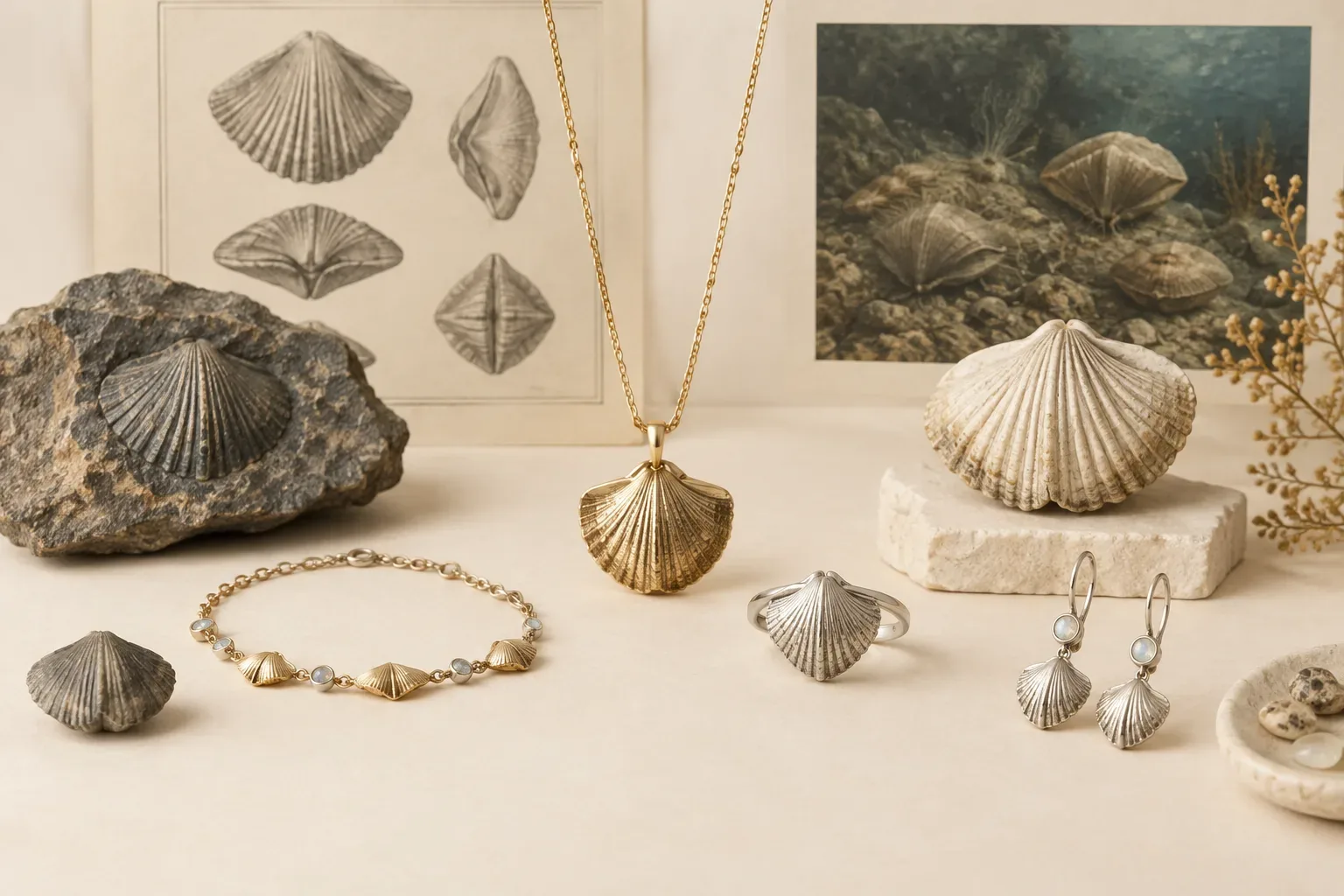
Meaning at a glance
Documented historical use of the brachiopod motif in major jewelry collections is limited; modern brachiopod jewelry is primarily a natural‑history and design choice rather than a long-standing religious or cultural symbol, and buyers should check provenance, disclosure of treatments, and makers' claims when selecting or gifting pieces.
Direct answer: what "brachiopod jewelry meaning" usually refers to
In short: there is little documented, culture‑specific history that assigns a fixed symbolic meaning to the brachiopod motif in traditional jewelry collections. Contemporary uses of brachiopod shapes or fossil specimens in necklaces, brooches, and rings are best understood as modern aesthetic or personal‑symbol choices inspired by natural history, rather than as an established ancient religious or cultural emblem. This article explains the limits of the historical record, separates documented evidence from later interpretations, and offers practical guidance for choosing and wearing brachiopod jewelry responsibly.
What the historical evidence says (and what it does not)
Major museum treatments of jewellery history emphasize how motifs and materials gain meaning through changing social contexts and tastes. The Victoria and Albert Museum's overview of jewellery history highlights how designs that seem timeless are often recent reinterpretations or revivals that reflect 19th–21st century collecting interests rather than continuous ancient practices. When curators trace jewellery forms and motifs, they document provenance, workshop traditions, and the cultural meanings recorded with objects in collections; the V&A resources note that meanings shift as objects move between contexts.
Applied to the brachiopod motif, the museum literature consulted for this guide does not provide evidence of a long, continuous, or widely attested symbolic use of brachiopod shells across named historical cultures. In other words, the sources used here do not show that brachiopods had a consistent, named religious or civic symbolism in ancient or medieval jewellery collections preserved in museums like the V&A. Instead, the motif appears primarily in contexts shaped by modern natural‑history collecting, scientific interest, and aesthetic revivalism.
Separating documented historical meanings from modern personal interpretations
Documented historical meanings are those that appear in primary records, museum catalogues, or contemporary accounts tied to a specific culture, workshop, or period. The authoritative museum overview used here underscores the need for that documentary link when assigning historic symbolism to a design. Because the sources consulted do not identify a named culture or period that consistently attributed a particular meaning to brachiopods in jewellery, any historic symbolic claims for such items should be treated cautiously and verified against object‑level records.
Modern personal interpretations, by contrast, are what most wearers and makers now ascribe to brachiopod motifs. These contemporary meanings often arise from associations with natural history—ideas such as resilience, geological time, scientific curiosity, deep time, or simply a love of seashell aesthetics. These are valid personal or designer meanings, but they are not documented historical attributions unless supported by object provenance or written testimony. Presenting modern symbolic readings as personal or contemporary avoids conflating them with an unverified ancient tradition.
How the motif and fossil material appear in jewellery
Designers and makers incorporate brachiopods in several practical ways: they use fossil specimens set as small cabochons or bezel‑mounted stones; they reproduce the shape in cast metal as pendants, brooches, and charms; they carve or laser‑engrave the silhouette into materials such as bone, horn, or contemporary resins; and they use stylized brachiopod forms as patterning in metalwork or enamel. Museum discussions of gemstones and materials emphasize that jewellery has long combined natural specimens and crafted elements, and modern makers continue that practice by foregrounding fossil texture and form.
Gemstone and material identification matters when fossils or fossilized matrices are part of a piece. The Victoria and Albert Museum's A–Z of Gemstones explains how museums and collectors record materials and treatments to understand an object's appearance and durability. For buyers, that means asking makers or sellers how a fossil was prepared, whether it has been stabilized or glued to a backing, and what other materials are present.
Practical and respectful selection or gifting guidance
Start by deciding whether you or the recipient value the piece for scientific interest, aesthetic appeal, or personal symbolism. If the meaning you want to convey is personal—an interest in paleontology, the sea, or endurance—choose makers who clearly state that interpretation so recipients understand it as contemporary sentiment rather than a claimed ancient tradition.
Check provenance and disclosure. The Federal Trade Commission advises consumers to look for honest descriptions of gemstones, treatments, and imitations. When a piece includes fossil material or gemstone substitutes, ask the seller to disclose any treatments, stabilizers, adhesives, or composite work. Clear disclosure protects both buyer and maker and prevents accidental misrepresentation of an object's nature.
Prefer transparent sourcing and documentation. While museum work demonstrates that materials and meanings change through time, it also shows the value of provenance for understanding an object. If provenance matters to you or your recipient, ask for documentation: where was the fossil collected, who prepared it, and how has it been handled since collection? For many contemporary makers, a short note about sourcing and preparation is standard practice and enhances the piece's story.
Respect cultural contexts. If a design or material clearly derives from a named culture or traditional craft, research that context and seek makers who practice or collaborate respectfully. The V&A reminds readers that jewelry's social meaning shifts; conversely, adopting a motif that carries specific cultural or ritual significance for a living community demands care and consent. When in doubt, prefer pieces described as inspired by nature or as contemporary interpretations rather than as reproductions of culturally sensitive designs.
Care and consumer protections to keep in mind
Treat fossil material with appropriate care: fossils embedded in jewellery are often more fragile than hard gemstones. Ask the maker about recommended care routines and whether the fossil has been consolidated or requires special handling. Museum descriptions of materials and treatments show that knowing an object's composition guides conservation and daily wear decisions.
Be aware of imitations and treatments. The FTC guidance on buying gemstones, diamonds, and pearls emphasizes that sellers must disclose treatments, enhancements, and imitations. Apply the same standard when purchasing jewellery containing fossil material: ask if the specimen is natural or stabilized, whether there are composite elements (for example, fossils mounted on a matrix or resin), and whether any polishing or dyeing has been applied.
Choose a reputable maker or seller. Reputation, clear photographs, condition reports, and written return policies foster trust. If a seller claims an object has historical significance beyond the piece's documented provenance, request the supporting documentation. Museums' cataloguing practices illustrate how provenance and records underpin reliable interpretation; buyers should seek comparable transparency.
A final note on meaning and conversation
Brachiopod jewellery meaning today is a matter of personal, designer, or collector intention rather than a single, documented cultural code. Wearing or gifting such a piece offers an opportunity to explain what it means to you—whether that is an admiration for natural forms, a nod to geological time, or simply an appreciation for unusual texture and shape.
If you plan to present a brachiopod piece as a symbol—of memory, endurance, or identity—make the symbolic intent explicit to avoid implying a historical or cultural authority the object does not have. That clarity respects both the object and the recipient.
Frequently asked questions
Are brachiopods the same as seashells used in jewellery historically?
Brachiopods are a type of shelled marine organism whose shape inspires jewellery designs, but major museum resources used for this guide do not document a continuous historical tradition that equates brachiopods with widely recognized seashell symbolism across named historical cultures. Contemporary jewellery that uses fossil shells typically reflects modern aesthetic or collecting interests rather than a single ancient practice.
Did any specific culture historically give brachiopods a religious meaning?
The museum literature consulted for this article does not identify a named culture or period that consistently attributed a religious meaning to brachiopods in jewellery. If a seller or source claims specific ancient religious symbolism for a piece, request the provenance or documentary evidence that supports that claim.
How can I tell if a fossil brachiopod in a piece is original or reconstructed?
Ask the seller for written disclosure about material composition and any treatments. The Federal Trade Commission advises buyers to request information on enhancements, stabilizing treatments, and imitations when purchasing gemstones and natural materials. Reputable makers will state whether a fossil is natural, consolidated, or a composite.
Are fossil specimens safe to wear in everyday jewellery?
Fossil material is often more fragile than most gemstones; whether a piece is suitable for daily wear depends on how the fossil has been prepared and set. Ask the maker about recommended wear and care, and whether the specimen has been stabilized. Museum guidance about materials and conservation underlines that knowledge of composition informs care.
If I want to give brachiopod jewellery as a symbolic gift, how should I explain it?
Be explicit about your intended meaning. Since modern attributions (such as resilience, a love of natural history, or geological time) are not the same as documented ancient symbolism, explaining the gift's personal or designer meaning helps the recipient appreciate it without assuming an unverified historic authority.
Where can I learn more about jewellery materials and provenance?
Museum resources such as the Victoria and Albert Museum's histories of jewellery and its A–Z of gemstones are useful starting points for understanding how materials and meanings are recorded, and the Federal Trade Commission provides practical consumer guidance on disclosures for gemstones and treated materials.
Sources and further reading
- Bedazzled: A History of Jewellery — Victoria and Albert Museum
- An A-Z of Gemstones — Victoria and Albert Museum
- Buying Gemstones, Diamonds, and Pearls — Federal Trade Commission