Meaning at a glance
Documented museum records do not support a single ancient cultural symbolism for crinoid fossils; natural forms and fossil materials have been used in jewellery at different times, and modern buyers should separate documented history from personal meanings while checking authenticity, treatment disclosure, and following sensible care guidelines.
What the historical evidence shows
Neither of the museum overviews provided in the approved sources names crinoids as a widely documented symbolic motif with an unbroken cultural tradition. The Victoria and Albert Museum’s surveys of jewellery history emphasize that jewellers have repeatedly drawn on natural forms and stone materials, and that meanings attached to motifs change with time and context. Use those general points from the Victoria and Albert Museum to frame any claims about fossils or natural forms: museums document the technique and popularity of natural motifs rather than a single, continuous symbolic meaning across cultures.
Because the authoritative museum summaries focus on broader patterns in jewellery use and on gemstone identification rather than on one fossil type, buyers and researchers should treat specific historic claims about crinoid symbolism with caution. If a seller or label asserts a precise historical cultural meaning for a crinoid motif, ask for primary evidence—museum references, archaeological reports, or scholarly citations—because overview histories do not automatically validate a single ancient symbolic lineage (Victoria and Albert Museum).
Separate documented meanings from modern personal interpretations
Documented meanings: the accepted museum literature documents how natural motifs and organic materials enter jewellery practice and how gem materials are classified and treated, but does not establish a consistent, named religious or cultural symbolism specifically for crinoids. Where a historic culture did use fossils in ornaments, such claims should be sourced to archaeological or museum records; when those records are not cited, the claim remains unverified by the referenced museum overviews (Victoria and Albert Museum).
Modern personal interpretations: contemporary wearers and designers commonly ascribe fresh meanings to fossils—ideas such as deep time, endurance, or a connection to the sea. These are valid personal or contemporary symbolic readings, but they are modern layers of meaning rather than documented historical consensus. Make a clear distinction when discussing a piece: label historic evidence separately from the modern narrative and treat both as meaningful in different ways.
How the crinoid motif and fossil material appear in jewellery today
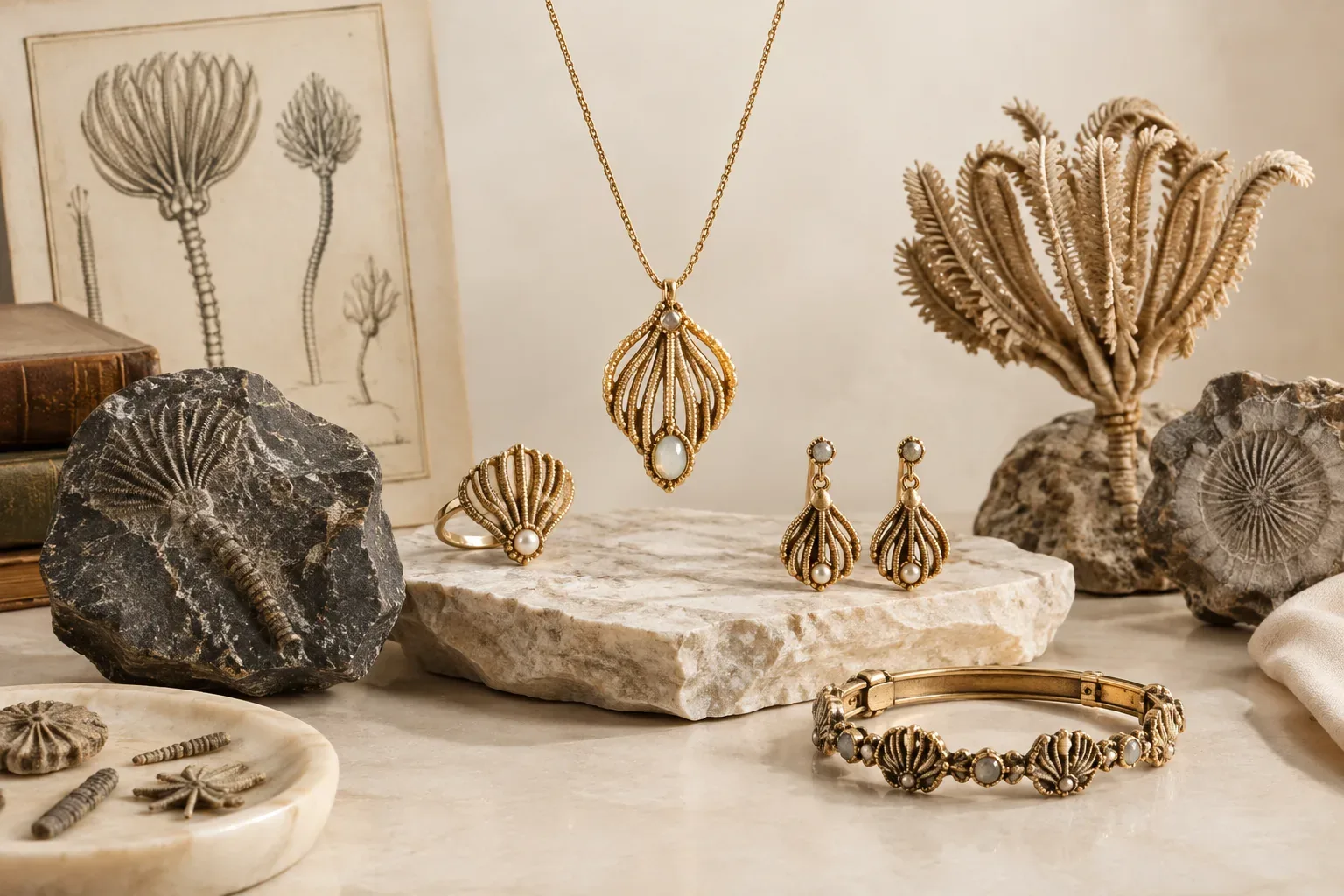
In contemporary jewellery markets, crinoid fossils are most often used as decorative materials: whole cross-sections or polished segments can be set into pendants, rings, or beads; fossil fragments can appear in cabochons and inlaid work; and artisan makers may shape or bezel-set pieces to highlight a fossil’s pattern. These uses reflect the broader pattern noted by the Victoria and Albert Museum that makers adopt natural forms and unique materials for their visual and tactile appeal rather than as a guarantee of historic symbolic meaning.
When a seller uses the word motif rather than material, they may mean a stylised crinoid design—an engraved or cast emblem inspired by the organism—rather than fossil material itself. Be clear whether you are buying the fossilized material or a motif inspired by it, because value, treatment, and care differ between actual fossil specimens and metal/stone representations.
Authenticity: how to verify crinoid fossils and treated materials
Ask the seller for a clear description of material. Good listings and reputable dealers identify whether a piece contains an actual fossil, an imitation, a cast or carving, or a stylised motif in metal. If a sale claim mixes historic symbolism with material claims, request documentation or provenance to support both the material identification and the provenance claim.
Use visual and tactile checks: a seller should provide clear photographs that show texture, cross-section, and any polishing or matrix. If you can inspect in person, look for natural irregularities and growth patterns that are consistent with fossil structure; be aware that some imitations and stabilized composites can look convincing. For valuable or ambiguous items, consider an independent appraisal by a qualified gemmologist or a fossil specialist who can confirm identity and any treatments.
Treatments, imitations, and required disclosures
The Federal Trade Commission requires sellers to disclose treatments, enhancements, and imitations for gemstones and similar materials. While the FTC guidance is framed around gemstones, its principle applies in consumer practice: ask whether a fossil has been dyed, stabilized with resins or epoxy, backed, or set into composite materials and expect honest disclosure (Federal Trade Commission).
Common trade practices include stabilising porous fossil material with clear consolidants to make it wearable, dyeing to enhance contrast, or embedding fragments in resin for durability. These are legitimate techniques when disclosed. If a seller claims a piece is untreated and natural but will not specify handling, that is a red flag—insist on confirmation in writing or seek another dealer.
Care and conservation for crinoid jewellery
Treat fossilized materials with the same caution you would give fragile or porous stones. Avoid prolonged exposure to household chemicals, perfumes, and cleaning agents. Clean gently with a soft, dry cloth or with a soft brush and mild, pH‑neutral soap and water if necessary, and dry thoroughly. Do not use ultrasonic cleaners or harsh abrasives on specimens that are stabilized with consolidants or that have visible cracks or matrix.
Store crinoid pieces separately from harder stones and metals to prevent scratches and impacts, and keep them away from extreme heat which can degrade resins or cause crazing in composites. For high-value or historically significant specimens, consult a conservator or a museum-quality care guide before attempting any home cleaning.
Practical and respectful selection or gifting guidance
Be explicit about intent. If you are buying or gifting crinoid jewellery because of a perceived cultural or spiritual meaning, do so with humility and transparency: ask the recipient whether they prefer a piece for its aesthetics, its natural history, or for an attached cultural story, and make your reasoning part of the gift conversation. Avoid claiming an unverified historical or religious provenance as if it were established fact.
Choose with information in hand. Prioritise sellers who describe materials clearly, who disclose treatments, and who provide return policies or third‑party verification for higher‑value purchases. For a meaningful gift, consider the piece’s durability and care requirements relative to the recipient’s lifestyle; a delicate fossil pendant may not be well suited to daily wear, while a carefully stabilized and set pendant can be both wearable and symbolic.
Respect cultural contexts. If a particular design or motif is presented as belonging to a living culture, ask for verified provenance and, when appropriate, consider supporting makers from that culture directly. If the item is sourced from a dig or a protected site, confirm legal and ethical sourcing: many museums and consumer guidance resources emphasise transparent provenance as an ethical baseline (Victoria and Albert Museum).
Frequently asked questions
Are crinoids the same as gemstones?
Crinoids are fossilized remains of marine organisms, not traditional gemstones; they are often used in jewellery as fossil materials or as motifs. Museum overviews classify materials by origin and treatment rather than by an assumed symbolic status, so treat crinoid material as a distinct category of natural ornamentation (Victoria and Albert Museum).
How can I tell if a crinoid piece is real or an imitation?
Ask the seller for explicit material descriptions and clear photos showing texture and cross section, and request disclosure of any stabilisation or resin. For high-value or uncertain items, obtain an independent appraisal from a qualified gemmologist or fossil specialist; the Federal Trade Commission recommends transparent disclosure of treatments and imitations.
Do sellers have to disclose treatments like dyeing or stabilising?
Yes: consumer guidance from the Federal Trade Commission stresses that sellers should disclose treatments, enhancements, and imitations. If a seller will not confirm whether a piece has been stabilised, dyed, or embedded in resin, consider that a warning sign and ask for written confirmation or look elsewhere.
What care does crinoid jewellery need?
Treat fossil jewellery gently: avoid harsh chemicals, ultrasonic cleaners, and prolonged sunlight or heat. Clean with a soft cloth or a soft brush and mild soap if needed, dry thoroughly, and store separately from hard stones and metals to avoid abrasion. For historically important or delicate specimens, consult a conservator.
Is there an ancient cultural or religious meaning attached to crinoid jewellery?
Museum resources do not document a single, widely recognised ancient symbolism specific to crinoids. While some cultures may have used fossils in ornament, the authoritative museum overviews emphasise shifting motifs and meanings across time and place, and any specific cultural claim should be supported with direct archaeological or museum citations (Victoria and Albert Museum).
What should I consider when gifting crinoid jewellery?
Be transparent about material and treatments, consider the recipient’s lifestyle and how much care the piece will need, and explain whether your gift is chosen for aesthetic, natural‑history, or personal symbolic reasons. If a seller attributes a cultural meaning to a piece, ask for provenance and avoid presenting unverified historic claims as fact.
Sources and further reading
- Bedazzled: A History of Jewellery — Victoria and Albert Museum
- An A-Z of Gemstones — Victoria and Albert Museum
- Buying Gemstones, Diamonds, and Pearls — Federal Trade Commission