Meaning at a glance
This article explains the documented history and changing contexts of the crinoid motif, separates historical evidence from modern interpretations, and offers practical guidance for choosing and wearing crinoid jewelry responsibly.
Quick answer
Crinoid jewelry meaning is chiefly a modern, personal and aesthetic use of fossil imagery rather than a single, documented historical symbol. Museums and curators show that jewelry has long borrowed from the natural world, but there is limited direct historical evidence that specific cultures assigned a fixed symbolic meaning to crinoids. Today, makers and wearers choose crinoid motifs for reasons ranging from an interest in natural history and deep time to simple visual appeal; when buying or gifting, verify authenticity, ask about treatments or stabilizing mounts, and match the piece to the recipient’s interests and values.
What the historical record shows (and what it does not)
The most reliable, documented statements about jewelry and natural motifs come from museum scholarship rather than isolated claims about a single fossil type. The Victoria and Albert Museum (V&A) frames jewelry as an object class whose motifs reflect shifting social tastes and scientific interests, and that natural-history subjects recur in different periods and places as collectors and makers respond to cultural change. That institutional perspective helps explain why fossil forms sometimes appear in ornaments, particularly when interest in natural history is strong.
However, there is little in mainstream museum cataloguing to support a claim that any particular historical culture — for example, an ancient Mediterranean society or a specific indigenous tradition — universally used crinoid fossils as a distinct religious or civic emblem. Where museums and scholarly exhibitions document natural motifs, they usually treat those motifs in broad categories (flora, fauna, geological forms) and highlight changing contexts rather than a single, continuous symbolic meaning for a single fossil type. In short: the historical record documents the broader pattern of natural motifs in jewelry (as described by the Victoria and Albert Museum) but does not provide a stable, cross-cultural symbolic canon for crinoids specifically.
Separating documented historical meanings from modern interpretations
Documented historical meanings for motifs are those that appear in primary sources, museum records, contemporary inventories, or clear cultural practice. For crinoids, such documentation is sparse: museums like the V&A document the appearance of natural-history motifs in jewelry and how those motifs reflect social interests, but do not provide firm evidence that crinoids carried a distinctive, widely recognized symbolic meaning in past cultures.
Modern interpretations are therefore best understood as contemporary layers of meaning that individuals and makers apply to the crinoid form. People today may wear crinoid jewelry to signal an interest in paleontology, to mark a love of the sea or deep time, to reference resilience or continuity, or simply because they like the pattern of a fossilized stem. These modern meanings are valid as personal or stylistic choices, but they should not be presented as continuous historical truths unless independent archival or museum evidence supports that claim. When you describe the symbolism of a crinoid piece, make clear whether you are reporting documented history or offering a modern, personal interpretation.
How the motif and fossil material appear in jewelry
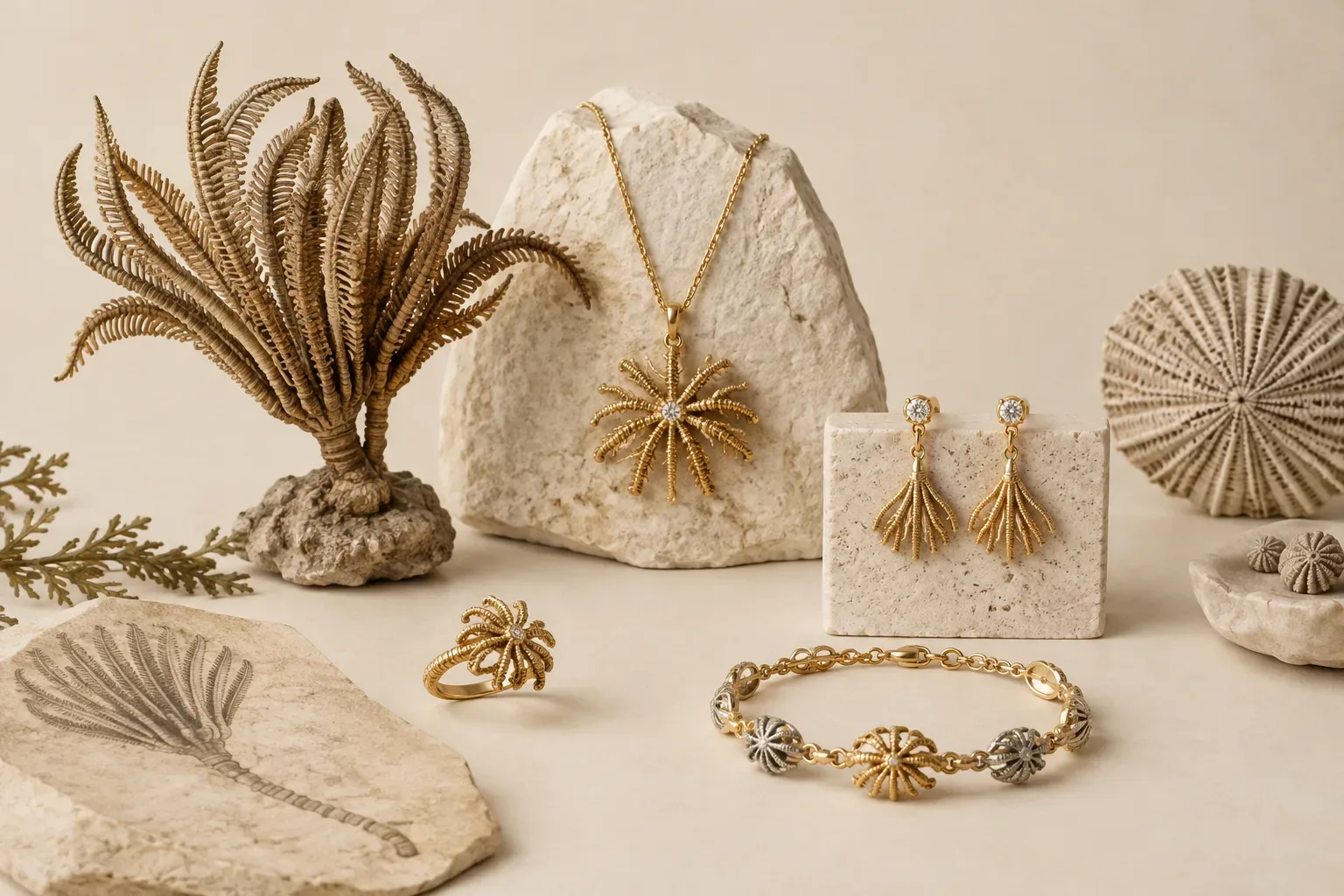
Contemporary jewelers and lapidaries use crinoid material in several recognizable ways. Fossil crinoid stems may be polished and set as cabochons, sliced to reveal internal columnal patterns, inlaid as decorative discs, or left with natural fracture surfaces and framed in metal. The radial, columnal pattern of many crinoid fossils lends itself to small, graphic pendants and beads as well as to larger, statement brooches or cuffs.
Designers also render the crinoid motif without actual fossil material, using engraved or cast metal, enamel, or gemstone mosaics that echo the star-like cross-sections and segmented stems of crinoids. In some pieces a small fossil fragment is bezel-set or resin-stabilized and then mounted in silver or gold. The material choices and techniques vary by maker, but the essential distinction for buyers is whether the piece contains an authentic fossil, a stabilized fossil (where consolidants or resins have been used), or a purely symbolic motif made from conventional gem or metalwork.
Practical guidance for selecting and gifting crinoid jewelry
Ask about authenticity and treatments. The Federal Trade Commission (FTC) advises buyers to seek clear disclosure about treatments, imitations, and enhancements when purchasing gemstones and related materials. When a seller presents a crinoid fossil as part of jewelry, ask whether the fossil is natural, stabilized with resin or other consolidants, dyed, assembled from fragments, or a cast or imitation. Reputable sellers will disclose such information readily.
Choose the right format for the recipient. If your recipient is a fossil enthusiast, a well-documented, lightly treated specimen set in a durable mount may be appreciated. For someone who values design over scientific authenticity, a stylized metal motif or an inlay that references crinoid patterns may be a better choice. Consider wearability: small pendants, studs, and rings may subject fragile fossil material to knocks; bezel settings and protective metal collars provide extra security.
Consider provenance and legality. Fossils have different legal and ethical statuses depending on where and how they were collected. Ask sellers about provenance and whether collection complied with local laws and museum best practices. If you are unsure, favor fossils sourced from commercial suppliers with written provenance and documented collecting permissions rather than unlabeled material.
Respect cultural contexts and avoid overclaiming. Because museums show that natural motifs shift meaning across cultures and periods, do not ascribe sacred or ancestral symbolism to crinoid pieces unless there is specific, documented evidence linking that fossil form to a community’s traditions. When in doubt, describe a piece as inspired by natural history or as a fossil motif rather than assigning an unverified cultural significance.
Balance care with use. Fossil material can be brittle. For everyday wear choose pieces with protective settings and avoid exposing fossils to acids, extreme heat, or ultrasonic cleaners. For heirloom or scientifically valuable specimens, consider keeping the fossilized material in a collection setting and commissioning reproductions for frequent wear.
Stylistic notes and final considerations
Crinoid imagery works well when you match the object’s aesthetic to its intended meaning. If the goal is to emphasize natural history and science, display provenance and any relevant collecting notes alongside the piece when gifting. If the goal is fashion or personal symbolism, choose a design language—minimal, ornate, modernist—that complements the recipient’s style.
Remember that meaningful jewelry is often meaningful because of context. A crinoid pendant given to a geology student will carry a different message from the same pendant given as a fashion accessory. Make your intention explicit in a short note when you give the piece and, where appropriate, include care instructions and information on treatment or provenance so the recipient can make informed decisions about wear and conservation.
Frequently asked questions
What exactly is crinoid jewelry?
Crinoid jewelry uses either actual fossil fragments of crinoids (a type of marine echinoderm) or design motifs inspired by their segmented stems and star-like cross-sections. Pieces range from genuine fossil cabochons and inlays to cast metal or enamel motifs that reference the fossil form.
How can I tell if a crinoid fossil in jewelry is authentic or treated?
Ask the seller for disclosure about treatments and stabilizing materials. The Federal Trade Commission (FTC) advises buyers to request clear information about enhancements, imitations, and treatments for gemstones and related materials. Reputable sellers will state whether a fossil is natural, resin-stabilized, dyed, assembled from fragments, or an imitation.
Are there cultural or religious meanings I should be aware of before gifting crinoid jewelry?
There is limited museum documentation tying crinoids to a specific cultural or religious symbolism. Museums emphasize that natural motifs change meaning across cultures and periods. Avoid assigning an unverified sacred meaning to a crinoid piece; describe it instead as inspired by natural history unless you have clear evidence linking it to a community tradition.
Is fossil jewelry durable for everyday wear?
Fossil material can be brittle. For everyday wear choose pieces with protective settings such as bezels or metal collars, and avoid exposing fossils to chemicals, extreme heat, or ultrasonic cleaners. For fragile or scientifically valuable specimens, consider wearing a reproduction and keeping the original in a protective collection.
What should I ask a seller when buying crinoid jewelry online?
Request high-resolution photos, detailed provenance or source information, disclosure of any treatments or stabilizing materials, the type of setting used, shipping insurance, and a clear return policy. If legal or ethical collection is a concern, ask for written provenance or collecting permissions.
Sources and further reading
- Bedazzled: A History of Jewellery — Victoria and Albert Museum
- An A-Z of Gemstones — Victoria and Albert Museum
- Buying Gemstones, Diamonds, and Pearls — Federal Trade Commission