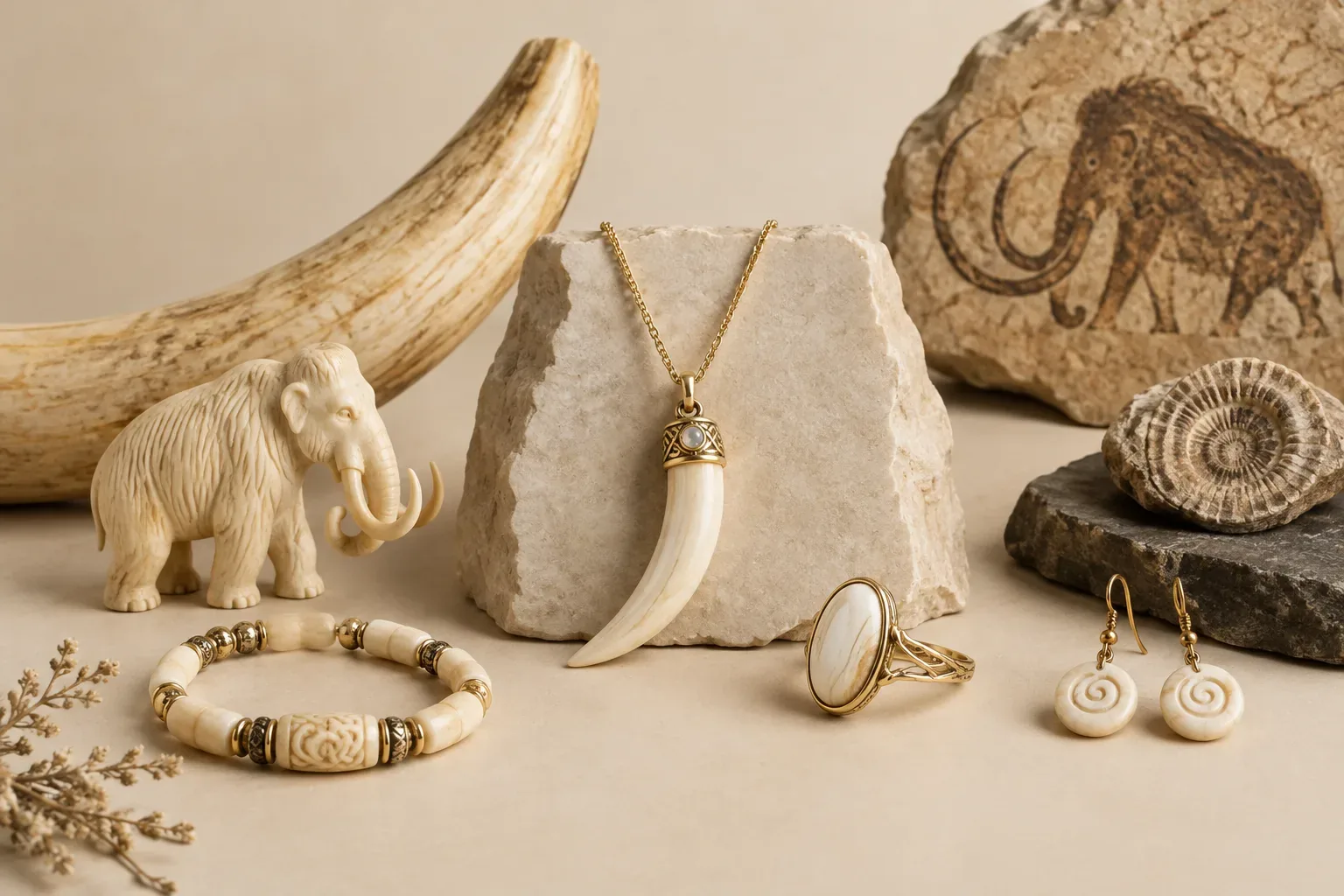
Meaning at a glance
Mammoth ivory jewelry meaning should be understood as a mix of documented material history and later cultural interpretation: museum evidence shows ivory and other organic materials have been carved and worn from prehistoric to modern times (Victoria and Albert Museum), but specific symbolic uses tied uniquely to 'mammoth ivory' are not well documented; modern meanings are often personal or contemporary cultural readings. This guide separates historical evidence from modern interpretation and gives practical selection and gifting advice.
Direct answer — the thesis in one paragraph
Mammoth ivory jewelry meaning is best approached in two parts: documented material and use on the one hand, and modern symbolic interpretation on the other. Museums such as the Victoria and Albert Museum present ivory and other organic materials as recurring media for beads, pendants and carved objects across human history, but they do not attribute a single, universal sacred meaning to 'mammoth ivory' itself. Much of what people now read as the symbolic content of mammoth ivory is a recent development — a cultural layer added by contemporary makers, collectors and markets — so treat historical claims and modern interpretations separately when choosing, gifting or wearing pieces.
What museums document: materials, techniques and periods
Museum surveys of jewellery history emphasize that humans have used organic materials — bone, shell, teeth and various forms of ivory — from the earliest periods of personal adornment through medieval and modern times. The Victoria and Albert Museum frames jewellery history across long periods, noting continuity in techniques such as carving, inlay and bead-formation and in contexts of display, identity and exchange. That institutional perspective is useful: it shows that the forms in which ivory appears (beads, pendants, carved figurines and inlay) are longstanding technologies and aesthetic choices.
When museum catalogues and exhibitions discuss 'ivory' they usually treat the material category broadly and focus on technique, style and provenance rather than on a single symbolic meaning. Collections labels and curatorial essays emphasize how materials were worked and circulated in particular times and places, allowing us to trace change in use and taste rather than to recover a single, fixed significance for any type of ivory.
Documented uses and cultural contexts — separate and precise
The historical record as curated by major museums is best read at the level of culture and period. Museum narratives typically identify objects by their archaeological or collection context (for example, Paleolithic adornment, Bronze Age inlay work, medieval religious objects, eighteenth- and nineteenth-century ornamental carvings, and contemporary studio jewellery). That means statements about symbolic meaning should be tied to those precise contexts rather than to the material alone.
For example, labels and scholarship assembled by institutions such as the Victoria and Albert Museum discuss how carved organic materials function within a given culture’s visual language or ritual practice, and how tastes changed in response to trade and technology. These are period- and culture-specific claims. By contrast, there is little in standard museum cataloguing that supports the idea of an ancient, cross-cultural symbolic meaning that applies only to 'mammoth ivory' as opposed to other ivories or carved organics.
What is historical documentation vs what is modern interpretation
Historical documentation is tangible provenance, archaeological context, or contemporary textual evidence that ties a specific object or motif to a time, place or practice. Museums rely on those kinds of data when they describe an item's role and meaning. When such evidence links an ivory object to a particular ritual or status function, that linkage is presented as specific to that culture and period.
Modern interpretations often layer new meanings onto old materials. In the case of mammoth ivory, modern makers, collectors and ethical discourses have generated contemporary associations — for example, attraction to Ice Age antiquity, ideas about sustainability when compared with modern elephant ivory, or the romantic appeal of recovered fossil material. These are legitimate contemporary meanings, but they are modern layers; they are not the same as documented historical or religious use unless supported by period evidence.
How the motif and material appear in jewellery today
In contemporary jewellery practice, 'mammoth ivory' functions primarily as a material choice and a surface for carving, much as other ivories have. Makers use sections of tusk for carved medallions and cameos, for three-dimensional animal or figurative carvings, for beads strung into necklaces, and as inlay panels in metalwork. Museums’ treatments of carved organic materials describe the same technical practices: carving, polishing, inlay and setting alongside metals and gems.
Designers also use the visual vocabulary of ivory — pale creamy surfaces, linear grain, and the potential for detailed carving — to create motifs that reference antiquity, wilderness, or natural history. In many contemporary pieces gemstone accents are combined with carved ivory sections, and traditional jewelry settings are adapted to hold carved elements securely. The appearance of mammoth ivory in modern jewellery therefore parallels long-standing jewelry techniques recorded in museum collections, while the motifs applied (for example, Ice Age animals or abstract patterns) reflect current tastes.
Responsible selection: provenance, disclosure and legality
Because the material and its trade are ethically charged, responsible selection depends on clear provenance and seller disclosure. The Federal Trade Commission recommends that sellers disclose treatments, imitations and relevant material information about gemstones and organics; that principle applies equally to ivory and fossil ivory. Ask sellers for documentation that states the source of the material, whether it is fossil mammoth ivory or modern elephant ivory, and whether any chemical stabilizers, coatings or reconstructions are present.
Laws and regulations about ivory and fossil ivory vary by country and sometimes by state or region. Rather than relying on general statements, check the rules that apply where you buy, import, own or gift the piece. When provenance documentation is unavailable or uncertain, consider choosing an alternative material or purchasing from dealers who provide verifiable lab reports or museum-standard provenance records.
Practical and respectful gifting guidance
When gifting a piece that contains mammoth ivory, match the choice to the recipient’s values and to the social context. If the person cares about conservation or ethical sourcing, ask the seller for clear documentation and be ready to explain what you learned. If the gift is meant to evoke antiquity or a connection to Ice Age natural history, make that explicit so the recipient understands the cultural frame you intend.
Avoid presenting material claims about ancient ritual significance unless you can point to specific, cited historical evidence from reliable museum catalogues or scholarship. Personalized meanings are appropriate and often the best reason to gift a piece, but keep those separate from assertions that the material carried the same symbolic value in a past culture unless you can document that with period-specific sources.
Care, conservation and display
Ivory and fossil organic materials are sensitive to humidity, heat and strong light. Store mammoth ivory jewellery in stable, moderate conditions and avoid rapid swings in temperature or moisture that can cause shrinking or splitting. Clean gently with a soft, dry cloth; avoid soak-cleaning or strong solvents unless a qualified conservator has advised that treatment.
If a piece has been stabilized (for example, impregnated with resin) or reconstructed, ask the seller for care recommendations specific to that treatment. Museums document that conservation interventions change how an object should be stored and displayed; follow professional guidance when in doubt.
Alternatives and design considerations
There are many widely accepted alternatives that capture ivory’s visual qualities without the ethical and legal uncertainties. Vegetable ivory (tagua), carved bone, certain resins, and responsibly sourced fossilized organics can provide similar color and carving properties. If you are designing a piece with a symbolic intent, consider whether the meaning you want to convey depends on the material itself or on the design and context. Often the design and the story accompanying the piece make the symbolic meaning clear and respectful.
Choosing a reputable maker who is transparent about materials and methods will give you the best combination of aesthetic satisfaction and ethical confidence. Museums’ discussions of materials emphasize technique and provenance; in practice, these are the same priorities collectors and givers should adopt.
Closing: reading meaning responsibly
Understanding mammoth ivory jewellery meaning requires distinguishing between what museums and catalogues can document — technical use, provenance and culture-specific functions — and what contemporary makers and buyers project onto the material. The Victoria and Albert Museum’s approach to jewellery history is a useful model: focus on evidence tied to a time and place, and treat later symbolic layers as modern cultural readings unless supported by period sources.
If you love the material or are considering it as a gift, demand transparent provenance, follow disclosure guidance (including that recommended by the Federal Trade Commission for treated and imitation materials), and frame your meanings as contemporary and personal unless you can cite precise historical evidence linking the motif to a past ritual or belief.
Frequently asked questions
Is mammoth ivory legal to buy and sell?
Laws vary by country and sometimes by local jurisdiction. Because regulations differ, check the legal requirements that apply where you are buying, importing or owning material. Always ask sellers for clear provenance documentation, and consult official authorities or customs agencies if you need certainty.
How can I tell mammoth ivory from elephant ivory?
Visual differences can be subtle and may require specialist examination. Dealers should provide provenance or laboratory reports that identify species or fossil status. When in doubt, request third-party testing or avoid purchase; the Federal Trade Commission recommends clear disclosure of material treatments and imitations in the market.
Does mammoth ivory carry a traditional symbolic meaning?
Museum documentation typically ties symbolic meaning to specific cultures and periods rather than to a raw material in general. While Ivory as a material appears in many cultural contexts, there is little museum-based evidence that 'mammoth ivory' alone carried a single universal symbolic meaning separate from local practices. Contemporary symbolic uses are often modern interpretations.
What should I ask a seller before buying a mammoth ivory piece?
Ask for documented provenance, any conservation treatments or stabilizers applied, species identification or laboratory reports, and a statement about legal compliance. Also request care instructions specific to any treatments. Transparent, documented answers are a mark of a reputable seller.
Are there ethical alternatives that look like ivory?
Yes. Vegetable ivory (tagua), carved bone from responsibly sourced materials, lab-created resins and other synthetics can replicate the look and carving characteristics of ivory. Choosing an alternative is a common solution for those who want the aesthetic without the ethical or legal complexities.
Sources and further reading
- Bedazzled: A History of Jewellery — Victoria and Albert Museum
- An A-Z of Gemstones — Victoria and Albert Museum
- Buying Gemstones, Diamonds, and Pearls — Federal Trade Commission