Meaning at a glance
This guide explains documented historic contexts for teeth and naturalia in jewellery (as represented in museum collections), separates those records from contemporary personal symbolism, and gives practical, respectful advice for verifying authenticity, understanding treatments and imitations, and choosing and caring for shark tooth jewellery.
Quick answer
Shark tooth jewellery buying guide: Use museum-based historical evidence to understand how animal teeth have been used in jewellery across periods, treat modern symbolic meanings as personal or contemporary rather than universal, and follow practical steps—ask sellers for provenance and treatment disclosure, prefer reputable dealers, and care for pieces gently—to select and care for shark tooth jewellery. This approach follows the kind of historical and material guidance found in Victoria and Albert Museum collections and the consumer-protection emphasis of the U.S. Federal Trade Commission.
What the historical record shows (and how scholars document it)
Museum collections and scholarship—including material held and interpreted by the Victoria and Albert Museum (V&A)—demonstrate that humans have incorporated animal parts such as teeth, claws and shells into personal adornment across many times and places. The V&A frames these examples as part of a longer history in which jewellery materials and meanings shift with social and technological context.
Those documented examples appear across broad periods: prehistoric hunter-gatherer contexts where worked animal parts served practical and symbolic functions; ethnographic material from oceanic and coastal societies collected in the 19th and 20th centuries; and European and North American jewellery traditions in the 18th to 20th centuries that adapted natural curiosities for fashion. The V&A’s collections and interpretive materials place teeth and naturalia into these distinct historical and social categories rather than presenting a single, continuous meaning.
Because museum documentation aggregates objects from many regions and times, it is important to treat specific cultural claims cautiously: the presence of a tooth in a European Victorian curiosity cabinet is not the same cultural practice as the use of teeth in an indigenous Pacific neck ornament. Where possible, rely on object-level provenance provided by museums or reputable dealers to understand the precise origin and period of a particular piece.
Documented historical meanings versus modern interpretations
Documented meanings recorded in museum catalogues and scholarly displays tend to be contextual and conditional: teeth could signify skill as a hunter, be part of exchange and status systems, serve as amulets, or simply be materials for ornament depending on the culture and time. The V&A’s work emphasizes that meaning changes with social context and that we should not project a single symbolism onto objects held across cultures.
Modern, popular interpretations that attribute uniform meanings such as 'strength', 'protection', or 'connection to the ocean' to shark tooth jewellery are largely contemporary personal interpretations or marketing narratives rather than universally documented cultural meanings. Individuals and designers may adopt those interpretations intentionally; they are valid as personal or commercial symbolism but are not the same as documented cultural or religious practices.
If you want historically grounded meaning for a specific object, ask for documented provenance, consult specialist museum catalogues or academic sources, and beware of generalizations in product descriptions that conflate diverse traditions.
How the shark tooth motif appears in jewellery
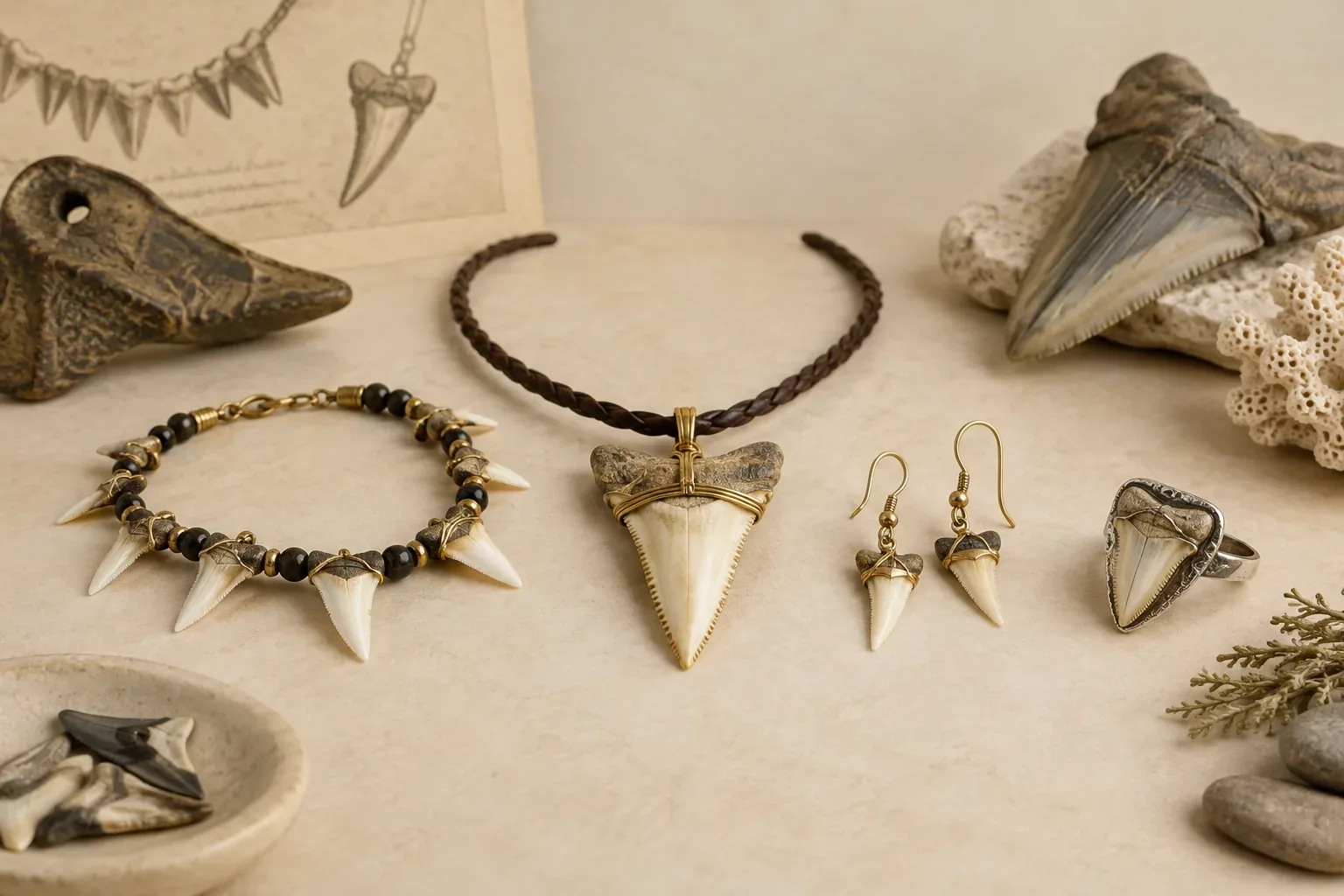
In jewellery design the shark tooth motif appears in several ways: as an actual tooth worn on its own or set with a metal cap or bezel; as a fossilised tooth from extinct or ancient species used as a pendant; as cast or carved replicas made from metal, resin, bone, or stone; and as an engraved or stylized motif in metals and manufactured beads.
Historically, museums catalogue both worked natural teeth and later decorative adaptations that reproduce tooth shapes in different materials. The V&A’s coverage of jewellery materials shows how artisans have combined natural elements with metalwork and gemstones across periods, so seeing a tooth mounted in silver or suspended with seed beads follows long-standing jewellery-making practices of combining materials for durability and display.
In contemporary commercial and artisan work you will also find hybrid pieces that pair real teeth with modern findings, use fossilised teeth for their patina, or reproduce tooth shapes in precious metals or carved gemstones for durability and legal or ethical reasons. Distinguishing among these options is a key part of informed buying.
Authenticity: what to check and what sellers should disclose
Sellers should provide clear, non-misleading information about what the item is and any treatments or modifications. The Federal Trade Commission’s consumer guidance on buying gemstones, diamonds, and pearls stresses that material treatments and imitations must be disclosed to buyers. Apply the same standard when evaluating teeth and fossil materials: ask whether a tooth is modern, fossilised, stabilized, dyed, or a cast replica.
Useful questions to ask the seller include: What is the piece made from exactly? What is its provenance (where and when was it collected or made)? Has the tooth been treated, stabilized, dyed or reconstructed? Does the item come with photographic evidence of provenance or an expert appraisal? What is the return policy if it proves misdescribed? Reputable sellers will answer these questions and welcome scrutiny.
Recognize common categories you will encounter: recently shed or cleaned teeth, fossilised teeth, cast or molded replicas, and decorative repros in other materials. Each has different values, conservation needs, and ethical considerations. If a seller claims a tooth is both 'museum-quality' and available at a very low price with no documentation, treat that claim skeptically and request independent verification.
Treatment, imitation, and legal or ethical considerations
Materials sold as natural may be altered: stabilized fossil teeth can be impregnated with resins, modern teeth may be cleaned and whitened, and replicas may be cast from molds. The FTC’s guidance highlights the need for full disclosure of treatments and imitations when selling jewellery and related materials. Ask for explicit details rather than accepting vague descriptions.
Beyond disclosure, consider legal and ethical issues. Some jurisdictions restrict the trade in certain wildlife products; others regulate fossil collecting and export. Sellers operating ethically will be able to explain provenance and compliance with local laws. If uncertain, seek sellers who document legal acquisition and provide clear provenance paperwork.
If you are especially interested in fossilised specimens for their scientific value, consult a paleontologist or a reputable fossil dealer, because items marketed purely as jewellery may have undergone cleaning or reconstruction that affects scientific worth.
Choosing and gifting shark tooth jewellery respectfully and practically
Start by defining what matters to you: authenticity (real tooth versus replica), aesthetic (raw tooth versus finished pendant), and provenance (recently collected, antique, or fossil). If gifting, consider the recipient’s values: do they prefer ethically sourced items, historically authentic pieces, or contemporary design with symbolic meaning?
If cultural sensitivity is a concern, avoid treating shark tooth motifs as interchangeable cultural symbols. As the V&A demonstrates in its contextual work, similar materials can have different meanings in different cultures. Where a piece is presented as belonging to a specific cultural tradition, ask for documented provenance or an expert attribution rather than relying on marketing claims.
For first-time buyers or gift-givers, prefer sellers who provide transparent provenance, clear photos, and a reasonable return policy. If cost is a factor, decide whether you want a genuine tooth (modern or fossil) or a high-quality replica; both have legitimate places depending on budget and intent. When in doubt, choose quality of craft—secure mountings, good metal findings, and sound construction matter for wearability and longevity.
When giving shark tooth jewellery as a symbolic gift, explain your intended meaning to the recipient and acknowledge that historical meanings are not universal. A short note that explains whether the piece is a fossil, a replica, or ethically sourced modern tooth helps recipients understand and appreciate the gift.
Care, conservation, and everyday wear
Shark teeth, like other organic and mineral materials, can be vulnerable to harsh chemicals, extreme humidity, direct sunlight and rough wear. Clean gently with a soft cloth and avoid ultrasonic cleaners or harsh chemical dips unless the seller confirms the piece can tolerate them. If a tooth is mounted in silver or another metal, follow standard metal care for those components.
For fossilised teeth that have been stabilized, check with the seller about recommended cleaning methods because resins and impregnations can be sensitive to solvents. Store tooth jewellery separately from harder materials to avoid abrasion, and consider removing pieces for sports, swimming in chlorinated pools, or heavy physical work that might dislodge mountings.
If a piece needs repair, choose a jeweller experienced with organic or unusual materials; conservative repairs that preserve original material are preferable to invasive reconstruction when the item has documented historical value.
Final checklist before you buy
Confirm exactly what you are buying and how it was obtained. Ask for written details on material, provenance, treatments and return policy. Prefer sellers who provide clear photos and welcome questions. Consider ethical and legal implications and favor documentation over marketing claims. Decide whether authenticity or aesthetic appeal is your priority, and choose construction quality and care guidelines accordingly. By combining the historical perspective seen in museum collections with the consumer-protection approach recommended by the FTC, you can make an informed and respectful purchase.
Frequently asked questions
How can I tell if a shark tooth is authentic or a replica?
Ask the seller for provenance and treatment details, request clear close-up photos, and ask whether the tooth is modern, fossilised, stabilized, or a cast replica. Sellers should disclose treatments and imitations; if information is not forthcoming, seek a second opinion from a reputable dealer or conservator.
Are there legal restrictions on buying shark teeth?
Legal restrictions vary by jurisdiction and by species or fossil status. Some countries regulate the export of fossils or wildlife products. Ask the seller about documentation and legal compliance before purchase and prefer vendors who can demonstrate lawful acquisition.
What treatments should I be aware of?
Teeth may be cleaned, whitened, dyed, stabilized with resins, or reconstructed. The Federal Trade Commission advises that such treatments and imitations must be disclosed when selling jewellery materials, so request explicit information about any treatments and how they affect care.
How should I care for shark tooth jewellery?
Clean gently with a soft cloth, avoid harsh chemicals and ultrasonic cleaners, store separately to prevent abrasion, and remove the jewellery for activities that risk impact, chlorine exposure, or heavy wear. If in doubt, follow care guidance from the seller or a conservator.
Is it respectful to wear or gift shark tooth jewellery from another culture?
Respect requires attention to provenance and cultural context. If a piece is presented as belonging to a specific tradition, verify its provenance and consider whether the item was acquired ethically. When gifting, explain whether the item is a contemporary design or a cultural object and, when possible, choose ethically sourced or locally made work.
Sources and further reading
- Bedazzled: A History of Jewellery — Victoria and Albert Museum
- An A-Z of Gemstones — Victoria and Albert Museum
- Buying Gemstones, Diamonds, and Pearls — Federal Trade Commission