Meaning at a glance
Documented museum collections show agate has been cut and set in a limited set of practical ways—cabochons, cameos and intaglios, slices and simple mounts—that favor durability and display; separate those historical practices from later popular meanings, and use basic durability, setting and disclosure checks when buying or gifting modern agate jewelry.
What history and museum collections tell us
The Victoria and Albert Museum catalogues and interpretive material make two useful points for anyone choosing agate jewelry. First, agate and related chalcedony materials appear repeatedly across many historical periods in the V&A’s holdings and exhibitions, used for decorative carving, signet and seal stones, and for set jewellery. Second, those collections show a clear preference for certain cuts and mounting styles that reflect both technical possibilities and practical needs rather than a single symbolic meaning. In plain terms: curators at the Victoria and Albert Museum present agate as a material frequently worked as smooth cabochons, engraved intaglios and cameos, and thin polished slices, and mounted in settings that protect the stone while showing its patterning.
Which cultures and periods are documented
Museum records at the Victoria and Albert Museum trace agate and similar stones across a wide chronological and geographic range. Examples in public collections include carved gemstone signets and intaglios associated with classical antiquity and the ancient Mediterranean, engraved gems and inlaid work from later European traditions, and ornamental uses in other historical contexts represented in the V&A holdings. The museum materials present these instances as evidence of changing techniques and fashions rather than a single, uniform cultural meaning.
Documented historical meanings versus modern interpretations
The historical record preserved and explained by museums like the Victoria and Albert Museum links agate chiefly to practical and social uses: signet and seal functions, personal adornment, and display of craftsmanship and wealth. Those are documentary observations based on surviving objects and archival interpretation. By contrast, a range of contemporary, personal or New Age meanings—claims that agate ‘grounds energy,’ offers specific healing properties, or universally protects the wearer—are modern interpretations and not universal historical facts. When describing agate’s past, the reliable source is what museums and object histories record: how a culture used the stone and how it was worked and mounted, not a single shared spiritual meaning across cultures.
Common agate cuts and why they matter
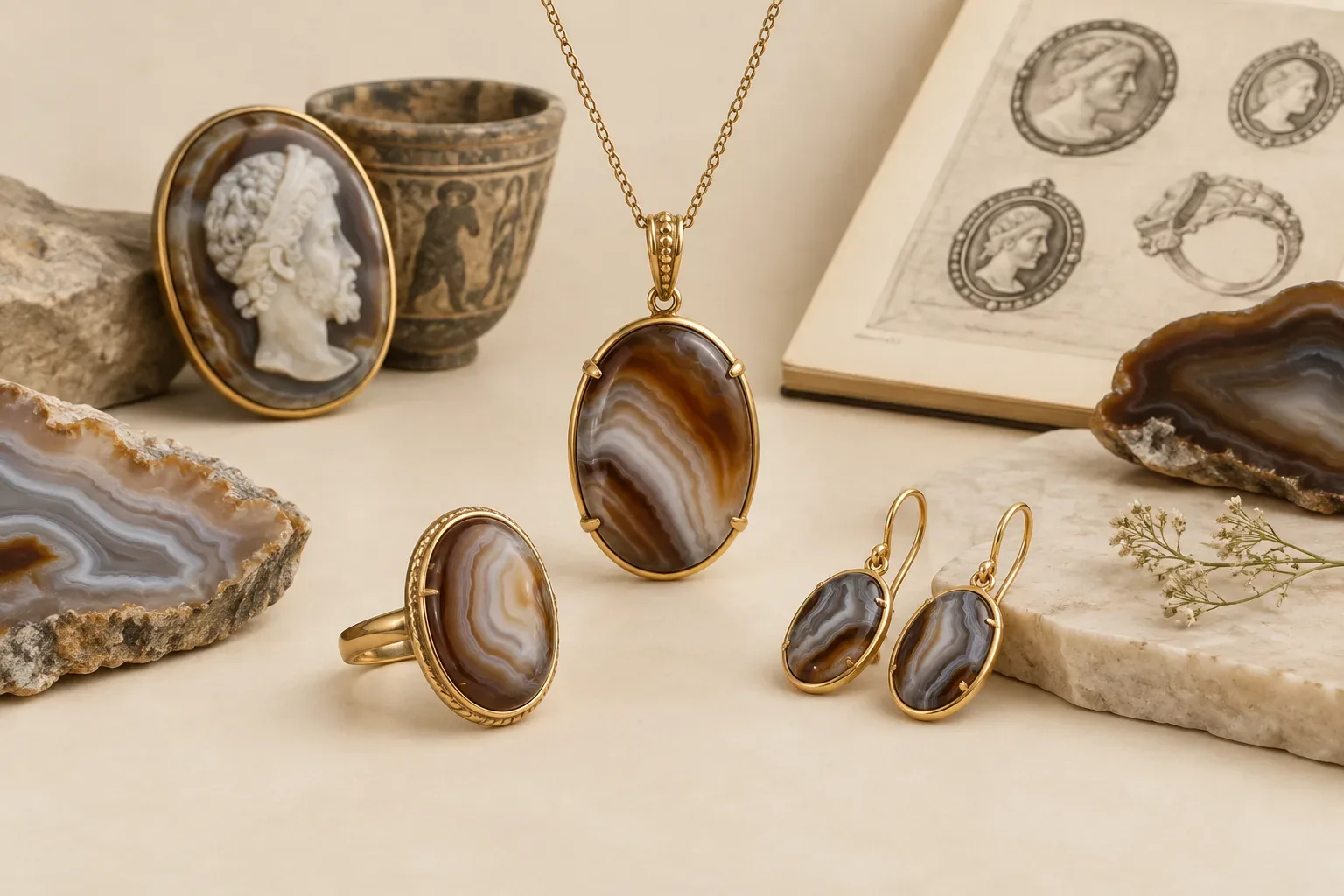
Historical and museum descriptions indicate a handful of cuts that recur in agate pieces and that remain practical today. The cabochon—an unfaceted, domed polish—is common because it shows banding and color without thin edges that chip easily. Carved techniques such as cameos (relief carving) and intaglios (incised designs) appear in museum collections as functional objects for sealing and as decorative artistry; these require thicker, stable material that can be securely set. Thin polished slices or slabs display agate’s banding and translucency and are often used for pendants, brooches or inlaid panels. Each cut affects how the stone should be mounted: domed cabochons and carved gems are usually set in protective, framing mounts; slices often need flat backing or bezel work to keep them stable.
Settings that protect and present agate
Museum mounts and surviving historical settings illustrate two guiding principles: protect exposed edges, and show the stone’s surface. Settings that fulfil these aims include bezels that wrap the stone’s rim, secure prong settings for thicker pieces, and closed or partially closed backs for slices that need support. Curators at the Victoria and Albert Museum describe many historical examples where mounts are chosen for stability and display. For everyday wear, modern interpretations of those historic mounts remain sensible: a low bezel for a ring reduces the chance of knocks, while a sturdy closed-back pendant or brooch protects a thin slice.
How agate appears in jewelry pieces
Across museum collections and modern practice, agate appears in rings, pendants, brooches and inlay work. In rings, thicker cabochons or engraved gems historically served as signets and decorative focal points. Pendants and brooches frequently use slices to showcase banding, sometimes backed or rimmed to create contrast. Cameos and intaglios appear in portrait or seal jewellery and are usually mounted so the carving faces outward while the rim is secured. The practical pattern in museum pieces is consistent: cuts and settings are chosen to protect the stone’s fragile edges and to display its best visual features.
Practical guidance for choosing agate jewelry
Decide how you will wear the piece before choosing cut and setting. If you want a ring for constant wear, prefer a thicker cabochon set low in a bezel; this minimizes chipping and snagging. For a pendant or brooch, a polished slice or cameo can be attractive, but look for backing or bezel work that prevents flexing and edge damage. When assessing quality and value, consider color consistency, clarity of banding, and the craftsmanship of any carving. The Victoria and Albert Museum’s resources on gemstones stress that historical techniques were chosen to suit a stone’s properties; modern buyers should do the same.
Buying, treatments and disclosure
Follow the FTC’s guidance about treatments and disclosure when you buy agate jewelry. Sellers should tell you if a stone has been dyed, stabilized, heat-treated, assembled from multiple pieces, or if it is an imitation. Ask for written confirmation of any treatments and for clear identification of materials used in the mounting. These procurement steps protect you financially and ensure you understand any care needs: for example, dyed stones may fade with cleaning, and assembled pieces might be more delicate. The FTC’s consumer guidance underlines that sellers must not withhold information about material treatments, so insist on transparency.
Gifting considerations and respectful choices
When gifting agate jewelry, match the piece to the recipient’s lifestyle and tastes. For someone who wears jewelry daily, choose secure settings and robust cuts like cabochons in bezels. If the gift is intended for ceremonial or symbolic reasons, check whether the recipient ascribes particular personal meanings to agate; modern symbolic associations vary widely and are personal rather than historically universal. Include provenance or care information when you give the piece: a short note that explains material, any treatments, and recommended care is both practical and respectful.
Care and long-term durability
Museum conservators and gem reference guides encourage sensible care: avoid harsh chemicals, ultrasonic cleaners for any assembled pieces unless confirmed safe, and repeated thermal shocks that can affect assembled or treated stones. Settings should be checked periodically—prongs can work loose and bezels can thin or deform—so a professional jeweller’s inspection helps maintain longevity. The V&A’s documentation of historical objects shows that thoughtful mounts and routine care have preserved many agate pieces for centuries; follow the same principles for modern pieces.
Final thought
Use historical practice as a practical guide rather than a prescriptive rule. Museum records show which cuts and settings have endured because they protect the stone and display its qualities. Combine that documented history with modern disclosure practices and sensible care to choose agate jewelry that is both beautiful and durable.
Frequently asked questions
What are the most durable cuts of agate for everyday wear?
Cabochons and thicker carved pieces such as intaglios or cameos set low in protective mounts are the most durable choices for daily wear because they present fewer exposed edges that can chip.
How should I care for an agate pendant or brooch?
Avoid harsh chemicals and thermal shocks, check the mounting periodically for looseness, and have a jeweller inspect and tighten settings as needed; thin slices should be supported by a bezel or backing to prevent flexing.
Are dyed or treated agates common, and should I avoid them?
Dyed and treated agates are available on the market. The FTC recommends asking sellers to disclose any treatments in writing; treatments are not inherently bad, but they can affect care requirements and value, so make an informed choice.
Do historical agate pieces carry a universal symbolic meaning?
No. Museum documentation shows agate’s historical uses were functional and decorative—signets, seals, and ornament—and meanings varied by period and culture; modern universal symbolic claims are contemporary interpretations, not consistent historical facts.
What setting should I choose if I want an agate ring for active wear?
Choose a low-profile bezel setting with a thicker cabochon; this combination protects the stone from knocks and reduces the chance of snagging during daily activities.
Sources and further reading
- Bedazzled: A History of Jewellery — Victoria and Albert Museum
- An A-Z of Gemstones — Victoria and Albert Museum
- Buying Gemstones, Diamonds, and Pearls — Federal Trade Commission