Meaning at a glance
This article explains documented history and changing contexts for garnet cuts and settings using museum evidence, separates historical meanings from modern personal interpretations, describes how garnet appears in different cuts and settings, and gives practical guidance on choosing and gifting garnet jewelry with durability and ethical buying in mind.
Documented history: where garnet appears and how museums describe it
Museum scholarship shows that garnet has been used across many cultures and periods, and that the ways it was cut and set changed with technique and taste. The Victoria and Albert Museum (V&A) records garnet among the gemstones used in decorative jewellery from ancient through modern eras, noting both early inlaid work and later faceted uses. In early medieval northern Europe and British contexts, for example, garnets appear in cloisonné-style inlay where small cut stones are set into metal cells, a technique the V&A describes as characteristic of certain periods and workshops.
The V&A also places garnet within changing social contexts, showing how the same stone served different visual and social purposes in different eras. In some periods garnet was used to create intense, flat red areas in brooches and pendants; in later periods, advances in cutting and polishing allowed more faceted, brilliant treatments suitable for rings and necklaces. The museum’s broader history of jewellery emphasizes that social meanings and techniques shift over time and that surviving examples reflect both technological possibilities and the tastes of particular societies.
Separating documented historical meanings from modern interpretation
What is documented: museum documentation links certain garnet uses to specific functions and styles. For example, V&A collections and commentaries identify garnet inlay work in early medieval pieces and show faceted garnet use in later decorative jewellery. Those are object-level, documented facts: which cuts and settings appear, and where those objects came from.
What is interpretation: assigning a single symbolic meaning to garnet across cultures is a modern interpretive move and not a safe historical claim. While later writers and contemporary buyers often attribute meanings such as passion, protection, or prosperity to garnet, those associations vary by time and place and are not universal. Where symbolism is claimed for a historical object, check whether that interpretation comes from contemporary records of the object's users or from later storytelling and revival fashions.
How garnet cuts and settings appear in jewellery
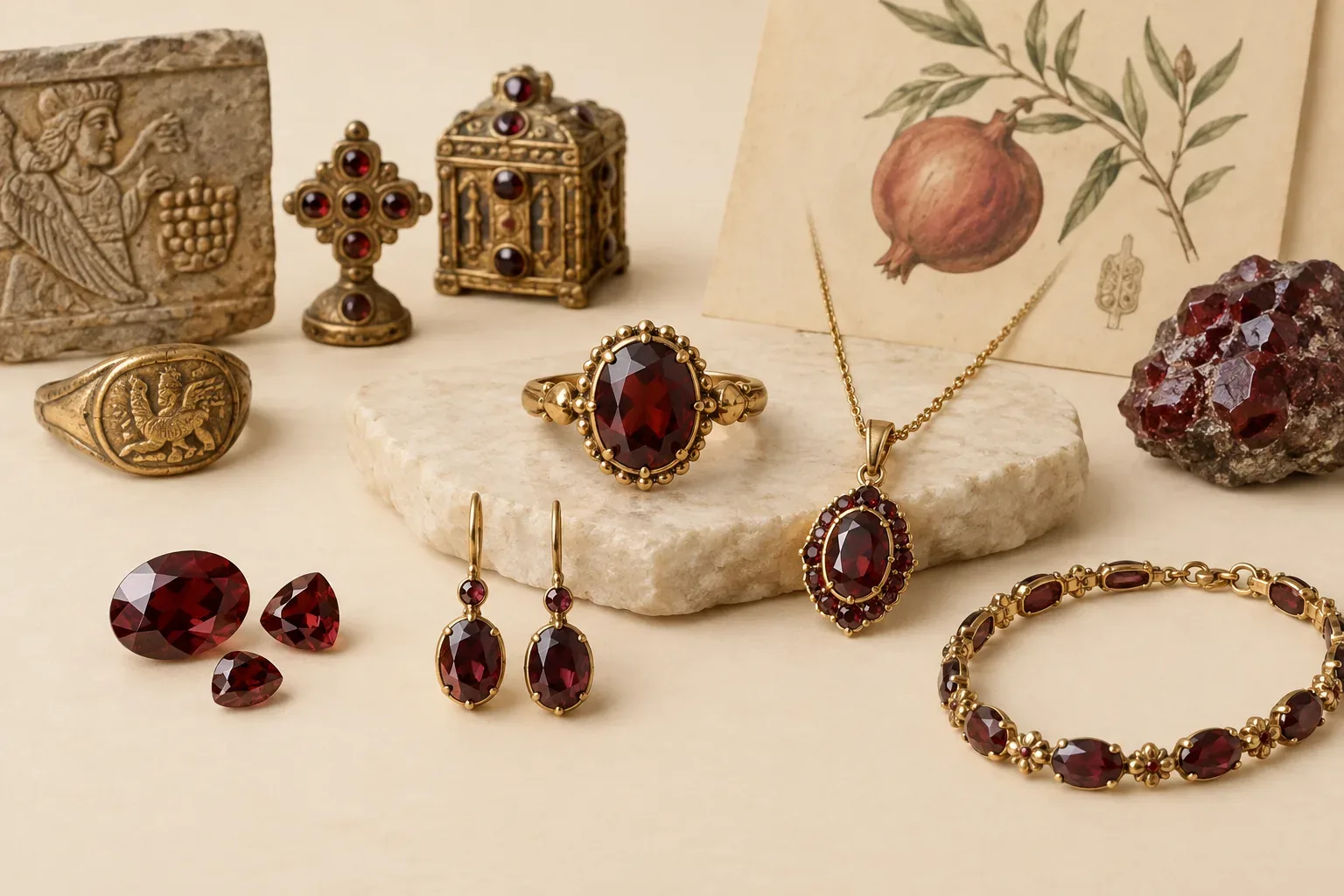
Cuts. Museum descriptions show a range of forms. Small, highly polished pieces were cut and used as inlaid garnets in cloisonné and tile-like patterns in ancient and early medieval work. As cutting technology evolved, transparent garnet varieties were faceted to emphasize brilliance and sparkle, while darker or included material was left as rounded cabochons to show color and depth. Today, you will see garnet in a wide range of cuts—cabochons, rose cuts, step cuts, and brilliant faceting—chosen to suit the stone’s clarity and color.
Settings. Historically documented settings range from flush inlay and low bezels that secure small inlaid garnets, to open-back and prong settings introduced as faceting made light performance a priority. Museum pieces illustrate contrastive metalwork—dark stones set in pale metal or vice versa—to emphasize color and pattern. In contemporary jewellery, bezel settings, prongs, and secure closed-back mountings are all common; choice of setting affects both appearance and how well a garnet withstands knocks and daily wear.
Durability considerations and practical choices
Use the cut to match the stone. Transparent, inclusion-free garnets are typically faceted to maximize sparkle; included or darker garnets are often cut as cabochons to show color without emphasizing internal features. Choosing the right cut for the stone’s material qualities will result in the most attractive and durable finished piece.
Choose settings to protect the gem. Historical examples show that small inlaid stones were protected by the surrounding metal. For wearable modern pieces such as rings, bracelets, or everyday pendants, consider bezel or partially bezel-style settings that shield the girdle and edges. Prong settings can display brilliance well but leave edges exposed; if you prefer prongs, choose secure prongs and discuss the number and height of prongs with your jeweller so the garnet is held safely.
Think about use and maintenance. If the recipient leads an active life, prioritize protective settings and lower-profile mounts. For pieces that will be worn rarely or as part of ceremonial dress, more open settings and delicate cuts that maximize sparkle may be appropriate. Regardless, ask about recommended cleaning methods for the stone and setting, and plan periodic checks of mounting security.
Buying and disclosure: what to ask and why it matters
Ask about treatments and imitations. The Federal Trade Commission (FTC) makes clear that sellers should disclose treatments, enhancements, and imitations when relevant. Ask whether a garnet has been heat-treated, fracture-filled, or otherwise altered, and whether the piece includes any synthetic or glass components. Full disclosure protects your purchase value and informs care requirements.
Provenance and documentation. Museum records remind us that the significance of a gem often ties to its origin and history. For modern purchases, request clear information on country of origin where available and any laboratory reports for very large or unusually colored stones. Written or lab documentation strengthens resale value and helps avoid surprises about treatment and identity.
Compare settings and ask for craft details. If you are concerned about longevity, ask how the jeweller sets the stone, whether the setting is soldered or snap-fit, and how the metal will be maintained. A well-executed setting from a reputable maker is often more important to long-term enjoyment than choosing the largest possible stone.
Respectful selection and gifting guidance
Consider cultural context. Because garnet has appeared in many cultures and been reinterpreted in revival fashions, avoid assuming that any single symbolic meaning applies universally. If gifting jewellery tied to a cultural motif or historical style, educate yourself about its origins and choose makers who respect that tradition. Museum scholarship underscores that styles migrate and are re-used; respectful gifting acknowledges that layered history rather than claiming a single origin story.
Match the piece to the recipient’s life and preferences. Practical fit matters: choose a cut and setting that suits how the recipient will wear the piece. For an everyday ring, choose a protective setting and a cut that hides inclusions. For a collector or someone who loves historical styles, a garnet-inlay motif inspired by museum examples may make a meaningful gift when accompanied by provenance notes or an explanation of the design’s historical source.
Include care and provenance information with the gift. Provide the recipient with the seller’s care instructions and any lab or provenance documentation. A short note explaining whether the piece is a historically inspired design, a modern reinterpretation, or an unaltered stone helps the recipient understand and appreciate the object without confusing documentary history and modern meaning.
When to consult an expert
If you are buying an antique or a very large stone, consult a qualified gemmologist or a reputable dealer who can verify identity, treatments, and whether the setting is original. Museum catalogues and the V&A remind buyers that stylistic details can imply age and origin, but informed professional assessment is necessary to confirm those signals.
For bespoke work, ask the jeweller for sketches or mock-ups that show how the chosen cut will sit in the setting. Practical proofing at the design stage reduces surprises and ensures the stone is secure and attractive in the finished piece.
Frequently asked questions
Are garnets durable enough for everyday rings?
Garnets can be suitable for everyday wear but durability depends on the specific garnet variety, the cut, and the setting. Choose protective low-profile or bezel settings for rings if the wearer is active, and have mountings checked periodically. When in doubt, ask the seller about the stone’s quality and recommended uses.
Which cuts make garnet look most brilliant?
Transparent, high-clarity garnets usually benefit from faceting—brilliant or step cuts—to maximize light return. Darker or included material is often cut as cabochons to emphasize color rather than sparkle. A reputable jeweller can advise which cut will best suit a particular stone.
What should I ask the seller about treatments and imitations?
Ask whether the stone has undergone heat treatment, fracture filling, dyeing, or other enhancements, and whether any parts are synthetic or glass. The FTC advises that sellers disclose treatments and imitations, so request written information or a lab report for expensive stones.
How do historical garnet settings differ from modern ones?
Museum records document early uses such as inlaid cloisonné and low bezels to hold small garnets, while later periods show more open-back and prong settings used with faceted stones. Modern jewellery draws on both approaches: you’ll see protective bezels and display-oriented prongs depending on design and intended wear.
Is it culturally insensitive to wear historical garnet motifs?
Wearing a style inspired by a historical or cultural motif is not inherently disrespectful, but sensitivity matters. Learn the motif’s origins, credit its cultural source if relevant, and avoid claiming historical meanings that are not documented. Choosing makers who acknowledge and respect the tradition is a good practice.
Sources and further reading
- Bedazzled: A History of Jewellery — Victoria and Albert Museum
- An A-Z of Gemstones — Victoria and Albert Museum
- Buying Gemstones, Diamonds, and Pearls — Federal Trade Commission