Meaning at a glance
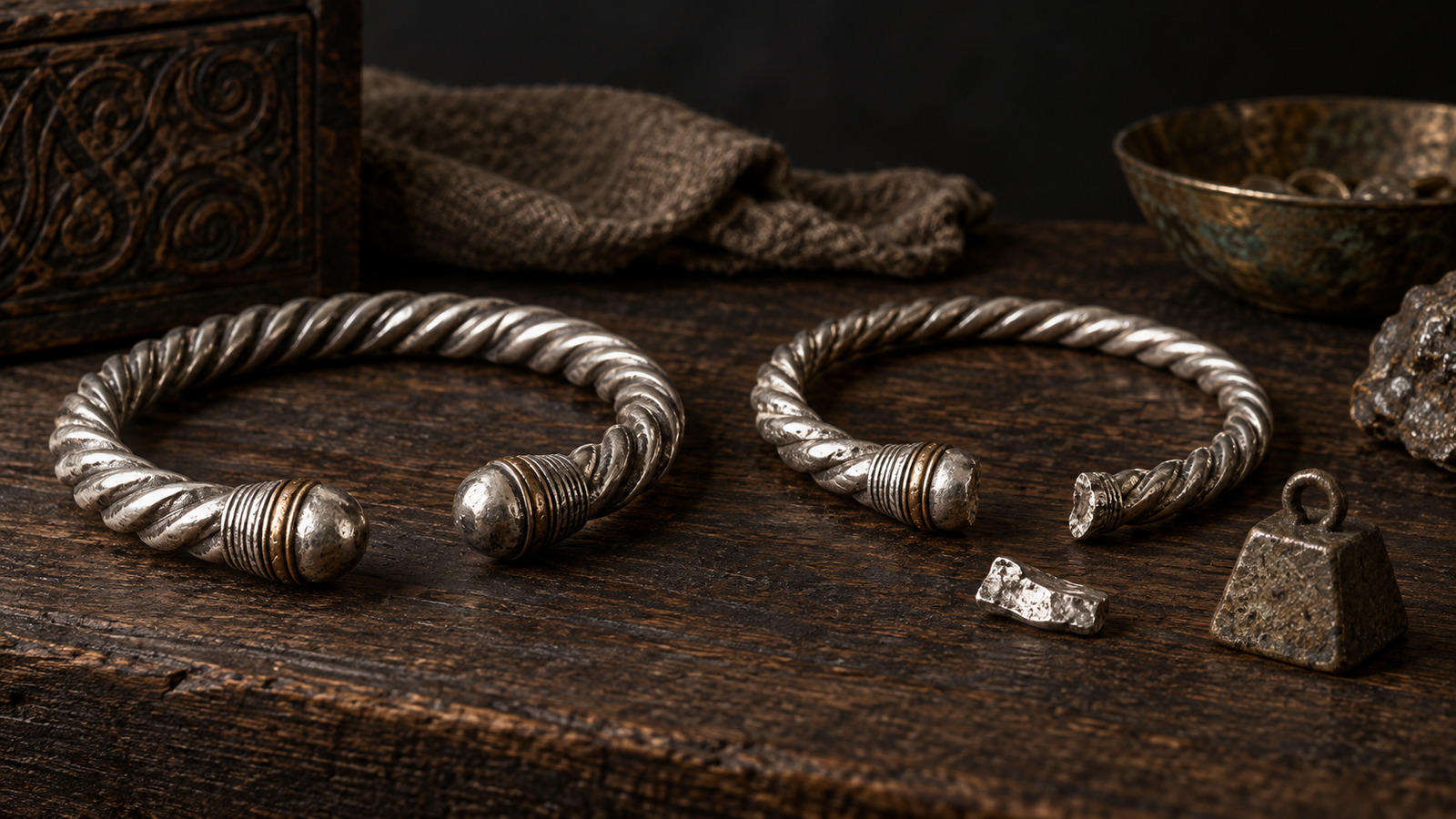
Viking Age arm rings served as adornment and could communicate wealth, participate in exchange, or appear in ritual contexts, but surviving evidence does not justify calling every arm ring an oath ring or assigning one universal meaning.
Short answer
Viking arm ring meaning: Archaeological and museum evidence shows that arm rings in the Viking Age functioned as personal adornment and as portable wealth that could be used in exchange or redistribution, and some examples appear in ritual or amulet contexts; however, surviving material does not justify a single, universal symbolic label such as “the oath ring” for all arm rings.
What the archaeological record and museums actually show
Surviving arm rings are well attested in Viking Age contexts and appear in museum collections across Scandinavia and beyond. The National Museum of Denmark catalogs arm rings among the period’s jewellery, noting both their role as personal decoration and the variety of contexts in which they occur. The Metropolitan Museum of Art has discussed precious metal work from the same era and highlights how jewelry made from gold and silver could function as a form of portable wealth that entered systems of exchange. The Swedish History Museum presents particular objects, such as amulet or ring forms, that point to ritual or protective uses in some cases.
Taken together, these institutional records show overlapping practical uses rather than a single fixed meaning. Arm rings occur in domestic finds, hoards, and burial contexts, and individual items sometimes display features that suggest particular uses: high-value metalwork could be melted down or paid out as reward, simpler forms were worn as personal decoration, and a subset of rings is found in contexts where ritual or protective function is plausible.
How scholars and museums attribute meanings to arm rings
Museums and specialists infer meaning from context, material, and patterning in finds. The National Museum of Denmark lists arm rings among varied forms of Viking Age jewelry but does not identify every arm ring as an oath object. The Metropolitan Museum of Art documents precious-metal jewelry that could be cut up for currency, trade, or recycling. The Swedish History Museum’s catalogue entry for an amulet ring demonstrates that some rings are interpreted as having ritual or amuletic associations.
These attributions are evidence-led: they rely on where rings are found, what they are made from, and how similar objects are used in contemporary written sources when available. None of these museums claim that one single symbolic meaning covers all surviving arm rings.
Documented historical functions, separated from modern interpretations
Documented historical functions supported by museum catalogues and specialist publications include personal adornment, use as portable wealth or bullion, participation in systems of exchange and reward, and, in a smaller number of cases, roles within ritual or amulet practice. The Metropolitan Museum of Art has emphasized the importance of precious-metal objects in economic exchange, while the National Museum of Denmark records arm rings among the Viking Age’s jewellery types without ascribing any single ritual function to all examples. The Swedish History Museum presents specific rings interpreted as amuletic, showing that ritual meanings were sometimes attached to individual objects.
Modern personal interpretations—how people use or understand arm-ring imagery today—are a separate phenomenon. Contemporary wearers and makers often adopt arm rings as symbols of heritage, loyalty, or personal commitment, and modern replicas may be inscribed with runes or combined with stones and motifs not common in every Viking-age find. These contemporary meanings are legitimate personal or cultural expressions, but they are not direct, universal continuations of a single historical function.
How the tradition and motifs appear in jewelry
In the archaeological record and in museum displays, Viking-age arm rings are typically made of precious or semi-precious metals such as silver and gold alloys, and they occur in a range of forms from simple twisted-wire bands to more elaborate cast or sheet-metal pieces. The Metropolitan Museum of Art highlights the high craftsmanship of metalwork around 1000 A.D., and examples in museum collections show the technical range of the period’s jewelers.
Some museum-held items are catalogued specifically as amulet rings or rings with features that suggest protective function, an association the Swedish History Museum has emphasized for particular objects. The National Museum of Denmark’s material demonstrates variety rather than uniformity, with differences in scale, decoration, and likely use. Gemstones are infrequently the defining feature of archaeological arm rings; later and modern pieces sometimes incorporate stones or added motifs for visual effect or contemporary symbolism, but those additions reflect later tastes rather than a continuous historical norm.
Using this knowledge when choosing or gifting an arm ring
If you are selecting or gifting an arm ring inspired by the Viking Age, do so with awareness of the distinction between documented historical uses and modern symbolism. Choose a piece that reflects the meaning you intend: a replica in untreated silver or a simple twisted band can honor the historical function as wearable metalwork and portable wealth, while a custom piece with added stones, inscriptions, or specific terminals can carry contemporary personal meanings such as commitment or heritage.
When gifting with a message—especially one that invokes oath or loyalty—be explicit about whether that meaning comes from your personal intent or from a reconstructed tradition. The museum evidence records varied jewelry and ring contexts rather than proving that every arm ring served as an oath ring, so asserting such a meaning as historically universal is misleading. For respectful use consider provenance and craftsmanship; if you value historical authenticity, favor makers who document their techniques and materials and avoid implying that modern replicas recreate a single definitive Viking function.
If the ring is intended as a ceremonial token— for example as a symbolic pledge between friends—prepare a clear explanation or ritual that belongs to your relationship rather than presenting the ring as a historically precise reproduction of an “oath ring.” This approach respects both the historical record and contemporary meanings people want to create.
Care, display, and ethical considerations
Treat archaeological originals in museums as research and heritage objects. If you purchase a replica, care for it according to the material: silver and gold alloys require different cleaning approaches, and some techniques used for modern replicas (patination, plating) need specialist maintenance. If provenance is important, ask makers for documentation of materials and production methods.
Be mindful about cultural sensitivity. Museums present these objects in historic contexts tied to the people and places where they were made and used. Avoid presenting Viking-inspired jewelry as a simplistic emblem of identity or making exclusive cultural claims; instead, acknowledge historical complexity and the limits of what surviving objects can tell us.
Frequently asked questions
Were all Viking arm rings oath rings?
No. Museum records show arm rings and related rings in varied decorative, economic, and sometimes ritual contexts; that evidence does not establish that every arm ring was an oath ring.
Did Vikings use arm rings as money?
Arm rings made of silver or gold could serve as portable wealth and enter systems of exchange or reward. The Metropolitan Museum of Art highlights how precious-metal jewelry could function economically in the Viking Age.
Are gemstones common on Viking arm rings?
Gemstones are not the defining feature of most archaeological arm rings in museum collections; surviving examples often emphasize metalwork. Modern replicas or inspired pieces sometimes add stones for contemporary aesthetics.
Can I gift an arm ring as an oath or pledge?
You can gift an arm ring with any personal meaning you choose, but be clear that asserting a single historical meaning—such as that it was universally used as an oath token—is not supported by museum evidence. If the pledge is important, create an explicit personal ritual or statement.
How can I choose a respectful replica?
Select makers who document materials and methods, avoid claiming that replicas recreate a single historical function, and prefer transparent provenance for materials. Consider a design that reflects the documented variety of historical forms rather than a supposed authoritative model.
Where should I go for trustworthy information about Viking jewelry?
Consult museum resources and object catalogues. The National Museum of Denmark, the Metropolitan Museum of Art, and the Swedish History Museum provide evidence-led descriptions and contextual interpretations of Viking Age jewelry.
Sources and further reading
- Clothes and jewellery — National Museum of Denmark
- The Art of Ivory and Gold in Northern Europe around 1000 A.D. — The Metropolitan Museum of Art
- Amulet ring — Swedish History Museum