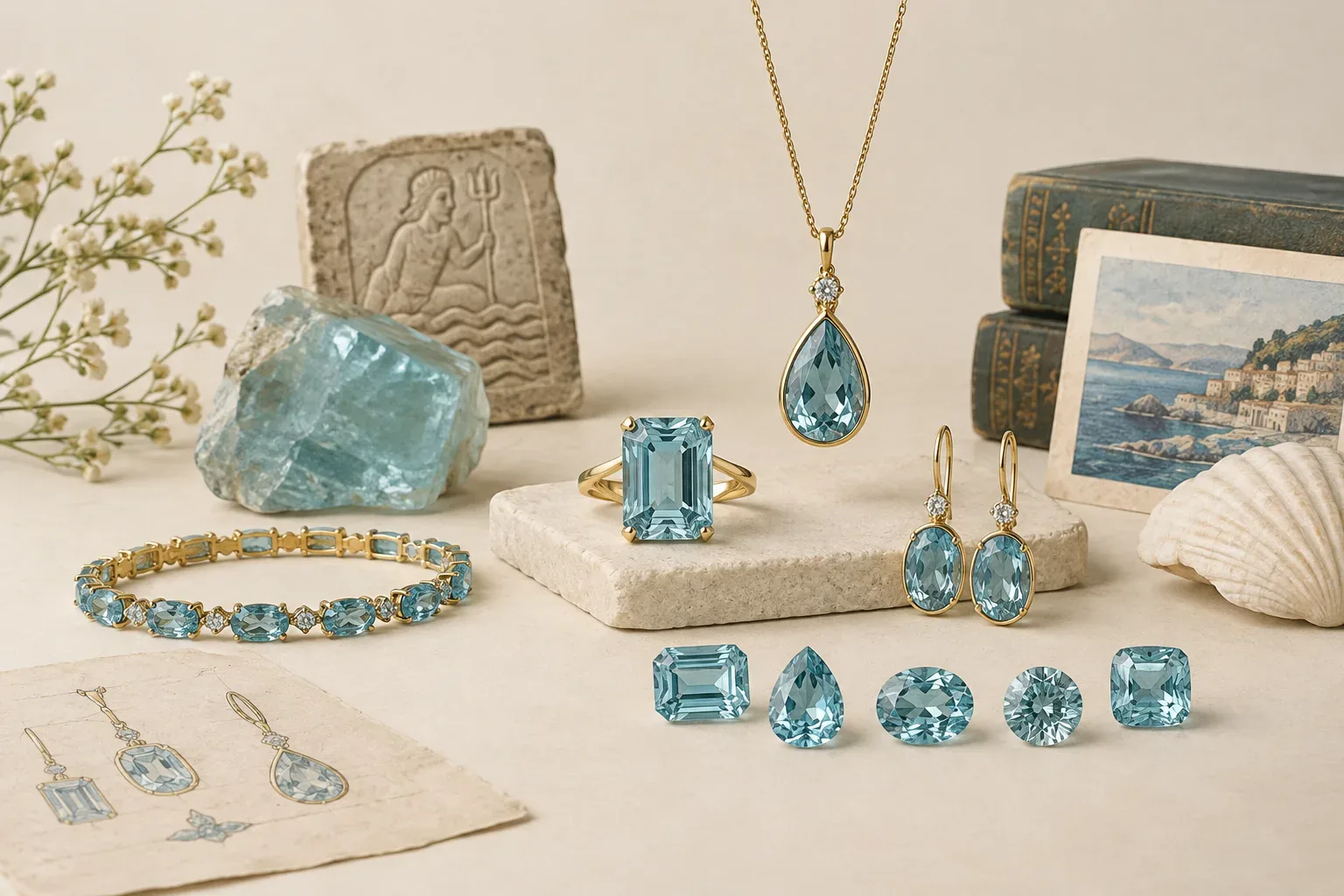
Meaning at a glance
Explain the documented history and changing contexts of the aquamarine cuts and settings motif, separate cultural or religious evidence from later popular interpretations, and give practical guidance for choosing and wearing the motif in modern jewelry.
What the historical evidence shows (and where it comes from)
Museum research makes clear that gemstones and the ways they are cut and set have shifted with fashion, technology and social context. The Victoria and Albert Museum’s survey of jewelry history discusses how jewelers’ technical skills, prevailing tastes and social signals shaped choices of stones, cuts and settings across periods and cultures. The V&A’s materials on gemstones also describe how jewelers selected particular stones for color, size and working properties rather than for a single, unchanging symbolic meaning.
In practice, documented evidence in museum collections and catalogues shows that different eras favored different visual outcomes: for example, earlier periods often emphasized large, flat-cut stones set to display color, while later cutting advances produced faceted stones that emphasized brilliance and dispersion. The exact examples and dates are catalogued in museum records and exhibition materials held by institutions such as the Victoria and Albert Museum; consult those records for period-specific examples.
Documented historical meanings versus modern interpretations
The careful distinction between documented meanings and modern interpretation matters. Museum documentation tends to describe what people did with gems (who wore them, when and how) and the social value attached to certain stones. That is different from assigning single symbolic meanings across time. The Victoria and Albert Museum frames much of its jewelry-writing in terms of changing social context and aesthetics rather than immutable symbolism.
By contrast, many of the meanings commonly attached to aquamarine today—such as tranquility, a specific connection to sailors, or a symbolic link to a particular personal quality—are largely contemporary sentimental interpretations or popular folklore. Those modern associations are valid as personal or cultural symbols in the present day, but they are not the only way the stone was understood in historical contexts and should not be presented as universal, documented facts.
How aquamarine appears in jewelry: cuts, motifs and settings
Aquamarine appears in jewelry in a range of ways, and choices about cut and setting shape both its look and its durability. Jewelers use faceted cuts to bring out brilliance and step or emerald cuts to emphasize color and clarity. Large aquamarine gems are often cut with long facets to flatter their pale-blue hues, while smaller stones may be cut with mixed or brilliant styles to add sparkle.
Settings change the visual emphasis and protect the stone. Open prong settings raise aquamarine to maximize light and sparkle, which suits pendants and cocktail rings used intermittently. Bezel settings encircle the gem’s girdle in metal, offering better protection against knocks and catching; these are common for active wear such as daily rings or bracelets. Halo settings surround an aquamarine with smaller accent stones to increase apparent size and contrast color, a technique used from historical jewelry into modern designs and documented in museum collections as a recurring decorative motif.
Choosing cuts for beauty and durability
When selecting a cut, prioritize what matters most for the piece’s intended wear. If brilliance and sparkle are the priority for a pendant or occasional wear ring, faceted brilliant or mixed cuts are appropriate because they emphasize light return. If you want to showcase the stone’s color and clarity while reducing the risk of visible chips or breakage in a ring worn daily, step cuts or emerald cuts create long, clean facets and a lower profile.
Also consider the size and proportion of the cut relative to the setting. Shallow cuts can appear larger face-up but are more exposed; deep cuts protect the table but may reduce face-up color. A competent jeweler will recommend proportions that suit both the stone and the intended setting. For historically inspired pieces, the V&A’s materials on gemstone practice provide context for why certain cuts appeared at particular times.
Choosing settings for protection and style
Settings offer the most direct protection for an aquamarine. For everyday rings choose closed or partially closed settings such as bezels or channel settings that shield edges and reduce the chance of catching. For occasional-wear pieces consider prong settings that lift the stone to maximize brilliance; ensure prongs are sturdy and periodically checked by a jeweler.
For necklaces and earrings, where contact and impact are less frequent, more open settings can be chosen to let light through. For heirloom or historically inspired work, settings that reflect the period—such as closed-back mounts or decorative metalwork cited in museum records—can be both authentic in style and suitably protective when well executed.
Treatments, imitations and what to ask sellers
Material treatments and imitations affect value and care. The Federal Trade Commission requires sellers to disclose material treatments, enhancements and imitations when marketing gemstones. Ask any seller for written disclosure of material treatments, a description of whether the gem is natural or synthetic, and any laboratory report that accompanies the stone.
Request clarity about return policies and ask whether the seller provides fiber-based or independent lab reports for larger gems. If a seller declines to provide clear treatment information or a reasonable return policy, treat that as a warning sign. Museum resources on gemstones explain identification and historical context; together with the FTC’s guidance on disclosure, those resources support an informed buying process.
Practical guidance for selection, gifting and wearing
Decide in advance how the piece will be used. For an everyday ring or a gift meant for daily wear, favor protective settings and modest elevations so the stone is less likely to strike hard surfaces. For a special-occasion pendant or a display ring, you can prioritize visual drama and choose cuts and settings that maximize color and sparkle.
Consider the recipient’s lifestyle and aesthetics. Someone active or who uses their hands frequently will benefit from a bezel or lower-profile setting. If you are following a historical design or gifting a piece with cultural resonance, explain the provenance and modern interpretation clearly so the recipient understands whether the symbolism is historical, folkloric or personal.
Budget for a reputable vendor and documentation. Allocate funds for a proper mounting and aftercare—professional setting work and periodic checks cost more but preserve the stone. When gifting, include the purchase documentation and any care instructions so the recipient has the information needed to protect and insure the piece.
Care and long-term considerations
All gemstones benefit from reasonable care: avoid abrasive contact, extreme temperature changes and household chemicals. Have settings inspected annually to ensure prongs are secure and bezels are intact. If the piece will be worn daily, consider insurance and record-keeping that includes the seller’s disclosures and any laboratory reports.
For historically styled or museum-inspired pieces, consult museum descriptions for styling context but do not assume the functional performance of older mounts will suit modern everyday wear. Modern workmanship can reproduce historical looks while improving protection and durability.
Frequently asked questions
What cut of aquamarine is best for everyday rings?
For everyday rings, prioritize cuts and settings that minimize exposure—lower-profile step or emerald-style cuts paired with bezels or partially closed settings reduce the chance of chipping and catching. Discuss the specific mounting with a jeweler to balance protection and appearance.
Do aquamarines need special care or cleaning?
Aquamarines should be protected from hard knocks, abrasive contact and household chemicals. Regularly check settings for loose prongs or metal fatigue and follow the seller’s cleaning recommendations; professional inspection once a year is a sensible precaution.
Are aquamarines commonly treated or imitated, and how can I be sure of what I’m buying?
Sellers must disclose material treatments and imitations under Federal Trade Commission guidance, so ask for written disclosure and any laboratory reports. Reputable vendors will provide clear documentation about whether a stone is natural, treated or synthetic.
Which setting shows the most color in an aquamarine?
Settings that allow light through the pavilion and do not obscure the girdle—open prong or halo settings—tend to emphasize brightness and perceived color, while closed-back or heavy bezel mounts can deepen color but reduce brilliance. Choose based on whether color or sparkle is your priority.
How should I choose an aquamarine as a meaningful gift?
Consider the recipient’s lifestyle and the intended use of the piece. For everyday wear choose protective settings; for symbolic or occasional pieces prioritize appearance. Explain any historical inspiration versus your personal meaning clearly so the gift’s symbolism is communicated respectfully.
Sources and further reading
- Bedazzled: A History of Jewellery — Victoria and Albert Museum
- An A-Z of Gemstones — Victoria and Albert Museum
- Buying Gemstones, Diamonds, and Pearls — Federal Trade Commission