Meaning at a glance
This article explains the documented history and changing contexts of sapphire cuts and settings, separates historical evidence from later popular interpretation, and gives practical guidance for selecting, setting, and caring for sapphire jewelry.
Historical evidence and cultural contexts
Museum scholarship collected by the Victoria and Albert Museum (V&A) treats jewellery as an object type whose forms and meanings change across times and places. V&A’s overview of jewellery history presents jewellery use from earlier periods through the modern era as evolving in response to available technologies, social hierarchies, and fashion. That context is the proper documented frame for understanding sapphire cuts and settings: the way a gem is cut and mounted in one period reflects the era’s tools and tastes as much as the gem’s intrinsic properties.
V&A’s A–Z of Gemstones and the V&A’s exhibition materials identify sapphires among the suite of gems used in European and global jewellery traditions, and they document different historical treatments of colour and form. For example, in earlier jewellery—before modern lapidary machinery—sapphire and other gems were often left as smooth cabochons or given simple faceting, and settings tended toward full bezels and heavy metal surrounds that protected the stone and emphasized colour. As cutting technology and consumer taste changed, faceted cuts that emphasize brilliance and light return became more common, and setting styles diversified to show more of the gem.
Those shifts are visible across documented periods in museum collections: in many medieval and later European pieces sapphires appear in ecclesiastical rings, signet-like rings, and court jewellery; in later periods more delicate rings and necklaces used faceted stones in open settings. The V&A’s narrative emphasises that these changes reflect social and technical changes—who wore gems, how they were displayed, and what tools were available—rather than a single, unchanging symbolic meaning.
Documented historical meanings versus modern interpretations
Where historical meanings are documented, museum records and collections provide the primary evidence. V&A catalogues and exhibition texts explain that gemstones, including sapphires, often served as status markers, as parts of religious or court regalia, and as decorative elements shaped by the aesthetic conventions of their time. These are context-specific observations about how gemstones functioned socially and visually in particular places and periods.
Modern symbolic claims about sapphires—such as broad assertions that a sapphire always means truth, protection, or fidelity—are typically later popular interpretations or marketing narratives rather than universally documented historical facts. Such meanings may draw selectively from older texts or from contemporary sentiment, but they are not uniform across cultures or historical periods. Present-day wearers and gift-givers commonly attach personal meanings to a sapphire’s colour, cut, or setting; those personal meanings are legitimate but distinct from the documented uses and social functions that museums record.
How cuts and settings affect appearance and durability
Cut and setting are the practical levers that determine how a sapphire looks and how well it will stand up to wear. Historically, cabochon forms—smooth, rounded stones—were common when faceting technology was limited, and cabochons still appear in antique and revival jewellery because they emphasise deep, even colour and present a bold silhouette. Faceted cuts, which multiply surfaces to reflect light, are a later development in lapidary practice and are widely used today to increase apparent brilliance and to open a gem’s colour to changing light.
Settings that show more of the stone—such as open prong mounts—make a faceted sapphire look brighter and more lively but expose edges and pavings to impacts. Settings that enclose more of the stone—such as bezel mounts and closed-back settings—protect the stone’s girdle and lower facets and were historically common where durability or modesty of display was important. Choosing a cut and a setting therefore involves trade-offs: do you want maximum colour and light, or maximum protection and longevity? Historic examples and museum descriptions show that artisans and wearers have balanced those trade-offs differently in different eras.
How the sapphire motif appears in jewellery
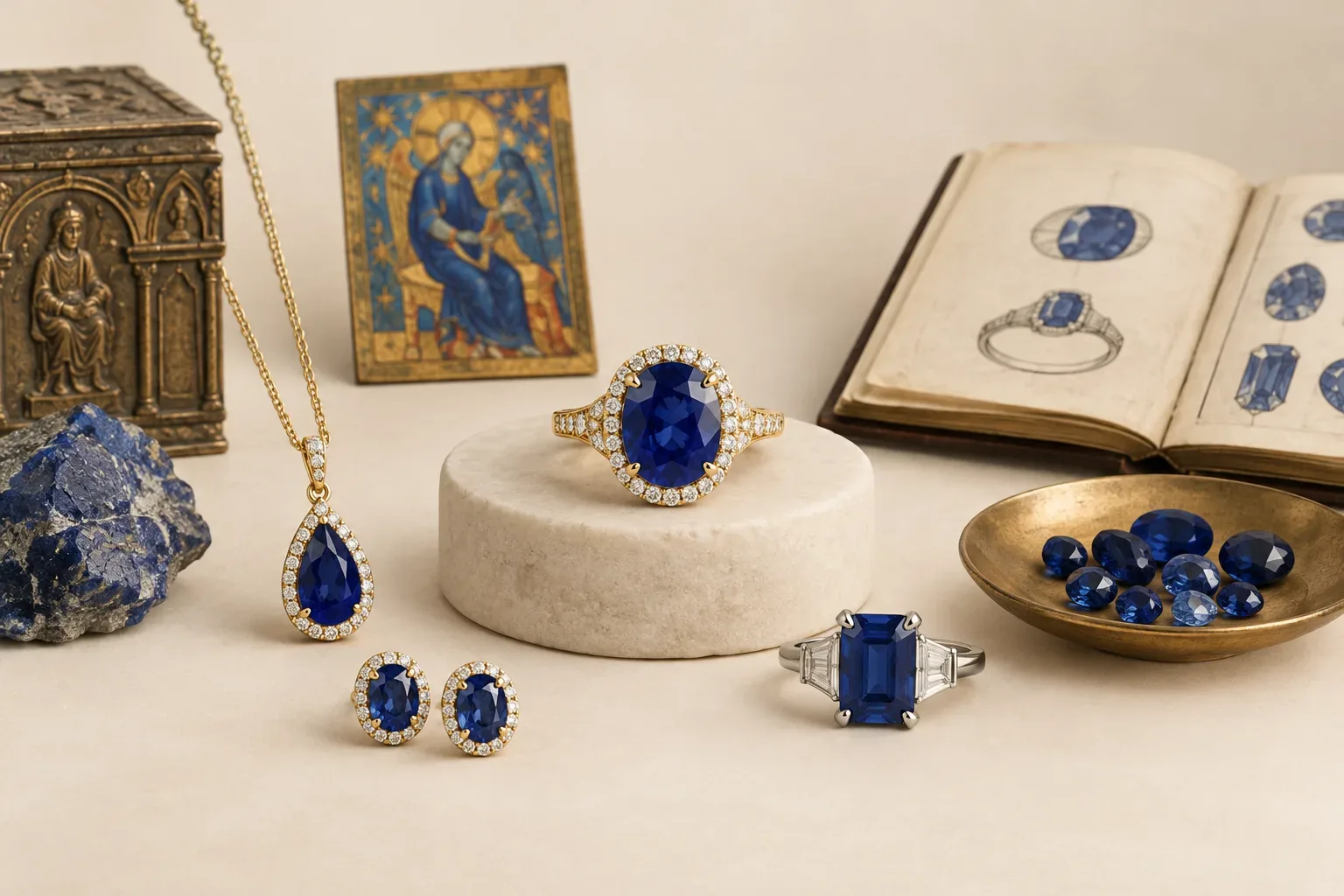
The ‘sapphire motif’—a recognizable preference for sapphires in a given shape, cut, or setting—appears in several ways across jewellery types. In historic church and court rings sapphires often form part of formal signet-like designs with substantial metalwork and symbolic engraving. In later personal jewellery, sapphires appear as single-stone solitaires, as colored centres in cluster settings, and as accent stones within patterned brooches or necklaces. Revival and vintage styles borrow historical settings—bezels, closed backs, heavy mounts—for their period look, while contemporary designs may use minimal metal to highlight faceting and colour.
In practice, a sapphire motif can mean a visual theme (for example, repeated blue stones in a necklace), a structural theme (a preference for bezel-set cabochons in a collection), or a symbolic theme chosen by the maker or wearer (using sapphires to echo a family colour or to match a uniform). Museum collections and historic examples documented by the V&A make clear these are culturally specific practices: the same motif has different social meanings depending on place and time.
Practical guidance for selecting or gifting a sapphire
Start with the occasion and the recipient’s lifestyle. If the wearer uses their hands frequently or prefers low-maintenance jewellery, choose a well-protected setting—such as a bezel or a design where metal shields vulnerable edges—and consider cuts that conceal inclusions and present stable colour rather than extreme faceting. If the recipient prefers flash and brilliance and will wear the piece in lower-risk contexts, a faceted stone in an open prong setting can maximise sparkle.
Ask for clear information about the stone’s treatments and origin. The Federal Trade Commission (FTC) recommends that sellers disclose common treatments, lab reports, and any imitations or synthetics. Treatment disclosure matters for long-term care and for the piece’s resale value; a reputable seller will provide written confirmation of what has been done to a stone and whether a lab report is available.
Balance aesthetics and durability. For day-to-day rings, choose settings that protect the girdle and culet and consider guard rails or thicker prongs to reduce the chance of chipping. For pendants and earrings—less likely to undergo direct impact—open settings that show off faceting are a good choice. If you are matching heirloom jewellery, respect the historic setting style: a Victorian bezel was often chosen to protect older cuts and to present colour in the way contemporaries preferred.
When in doubt, consult a trusted jeweller or a gemological laboratory. Ask about the maker’s experience with sapphire lapidary work and settings, and request photos of how the stone sits in the chosen mount. If you plan to insure the piece, accurate documentation of cut, setting, treatments, and any gem reports will make appraisal and claims straightforward.
Care, treatments, and buyer protections
Sapphire pieces can be durable, but care and knowledge matter. Have any included documentation explain whether the stone has been heat-treated or otherwise enhanced. The FTC’s consumer guidance on buying gemstones, diamonds, and pearls underlines the importance of disclosure of treatments and imitations, and it advises buyers to seek written confirmations from sellers. That documentation is useful both for everyday care and for future resale.
If you inherit or buy vintage sapphire jewellery, a style’s historical character may be part of its appeal, but older cuts and settings may need professional assessment. Museum descriptions, such as those from the V&A, show how earlier mounting conventions prioritised protection and colour in different ways; a conservator or experienced jeweller can advise whether a bezel should be preserved or whether a piece can be sympathetically reset for modern wear.
Final note
Sapphire cuts and settings are at once technical decisions about light and protection and cultural decisions shaped by time and place. Use historic examples to inform aesthetic choices, treat symbolic claims as culturally and personally specific rather than universal, and prioritise clear disclosure and sturdy settings when buying or gifting. For further reading about gemstones and jewellery history, consult museum resources like the V&A’s materials and consumer protections such as the FTC’s buying guidance.
Frequently asked questions
Are certain sapphire cuts more durable than others?
Durability in wear depends on both the cut and the setting. Historically, smoother cabochon forms and enclosed settings were used to protect gems, while faceted cuts and open prong mounts show more of the stone but expose it to impact. Choose a protective setting if daily wear and rough use are expected.
Should I expect disclosure of treatments for sapphire?
Yes. The Federal Trade Commission recommends that sellers disclose common treatments and any synthetic or imitation stones. Ask for written confirmation or a lab report where appropriate.
Is it appropriate to reset an antique sapphire into a modern style?
It depends on the piece’s historical value and sentimental importance. Museum practice, as described by the V&A, treats historical settings as part of an object’s story; consult a conservator or trusted jeweller before altering a historically significant item.
How should I choose a sapphire setting as a gift?
Match the setting to the recipient’s lifestyle and aesthetic: select protective mounts for everyday wear and open settings for pieces that will be worn sparingly. Request treatment disclosure and documentation, and prefer sellers who provide clear information.
Do museums show consistent symbolic meanings for sapphires?
No single symbolic meaning is consistent across all cultures and periods. Museum documentation, such as the V&A’s collections, records context-specific uses—status, religious, or decorative—rather than a single universal symbolism.
Sources and further reading
- Bedazzled: A History of Jewellery — Victoria and Albert Museum
- An A-Z of Gemstones — Victoria and Albert Museum
- Buying Gemstones, Diamonds, and Pearls — Federal Trade Commission