Meaning at a glance
Explain the documented history and changing contexts of the sapphire treatments and imitations motif, separate cultural or religious evidence from later popular interpretations, and give practical guidance for choosing and wearing the motif in modern jewelry.
What the historical record shows (and who recorded it)
Museum scholarship places gemstones, including sapphires, within changing social and technological contexts rather than as static symbols. The Victoria and Albert Museum frames jewellery history as an evolving conversation between materials, techniques, and social meanings; this perspective helps explain why sapphires have moved between sacred use, courtly display, and popular fashion at different times and places (Victoria and Albert Museum).
The V&A’s general accounts of gemstone history emphasize that the use, value, and symbolic attribution of gems depend on culture and period. Across recorded history, precious stones have appeared in religious objects, crown jewels, love tokens and personal adornment, but the museum cautions against reading any single, unchanging meaning onto a gem because meanings shift with social context (Victoria and Albert Museum).
More specifically, reference materials that summarize gemstones’ properties and identification explain that what looks like a sapphire in an object may be a natural corundum (the mineral species that includes sapphires), a lower-value natural substitute, or a manufactured material. Cataloguing and identification guides at institutions like the Victoria and Albert Museum document these distinctions to help historians and conservators interpret objects accurately (Victoria and Albert Museum, An A-Z of Gemstones).
Documented historical meanings versus modern personal interpretations
Documented historical meanings are those the evidence links to specific cultures, periods or contexts. Museum records and object catalogues often record use-contexts such as religious or royal display, trade-driven prestige, or mourning jewellery, and point to those as the bases for particular symbolic uses of gems at particular times. For example, museums may note that certain gems were repeatedly chosen for coronation or devotional objects in particular courts or religious traditions, which is a historical observation about usage rather than a universal symbolic claim (Victoria and Albert Museum).
Modern personal interpretations—what individuals today might feel or say a sapphire represents for them—are separate. Contemporary buyers often associate sapphires with qualities such as loyalty, wisdom, or calm, but those associations are personal or commercially promoted rather than universally documented across historical sources. The V&A’s work underlines that such meanings are contingent on context and can be layered on top of, but are not the same as, historically documented uses (Victoria and Albert Museum).
A careful buyer or gift-giver will therefore distinguish between documented history (how and where sapphires and substitutes were used) and modern sentimental attributions when deciding what a sapphire should mean in a present-day piece.
How treatments and imitations appear in the historical and modern record
Historically, jewellery makers and traders have used a variety of materials to achieve the desired colour and shine in objects, and museums document many cases where the visible effect was more important than botanical-style identification of a mineral. Substitutes—such as naturally occurring minerals that resemble more prized stones or man-made glass—appear in museum collections and records as part of trade and fashion practices that economized on cost or produced a required look (Victoria and Albert Museum, An A-Z of Gemstones).
In modern markets, treatments and synthetic options are common. Treatment can mean processes that alter a natural sapphire to improve its colour or clarity, while imitations may be lab-grown corundum (sapphire by composition) or other materials made to look like sapphire. The Federal Trade Commission emphasizes that sellers must disclose treatments and deceptive imitations; consumers should therefore expect straightforward information from reputable dealers (Federal Trade Commission).
How the gemstone and its substitutes appear in jewellery
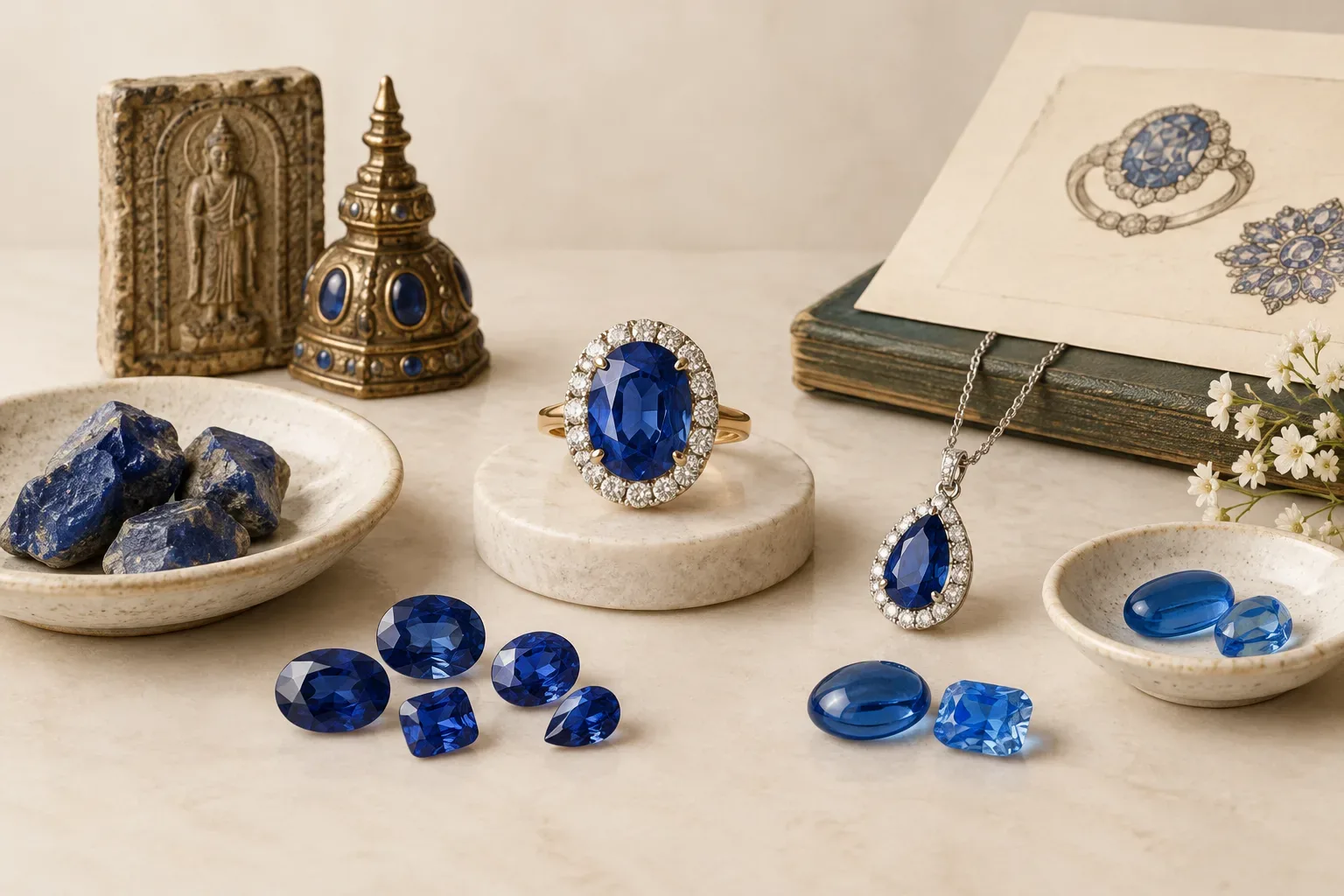
Sapphires and sapphire-look materials appear in many forms of jewellery: set as center stones in rings, used in brooches and pendants, combined into cluster settings or pavé work, and in larger objects such as tiaras and ceremonial items. Museum collections show that settings, cuts and mountings change with fashion: earlier cutting and mounting styles tend to leave more of the original crystal form visible, while later techniques use faceting and polishing to emphasise colour and brilliance (Victoria and Albert Museum).
When substitutes are used—either historically or in contemporary pieces—makers often mimic the visual qualities of sapphires rather than trying to reproduce mineralogy. That can mean using darker blue glass, spinel or other blue minerals historically, or using modern synthetic corundum or other lab-created materials in contemporary jewellery. The material affects long-term durability, how the stone responds to cleaning or repair, and its market value, so identifying the material has practical implications beyond meaning (Victoria and Albert Museum, An A-Z of Gemstones).
Practical questions to ask before you buy or gift
Start with clear provenance questions and written disclosure. Ask whether the stone is natural, whether it has been treated and which treatment was applied, and whether it is lab-grown or an imitation. The Federal Trade Commission makes clear that sellers should disclose treatments and synthetic origin; insist on written confirmation or a certificate from a recognised laboratory when material value or sentimental importance is high (Federal Trade Commission).
Ask about durability and care. Different materials require different cleaning and repair approaches. Treatments can affect how a stone responds to heat, acids, or ultrasonic cleaners, and some imitations are less hard or less colour-stable than natural corundum. A jeweller or certificate should specify care recommendations so the recipient can maintain the piece safely.
Clarify return policies and certification. If a seller provides a lab report, check what the laboratory tests for and whether the certificate covers treatment detection and origin. Confirm the shop’s return policy in case the written description does not match the stone you receive.
Consider symbolism and intention separately from material facts. Decide whether the meaning you intend—such as a token of fidelity, a family heirloom, or a fashion purchase—depends on the stone being natural, untreated, or simply blue and beautiful. If symbolism depends on the stone being natural or untreated, make that explicit when buying or commissioning a piece.
Respect the recipient’s preferences. If you are gifting, ask discreetly about preferences for natural versus lab-grown stones, for luminous colour versus historical authenticity, and for ethical sourcing. Many people value lab-grown sapphires for their lower environmental footprint and lower price; others prioritise natural, untreated stones for traditional or sentimental reasons. There is no single correct choice.
Choosing a reputable vendor and reading labels
Buy from established retailers, independent gem labs, or reputable auction houses that provide transparent, written statements about treatments and origin. The FTC guidance is practical here: sellers must not misrepresent treated stones as natural or fail to disclose lab-grown origin. When a seller is reluctant to put information in writing or the description is vague, treat that as a red flag and keep shopping.
Use museum or reference guides to inform questions. Institutions like the Victoria and Albert Museum publish accessible introductions to gemstones and jewellery history that help buyers understand how materials and meanings have changed over time. These resources are useful background for assessing what a seller tells you and for distinguishing documented history from modern personal meanings (Victoria and Albert Museum, An A-Z of Gemstones).
Final practical tips for gifting or wearing
If you plan to gift a sapphire for its symbolic value, state your intention and, if it matters, the stone’s status (natural, treated, lab-grown). That honesty preserves both the sentimental meaning and the recipient’s ability to care for the piece. If you are buying for fashion, a lab-grown or treated stone can offer spectacular colour for less cost and with different environmental and ethical profiles.
When in doubt, ask for a short period of trial or a documented return policy, secure a written certificate for higher-value purchases, and keep care instructions with the piece. Remember that while museums document how jewellery has carried meaning in many cultures, today’s meanings are often personal. Choosing jewellery with care and clear information lets the material and the sentiment align with confidence.
Frequently asked questions
What should I ask to know if a sapphire is natural or lab-grown?
Ask the seller directly whether the stone is natural or lab-grown and request a written statement or a laboratory report. The Federal Trade Commission advises that sellers disclose synthetic origin clearly, and a certificate from a recognised gemological laboratory gives additional assurance.
How can I find out if a sapphire has been treated?
Ask what treatments have been applied and for written disclosure. Common modern treatments improve colour or clarity, and reputable vendors or a gem report will specify them. The FTC expects sellers to avoid misleading claims and to disclose material treatments.
Are imitations common and how do they affect value?
Yes, both historical substitutes and modern imitations exist. Imitations and lab-grown stones can look very like natural sapphires but typically carry different market values and care requirements. Knowing the material lets you assess monetary value, durability, and appropriate cleaning methods.
Does the historical use of sapphires mean they have one fixed symbolic meaning?
No. Museum scholarship shows that gemstones’ meanings vary by culture, period and context. Historical use in royal or religious objects is a documentation of use rather than a universal symbolic definition; modern personal meanings are layered on top of those histories.
What documentation should I get for a significant purchase?
For higher-value pieces, ask for a gemological report that states whether the stone is natural, treated (and by what method), or lab-grown, and confirms weight and measurements. Also verify the seller’s return policy and keep written care instructions.
Sources and further reading
- Bedazzled: A History of Jewellery — Victoria and Albert Museum
- An A-Z of Gemstones — Victoria and Albert Museum
- Buying Gemstones, Diamonds, and Pearls — Federal Trade Commission