Meaning at a glance
Edwardian jewelry symbols are best understood through documented social and material history: museums record that early 20th-century jewelers favored light, delicate ornament and sentimental motifs, while modern wearers often apply personal meanings. This article separates museum-evidenced history from contemporary interpretation, explains how motifs and gemstones appear in jewelry, and offers practical selection and gifting guidance.
Direct answer — the short thesis
Edwardian jewelry symbols should be read as historically situated design choices rather than universal messages: museum evidence shows that turn-of-the-century designers and owners preferred delicate, classically inspired motifs and particular gems for their aesthetic and social connotations, while modern use often layers private or revived meanings on those designs. The right approach is to treat documented historical associations as context, distinguish them from later popular interpretations, and apply practical buying and gifting standards when selecting Edwardian or Edwardian-style jewellery.
What the historical evidence shows (periods and sources)
When we talk about Edwardian jewelry symbols we mean ornament produced in the late Victorian and Edwardian periods—roughly the last decades of the nineteenth century through the reign of Edward VII—plus direct revival pieces that consciously copy those historic forms. The Victoria and Albert Museum frames this era within a longer history of changing social fashions and jewellery technologies, noting shifts in taste and technique across the nineteenth and early twentieth centuries.
Museum documentation emphasizes two connected contexts. First is social context: jewellery reflected changing ideals of femininity, display, and private sentiment as recorded by curators and collections. Second is material and technological context: improvements in metalworking and the wider availability of certain gems shaped what makers could design and what clients could wear. Both contexts are necessary to understand why particular motifs and gems appear together in Edwardian pieces.
Documented historical meanings versus later or modern interpretations
Documented historical meanings come from how objects were used, catalogued, and explained in museums and archives. The Victoria and Albert Museum and similar institutions show that many turn-of-the-century pieces carried conditional, socially legible meanings: lockets, hair-mourning jewellery, and portrait miniatures functioned as tokens of memory and family ties, while neoclassical and natural motifs referenced education, taste, and fashionable ideals. These are context-dependent associations recorded by curators and historians rather than fixed symbolic dictionaries.
Modern personal interpretations are often layered on top of those historical contexts. Today a buyer might choose an Edwardian-style garland pendant because it looks 'romantic,' or select a crescent motif because they feel personally connected to moon symbolism. Those readings are valid as private meanings, but they are not the same as documented, period-specific uses and should not be presented as universal facts. Treat museum-documented associations as informed background and modern interpretations as contemporary personal or cultural re-use.
Common motifs, gemstones, and how they appear in Edwardian jewellery
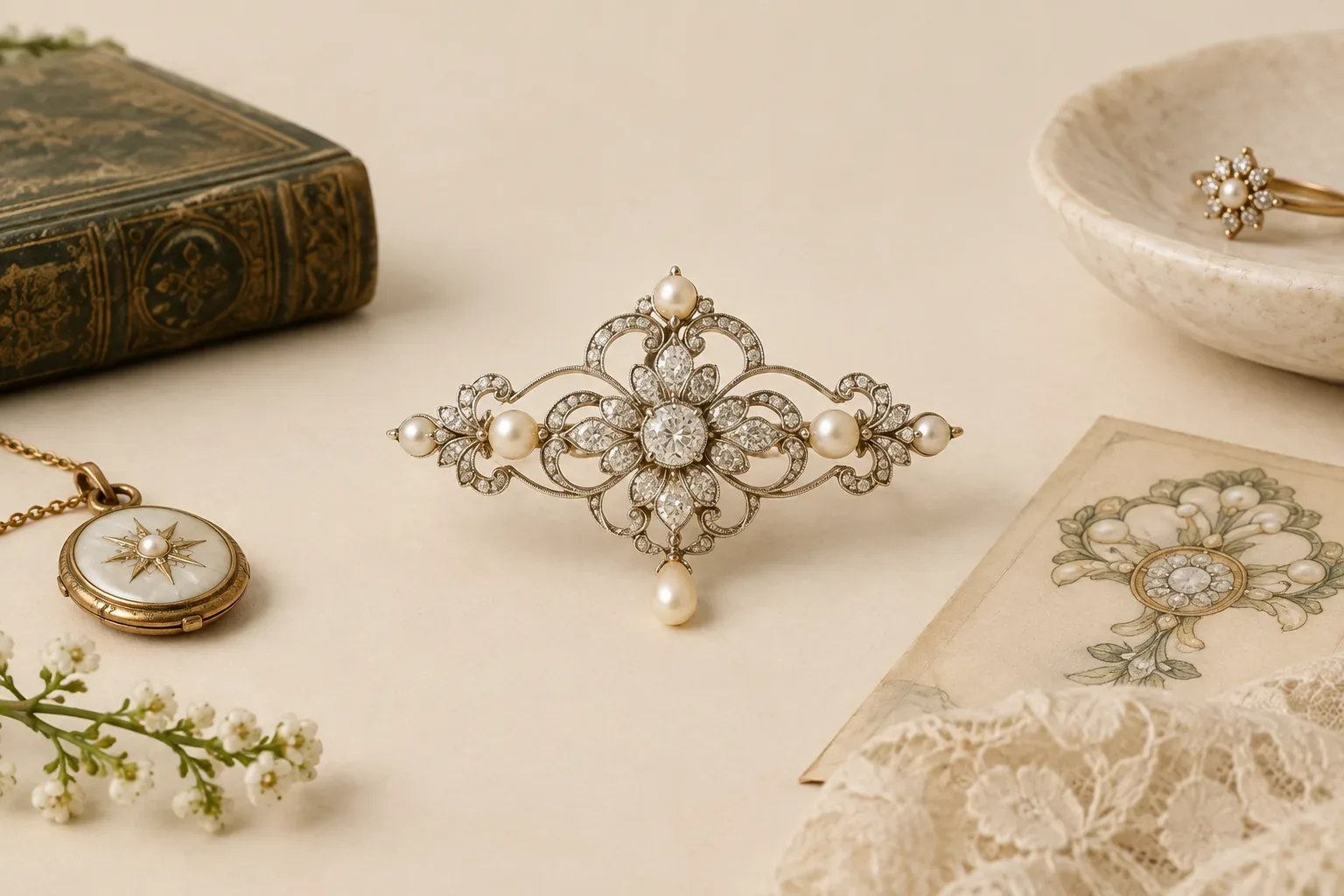
Across museum collections and historical surveys, Edwardian-era pieces are characterized by an emphasis on lightness, intricate surface treatment, and classical or natural motifs. These features were realized through techniques that create lace-like openwork, slender settings, and rhythmic ornament rather than heavy, compact silhouettes. Curators at the Victoria and Albert Museum discuss these shifts as part of the broader history of jewellery design and social taste.
Motifs commonly associated with the period in museum displays include bows, garlands or festoons, laurel and foliate scrolls, delicate swags, and allegorical or classical references. These appear in jewellery as engraved or pierced metalwork, small-scale reliefs, and three-dimensional mounts that integrate gemstones primarily for sparkle and accent rather than overwhelming color.
Gemstones documented in early twentieth-century pieces are often diamonds and pearls, which were prized for their ability to read as light and luminosity against pale metals. The Victoria and Albert Museum's overview of gemstones explains how different stones were chosen for optical effect, meaning, and availability. In many objects the gems are small and closely set to emphasize surface decoration: seed pearls outlining a scroll, a tight cluster of small diamonds forming a star or rosette, or a single pearl as a pendant's focal point.
Technically, these looks are frequently achieved in precious metals such as platinum and high-karat gold using fine settings and millegrain or beadwork to secure small stones. The overall aim recorded by museum curators is a sense of refinement and delicate display rather than mass or bold color.
How motifs and gemstones conveyed meaning in practice
Historically, meaning often rested on context. A locket worn at the throat could index intimacy or remembrance; a brooch with hairwork could explicitly signal mourning or connection to a deceased loved one, depending on the accompanying social practices. Museums document such uses as part of the object's provenance and interpretation rather than as universal symbolism.
Motifs that referenced classical antiquity or botanical forms tended to signal education, taste, or fashionable alignment with contemporary aesthetics. The presence of delicate diamonds and pearls supported those messages by reinforcing a refined, luminous appearance. Curatorial notes at institutions like the Victoria and Albert Museum help trace these links between motif, material, and social reading.
Choosing or gifting Edwardian-style symbols today: practical and respectful guidance
Start with intention: decide whether you want an authentic period piece, a documented museum-quality example, a verified antique with provenance, or a modern piece inspired by Edwardian design. Each choice carries different expectations about condition, price, and meaning. If historical authenticity matters, work with a reputable dealer or auction house and ask for documentation; if the aesthetic alone matters, a modern maker can reproduce Edwardian motifs with contemporary materials and comfort.
Ask about materials and treatments. The Federal Trade Commission provides consumer guidance on asking sellers about treatments, imitations, and disclosure. When buying gemstones or pearls, request clear information about any enhancements, synthetic stones, or assembled components and keep written receipts for disclosures.
Consider the recipient’s cultural and personal context. Avoid assuming a motif has a single fixed meaning; instead choose symbols whose documented historical associations align with the occasion, or select motifs purely for their beauty if that better matches the recipient. For gifts intended to evoke memory or sentiment, accompany the object with a short note explaining the historical resonance or the personal meaning you intend; that preserves respect for history while making your intention clear.
Handle care and assessment practically. Edwardian metals and small pavé settings can be fragile compared with modern, more robust construction. If buying an antique, request a condition report and, if possible, consult a jeweller experienced with period work about necessary conservation. For modern reproductions, confirm metal purity and gemstone sourcing and secure appropriate hallmarks or certifications when available.
Ethics and clarity matter. If you present a piece as an antique or as historically significant, ensure the provenance and seller statements support that claim. If a contemporary piece is made 'in the Edwardian style,' label it as such. Transparency honors both the object’s history and the recipient.
Frequently asked questions
What are typical Edwardian jewelry symbols?
Museum documentation shows that Edwardian-era and related late-Victorian pieces often feature delicate garlands, bows, laurel or foliate scrolls, classical references, and sentimental forms such as lockets. The exact repertoire and use vary by object and provenance; consult museum descriptions for period examples.
Did Edwardian motifs have fixed symbolic meanings?
No single, universal symbolic dictionary governed Edwardian motifs. Curatorial records indicate that many designs had socially legible associations—mourning jewellery for remembrance, classical motifs for taste—but meanings were context-dependent and not universally fixed.
How can I tell an authentic Edwardian piece from a modern reproduction?
Authentication requires provenance, condition reports, and sometimes specialist examination. If historic authenticity matters, request documentation from the seller and, when possible, an assessment by a recognised dealer, auction house, or conservator experienced with period work.
Are pearls and diamonds typical in Edwardian jewellery?
Yes; museum collections and gemstone overviews indicate that diamonds and pearls were frequently used in the period for their luminous qualities and suitability to delicate, light-focused settings. For details on specific stones, consult museum gemstone references.
What should I ask a seller about gemstone treatments?
Follow consumer guidance from the Federal Trade Commission by asking whether gemstones have been heat-treated, dyed, filled, assembled, or are synthetic, and request written disclosure. Sellers should be clear about treatments and imitations.
Sources and further reading
- Bedazzled: A History of Jewellery — Victoria and Albert Museum
- An A-Z of Gemstones — Victoria and Albert Museum
- Buying Gemstones, Diamonds, and Pearls — Federal Trade Commission