Meaning at a glance
This article explains documented Edwardian jewelry history—materials, motifs, and social uses—distinguishes historical evidence from modern personal meanings, and offers practical selection and care guidance.
What the historical evidence shows
The Victoria and Albert Museum places Edwardian jewelry within a shifting social context and technical environment: the era associated with the reign of King Edward VII and the early 20th century saw new metalworking capabilities and changing fashion ideals that encouraged light, airy ornament rather than the denser Victorian silhouettes familiar from earlier decades. Museum scholarship emphasizes materials, workmanship, and how jewelry related to dress and status rather than assigning single, universal symbolic meanings to every motif.
Technological developments are central to the documented history. According to the Victoria and Albert Museum, the increased availability and use of platinum allowed makers to create stronger, finer frameworks that supported fragile, openwork designs. This change in metal technology is a concrete driver of what collectors and historians now classify as Edwardian style: pieces that are finely pierced, filigreed, and often set with small stones to achieve an overall effect of lightness.
Gemstone use is also described by museum sources in terms of visual effect and availability. The Victoria and Albert Museum catalogs show a preference for diamonds and pearls for their brightness and ability to read as ‘delicate’ on the new, pale evening gowns and high-necked daywear of the time. Colored gemstones appear as accents but are not the defining feature of the mainstream Edwardian look the museum documents.
The museum-focused view treats jewelry as evidence of social practice—what people wore to signal class, follow fashion, or participate in newly relaxed social entertainments—rather than as a simple catalogue of universally understood symbols.
Separating documented historical meanings from modern interpretations
Historical documentation cited by the Victoria and Albert Museum supports statements about materials, techniques, and the contexts in which jewelry was worn, but it does not claim that specific motifs carried one fixed meaning across all wearers. Museum interpretation is careful to describe what the pieces are and how they were used in social life rather than to assert single symbolic readings for each motif.
In contrast, many modern personal or commercial interpretations—such as assigning a single emotional meaning to bows, garlands, or crescent motifs—are contemporary layers of meaning layered onto historic forms. These modern attributions can be meaningful for the wearer, but they should be treated as personal or cultural interpretations rather than as the only historically documented meaning.
When researching a motif, distinguish between primary evidence (what materials were used, how a piece was constructed, how it matched contemporary dress) and secondary, modern narratives about symbolism. The Victoria and Albert Museum’s account helps with the former; modern marketing or personal storytelling often provides the latter.
How motifs, gemstones, and traditions appear in Edwardian jewelry
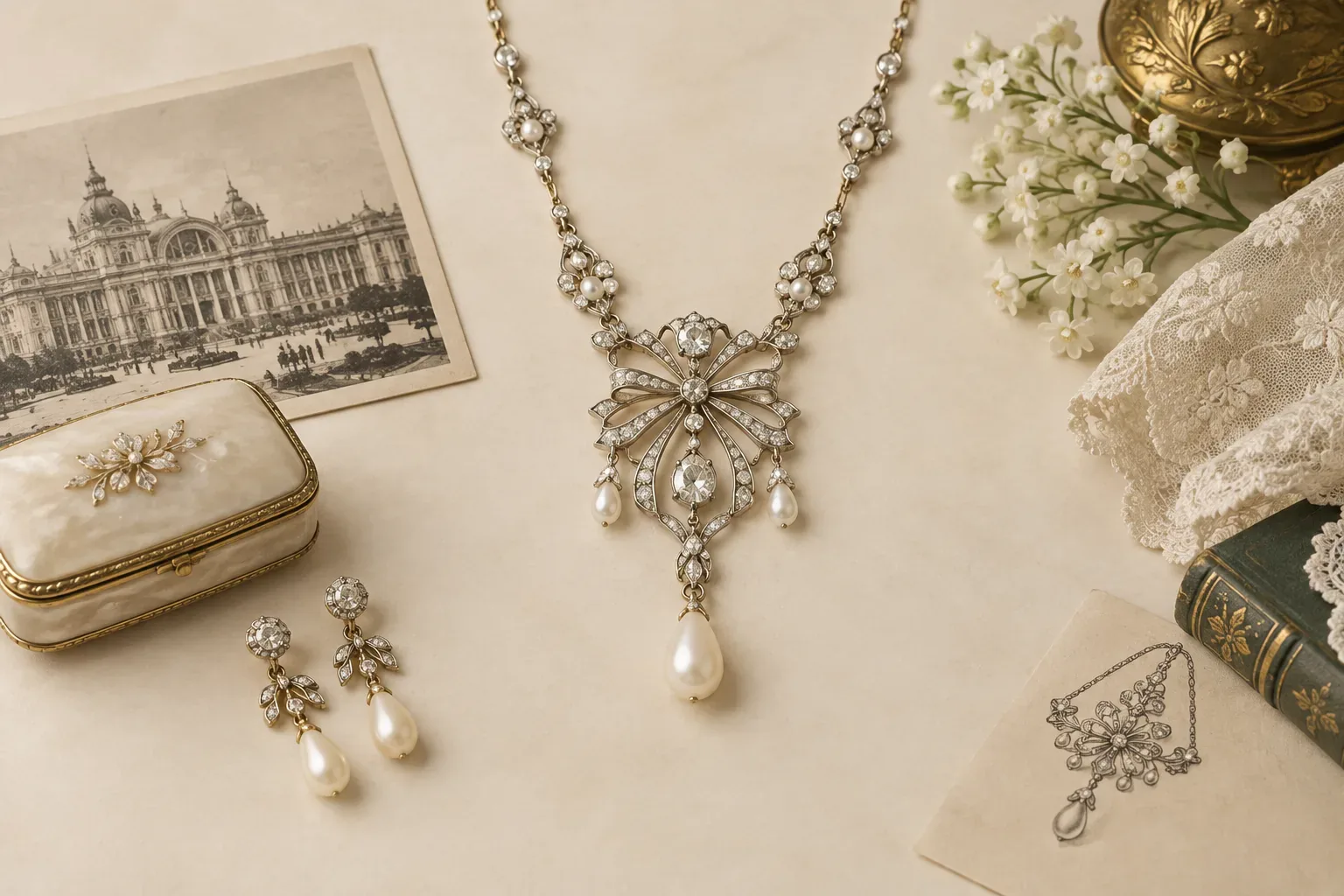
Motifs most commonly associated with the Edwardian style appear as delicate scrollwork, garlands, bows, and floral sprays worked into open frameworks. Museum collections illustrate how these elements are integrated into brooches, tiaras, pendants, and combs with an emphasis on line and negative space rather than mass. The motifs function as decorative structures that complement the cut and fall of contemporary dress.
Gemstones in these compositions were chosen for their optical properties and suitability to fine settings. Diamonds, often rose-cut or old mine-cut in period pieces, were used to generate sparkle against pale fabrics and to read clearly at small scale. Pearls were valued for their subdued sheen and ability to reinforce the soft, feminine silhouette of the period. The Victoria and Albert Museum’s resources explain these choices in terms of aesthetic and technical considerations rather than universal symbolism.
Techniques such as filigree, millegrain edging, and platinum openwork are repeated across types of jewelry. Chains, clasps, and settings were designed for the lifestyle of the wearer: some pieces were intended for formal evening wear, while lighter, simpler items suited daytime or travel. The museum’s analysis highlights how craft and fashion intersected in the period’s jewelry.
Status and daily wear: documented patterns
Museum documentation links particular jewelry types to social practices and status markers. High-quality materials and complex workmanship signaled wealth and access to skilled workshops. At the same time, the Edwardian era’s relaxed entertainments and evolving dress codes meant that the wealthy adopted lighter, less rigid accessories for many occasions, and some items were designed for repeated use rather than only the most formal events. This context is central to the museum’s interpretation of the period.
However, documented patterns in museum collections relate primarily to those who left surviving objects—often wealthier individuals. The absence of extensive material evidence for lower-income wearers means that museum accounts tend to reflect the practices of the population who could commission and keep such jewelry. That limitation is important to recognize when drawing conclusions from surviving pieces.
The museum’s records and interpretive material emphasize that wearing certain jewels was part of a broader visual language of class and taste in the early 20th century, not a simple or universal code of symbolic meaning.
Practical guidance for choosing and gifting Edwardian-style jewelry today
Decide whether you want an original antique, a period-correct vintage piece, or a modern piece inspired by Edwardian aesthetics. Originals have historic patina and potential conservation needs; carefully vetted vintage pieces may offer similar authenticity at lower cost; modern pieces can replicate the look while offering contemporary standards for durability and disclosure.
Pay attention to materials and treatments. The Federal Trade Commission advises buyers to ask about treatments, imitations, and disclosures when purchasing gemstones, diamonds, and pearls. Whether buying an antique or a new piece, request clear information about whether gems are natural, treated, or lab-created, and whether metals have been altered or repaired.
If choosing an original Edwardian-era piece, seek provenance and condition reports from reputable dealers or auction houses. Ask whether the piece has been conserved and whether any stones are later replacements. For modern Edwardian-style pieces, evaluate the construction quality: look for fine settings that protect delicate stones and for closures and clasps suited to everyday wear if you intend to wear the item frequently.
From a gifting perspective, be explicit about intent. If you are gifting an antique, include a note about its age and care needs; recipients may appreciate a short history and any documentation. If the gift is meant to carry a symbolic meaning for the recipient, make clear whether that meaning is a contemporary personal choice rather than an assertion about historic usage.
Care, wear, and respectful stewardship
Delicate Edwardian pieces, particularly those with fine filigree and old-cut stones set in platinum, often require gentle care. Store items flat or on soft padding to avoid distortion of openwork, and have antique pieces inspected by a conservator or experienced jeweler before regular wear. Routine cleaning should be conservative: strong ultrasonic cleaners can damage fragile settings or pearls, and professional cleaning may be the safest option for valuable or historic items.
Respectful stewardship also includes transparency when wearing or selling pieces. If an object is antique, be accurate about its provenance and condition. If you wear Edwardian-inspired new-jewelry, acknowledge the historic influence rather than claiming undue historical provenance.
Final thoughts
Edwardian jewelry history—when described through museum research—offers a clear picture of how materials, new metalworking techniques, and changing social life produced a distinctive aesthetic. Use the documented evidence to understand what a piece is and how it functioned in its original context, and allow modern interpretations to enrich personal meaning without conflating them with what the historical record documents.
For anyone choosing or gifting Edwardian or Edwardian-style jewelry today, balance aesthetic preference with material facts and conservation needs, and seek clear disclosures about treatments and provenance in keeping with guidance from institutional sources.
Frequently asked questions
What materials define Edwardian jewelry?
Museum research identifies platinum, diamonds, and pearls as central to the Edwardian aesthetic because platinum enabled fine openwork and diamonds and pearls provided the bright or subdued optical effects that complemented period dress.
Were specific motifs like bows or garlands universally symbolic in the Edwardian era?
No single universal symbolism is documented in museum sources; motifs served decorative and stylistic functions within social contexts, while modern symbolic readings are often contemporary personal interpretations.
Can I wear an Edwardian piece every day?
Many original Edwardian pieces are delicate and may require conservation; before daily wear have an expert assess condition and suitability, and consider modern reproductions for frequent use.
How can I verify whether gemstones are treated or imitation?
Follow the Federal Trade Commission’s advice: ask sellers for disclosure about treatments, origin, and whether gems are natural, lab-created, or imitations, and request written documentation when available.
Should I buy an antique Edwardian piece or a modern reproduction?
Choose an antique for historical authenticity and patina if you understand conservation needs; choose a modern reproduction for durability, transparent disclosure about materials, and often lower cost.
How should I care for pearls and fragile settings from the Edwardian period?
Pearls and fine filigree are vulnerable to chemicals, abrasion, and ultrasonic cleaners; store on soft padding, avoid harsh cleaners, and consult a professional conservator or experienced jeweler for cleaning and repairs.
Sources and further reading
- Bedazzled: A History of Jewellery — Victoria and Albert Museum
- An A-Z of Gemstones — Victoria and Albert Museum
- Buying Gemstones, Diamonds, and Pearls — Federal Trade Commission