Meaning at a glance
This article explains the documented history and changing contexts of Victorian jewelry motifs, separates contemporary personal interpretations from period meanings, outlines how motifs and gemstones appear in pieces, and gives practical tips for selecting or gifting Victorian-style jewelry.
What the historical evidence says and which period or culture it refers to
When I discuss "Victorian" jewelry in this article, I refer to the style and social uses of jewelry documented by curators and historians for the Victorian period, as summarized by the Victoria and Albert Museum (V&A). The V&A frames this era as one in which jewelry’s designs and social meanings shifted with changing fashion, technology and personal practice, so identifications should be tied to material and stylistic evidence rather than assumptions.
Museum research shows that motifs and materials varied across contexts—public display, private sentiment, mourning, and novelty—and that some motifs migrated in meaning over time. For identification that distinguishes original Victorian pieces from later revivals, look for construction techniques, hallmarking, and wear consistent with nineteenth‑century manufacture, and consult experts or institutional references when in doubt. The V&A’s collections and interpretive resources provide documented examples and explanations of how motifs and gemstones were used in different contexts during this period.
For gemstone and material identification, rely on technical references and consumer protection guidance. The V&A’s A–Z of Gemstones describes historical uses of particular stones and materials, while the U.S. Federal Trade Commission (FTC) explains how treatments, imitations and disclosure practices affect modern buying and labeling. Those three strands—the museum record for context, the gem references for materials, and the FTC for modern treatment and disclosure—are the evidence base used here.
Common Victorian motifs and what they meant then (documented) versus what people often say today (modern interpretations)
Documented Victorian meanings: Museum documentation records several recurrent motifs and their conventional uses in nineteenth‑century jewelry. Lockets and hairwork brooches were commonly used for personal remembrance or to keep a loved one close; naturalistic motifs such as flowers, leaves and insects reflected the period’s interest in the natural world and often signified seasonality, beauty or personal taste; and symbols like serpents, knots and acorns were used to suggest continuity, fidelity or growth in specific giving contexts. The V&A emphasizes that these motifs operated within social practices of display, memory and affection rather than as single, fixed messages.
Modern personal interpretations: Today, people frequently layer contemporary symbolic readings onto Victorian motifs—declaring, for example, that a certain flower must mean a single emotional state, or that every serpent ring is an engagement token. Those emphatic, universal claims are modern, often personal, interpretations rather than consistent historical facts. The museum record shows motifs had multiple uses and meanings that could vary by wearer, occasion and date. Treat modern symbolic claims as one reading among several rather than definitive historical truth.
How motifs, gemstones and traditions appear in Victorian jewelry
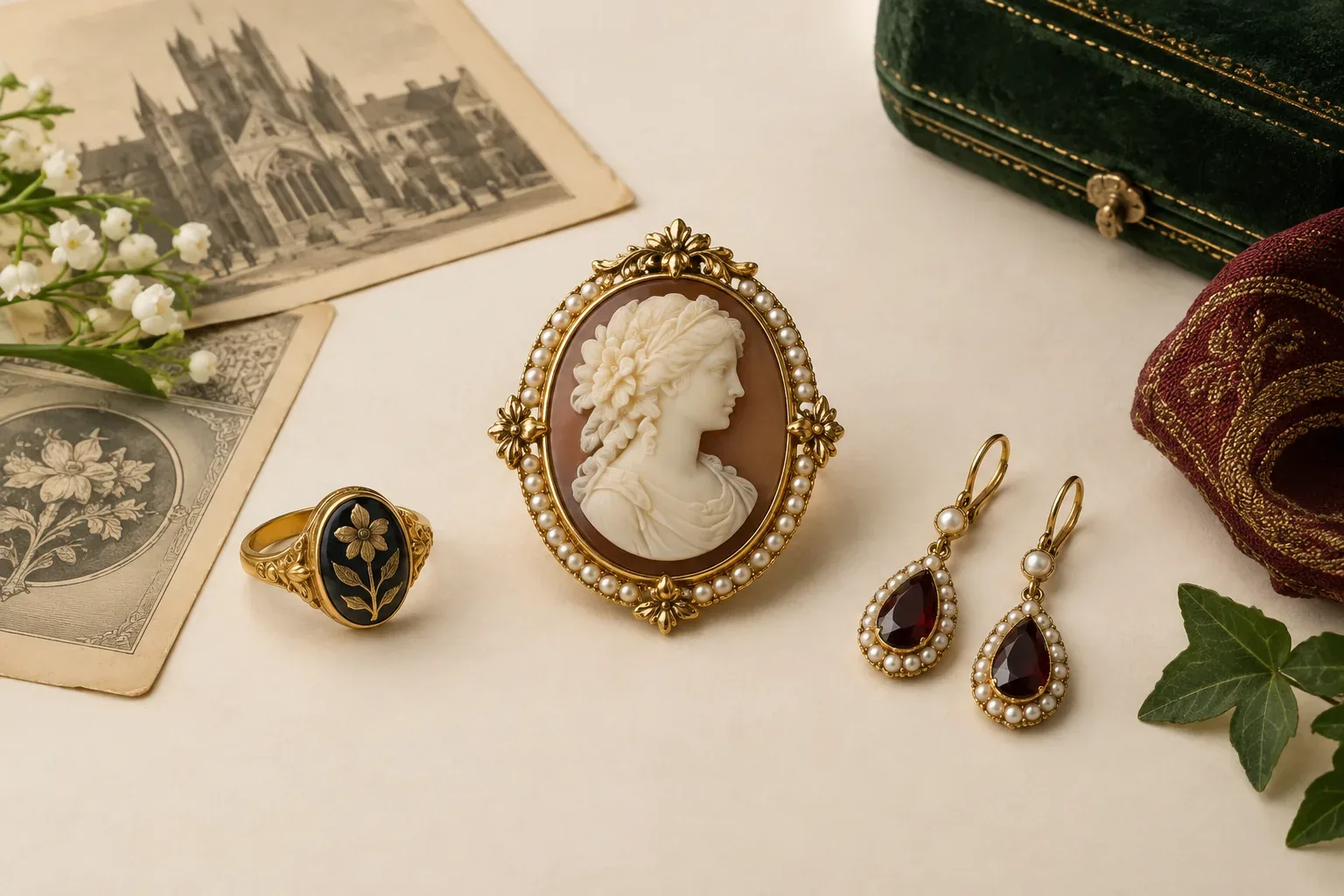
Motifs: Victorian motifs appear in a range of forms. Lockets typically take the form of small hinged cases designed to hold hair or a portrait. Mourning jewelry often appears as black materials—jet, enamel, or cut steel—and may incorporate woven hair or inscriptions. Natural history motifs appear as delicate gold‑work, enamelled botanical designs, or carved cameos showing floral subjects. Symbols such as snakes and knots are frequently realized as rings, brooches or bracelet clasps with fine engraving or applied decoration. The V&A’s collection examples illustrate how a single motif could be rendered in many media depending on fashion and price.
Gemstones and materials: Gem use in Victorian pieces ranges from seed pearls and garnets to diamonds and cameos. The V&A’s A–Z of Gemstones explains how particular stones were used for effect and status in period jewelry. Some stones were cut and set in ways distinctive to the period; for example, certain table cuts, closed settings and foiled stones are common in earlier nineteenth‑century pieces. Beads, paste (glass imitating gems), and early synthetic stones also appear, and modern sellers may not always disclose treatments or imitations unless asked.
Construction and finish: Identification also rests on manufacturing clues. Hand engraving, soldering marks, riveted brooch stays, and patina consistent with age can indicate nineteenth‑century manufacture, whereas machine finishes, modern adhesives, or ultramodern clasp styles point to later production. Museum catalogues note that changes in technique across the century affect how motifs were produced and how they have aged.
Common mislabels and identification pitfalls
Many pieces marketed as "Victorian" are later revivals or simply 'Victorian style.' The V&A underscores the importance of context: a motif alone does not date a piece. Sellers and buyers often misidentify reproductions, later romantic revivals, or mass‑produced twentieth‑century items as original Victorian jewelry.
Another frequent mislabel is material misidentification. The FTC warns buyers to ask about treatments and imitations: paste, glass, or modern synthetics can imitate period gemstones, and many stones receive heat or dye treatments that alter their appearance. Without explicit disclosure or gem testing, appearance alone can mislead identification.
Finally, attribution of singular symbolic meaning is a common error. Historical uses were varied and context-dependent, so treating a single motif as carrying one fixed message may misrepresent the object’s original social function.
Practical steps for identifying Victorian pieces
Start with the whole object: evaluate motif, construction, materials and signs of wear together. Ask for any hallmark, maker’s mark or provenance documentation and compare these with museum examples where possible. Use technical references such as the V&A’s A–Z of Gemstones for material context and consult reputable dealers or certified gem laboratories for stone reports when price or authenticity are important.
If the piece is sold as nineteenth‑century, request documentation of age and any lab reports. For stones and treatments, the FTC advises buyers to ask directly about treatments, imitations and disclosures; reputable sellers will provide clear information. When in doubt, a gemological report will confirm whether a stone is natural, treated, synthetic or imitation.
Selecting and gifting Victorian or Victorian‑style jewelry—respectful, practical guidance
Match the context and the motif to the recipient: choose sentimental motifs such as lockets or hearts for recipients who appreciate personal symbolism, but avoid gifting authentic mourning jewelry (for example, pieces explicitly inscribed for bereavement) unless the recipient understands and welcomes the provenance. The V&A’s work on memory and jewelry highlights how nineteenth‑century objects could be intensely personal; respect that history when gifting.
Be transparent about authenticity and condition: if you choose a genuine antique, provide any provenance and explain its status as a historical object that may show wear. If you choose a modern piece in Victorian style, present it as such and describe the materials and any stone treatments. The FTC’s consumer guidance recommends clear disclosure about treatments and imitations so recipients know what they are receiving.
Consider jewelry care and repair needs: older metals and settings may be fragile or require specialist repair. Ask the seller about maintenance recommendations, and when giving an antique piece, include guidance on care. If you want the visual language of Victorian jewelry without conservation concerns, select contemporary makers who replicate motifs using modern materials and secure settings.
When to seek expert help
If value, rarity, or historical importance is at stake, consult a qualified appraiser, a museum curator, or a certified gem laboratory. Museums like the V&A can be a reference point for stylistic categories and documented examples, and gem labs provide technical verification of stones and treatments. For high‑value purchases, independent verification protects both buyer and seller from mislabeling and incomplete disclosure.
Frequently asked questions
How can I tell if a piece is an original Victorian antique or a later revival?
Look at the whole object: construction techniques, hallmarks, patina and wear, and the style of settings and clasps. Compare the piece to museum examples and ask for provenance. When in doubt, request an expert appraisal or laboratory report—museums like the V&A document stylistic differences that help distinguish originals from later copies.
Are serpent rings always engagement rings in Victorian jewelry?
No. While serpents were used to suggest continuity or fidelity in some nineteenth‑century contexts, the symbolic use varied. Museum documentation shows the motif had multiple meanings and uses, so treat any single symbolic claim as a possible interpretation rather than a universal rule.
What questions should I ask a seller about gemstones and treatments?
Ask whether a stone is natural, treated, synthetic or an imitation, and request written disclosure or a laboratory report for high‑value items. The FTC advises consumers to seek explicit information about treatments and imitations before purchasing.
Is it appropriate to gift mourning jewelry?
Be cautious. Authentic mourning pieces often have explicit funerary associations; give them only to recipients who understand and welcome that history. If you want the look without the historic connotations, choose contemporary pieces inspired by Victorian motifs and present them as modern creations.
Where can I find reliable references to compare motifs and materials?
Museum resources such as the Victoria and Albert Museum’s catalogues and the V&A’s A–Z of Gemstones provide documented examples and material context. For technical gem identification and disclosure standards, consult consumer guidance such as the Federal Trade Commission’s advice on buying gemstones, diamonds and pearls.
Sources and further reading
- Bedazzled: A History of Jewellery — Victoria and Albert Museum
- An A-Z of Gemstones — Victoria and Albert Museum
- Buying Gemstones, Diamonds, and Pearls — Federal Trade Commission