Meaning at a glance
Document the Victorian motifs and their changing meanings as described by museum scholarship, separate historical evidence from later popular interpretations, and offer practical, ethically minded advice for selecting, verifying, and wearing revival pieces today.
What the historical evidence shows
Museum scholarship documents a wide range of styles and uses for nineteenth-century British jewelry commonly called "Victorian." The Victoria and Albert Museum describes how the period encompassed sentimental lockets and hairwork, Gothic and medieval revivals, and naturalistic motifs such as flowers and insects, each appearing in different decades and social contexts.
The V&A frames these changes as responses to broader cultural forces, including technological advances in production, shifting fashion tastes, and changing ideas about memory and mourning. These institutional accounts are the basis for identifying a piece as historically Victorian: style vocabulary, construction methods, and documented provenance or comparable museum examples all matter.
Identifying cultures and periods precisely
When we say "Victorian" we are referring to a set of nineteenth-century British styles and practices rather than a single, uniform meaning. Within that span you will find distinct phases: early romantic and medieval revival references, mid-century mourning and sentimental jewellery, and later naturalistic and elaborate designs. The Victoria and Albert Museum's historical surveys are useful for distinguishing these phases by motif, technique, and social use.
It is important to keep geographical and cultural limits clear: documented Victorian meanings come from British social and material history as studied by museum collections and curators. Similar motifs were used elsewhere and at other times with different meanings; those parallels should be treated as separate lines of evidence rather than proof that a Victorian meaning was universal.
Documented historical meanings versus modern interpretations
Documented meanings rely on contemporary nineteenth-century sources, object labels, and museum research. For example, lockets and hairwork are well documented in museum literature as forms of personal or family memory and, in many cases, mourning practice. These contexts are described in the V&A's histories of jewelry and collection notes.
Modern personal interpretations are legitimate but distinct. A locket worn today may be intended as a fashion statement, an expression of romance, or a mindful heirloom. None of those modern readings erase the historical uses, but they should not be presented as the original documented meaning unless supported by period evidence. Always separate what museums have documented from how people choose to wear and understand pieces now.
How motifs, gemstones, and traditions appear in jewelry
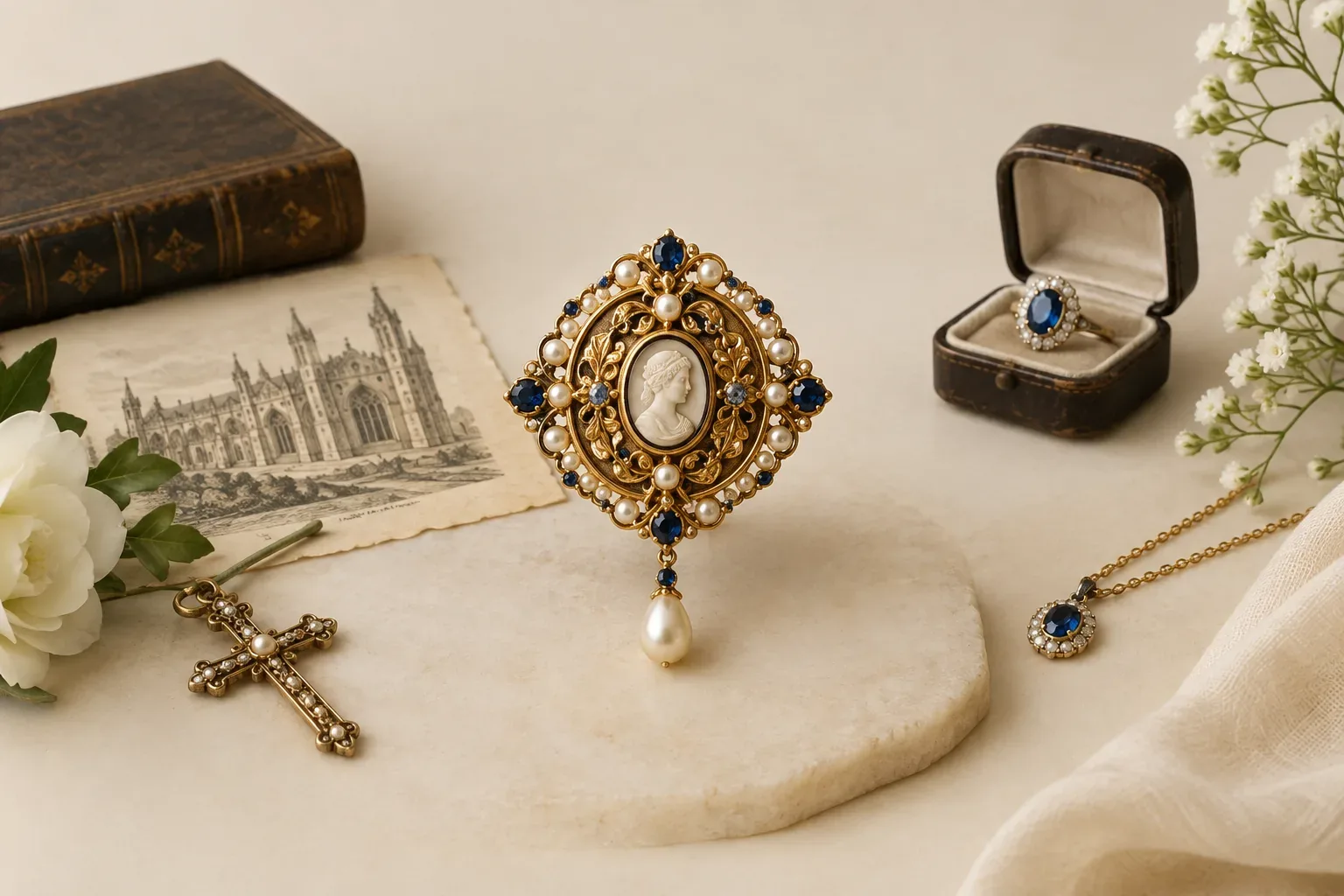
Motifs: Victorian pieces often display specific motifs tied to their social uses. Mourning jewelry frequently features dark materials, stylized urns, willows, or clasped hands. Sentimental pieces incorporate portraits, miniatures, or hair encased in lockets and brooches. Gothic or medieval revival elements show pointed arches and motifs borrowed from historical sources. These forms are reflected in the V&A's descriptive accounts of nineteenth-century jewelry styles.
Gemstones and materials: The V&A's A–Z of Gemstones explains how particular stones and materials were used in historical pieces. Jet and black enamel commonly appear in mourning contexts, seed pearls and garnets are frequent in mid-century designs, and diamonds and colored gemstones appear across the period as tastes and incomes varied. Gemstone cuts and mounting styles also changed over the century and can help date a piece.
Construction and technique: Victorian jewelry can be recognized by construction details that museum conservators and catalogues note, such as the presence of hairwork set under glass, early mass-production joins alongside hand-finished details, and characteristic settings for certain stones. Those technical clues are often as useful as visual style in identifying period work.
Practical buying checks: authenticity, treatments, and disclosure
Start with clear documentation. Provenance, photographs of hallmarks, condition reports, and seller descriptions that reference comparable museum examples strengthen a purchase. When a seller cites museum parallels or period references, ask for the specific sources or comparable catalogue entries.
Ask about treatments and imitations. The Federal Trade Commission recommends that sellers disclose material treatments, imitations, and enhancements for gemstones, diamonds, and pearls. Ask whether stones have been heat-treated, dyed, assembled from smaller parts, or are modern reproductions. A reputable seller will provide clear information or independent testing if necessary.
Condition matters. Antiques may require conservation or careful repair; repairs can affect value and wearable safety. Request detailed images of mounts, clasps, and any repairs, and consider having a trusted jeweller or conservator inspect an expensive piece before completing a purchase.
Choosing between antique originals and modern revival pieces
Antique originals carry historical patina and the risk of previous repairs or lost components; they may also require special care. Revival pieces capture Victorian motifs but are often constructed with modern materials and techniques. Decide whether historical authenticity or contemporary wearability and price are your priority.
If you choose a reproduction or revival piece, confirm what aspects are modern: metals used, stone treatments, and whether the design is merely inspired by Victorian forms rather than being a faithful recreation. Sellers should be transparent about this distinction because the historical label affects both expectation and price.
Respectful selection and gifting guidance
Be mindful of context. Mourning symbols — jet, black enamel, or explicit memorial wording — may still carry emotional weight for recipients. If you are unsure whether a mourning motif is appropriate, ask discreetly about family sensitivities or choose a related but more neutral motif such as a floral or simple locket.
Match recipient preferences and provenance. If you plan to gift an antique, consider how the recipient values authenticity versus wearability. Present provenance information with the gift and, if possible, a short note explaining the documented nineteenth-century context as described by museum resources, so the recipient can appreciate the object's history.
Avoid assuming symbolic meanings. Victorian motifs can be interpreted differently today, and meanings attributed in vintage or commercial descriptions may reflect later romanticized narratives. When in doubt, frame the gift with your personal intention while acknowledging historical uses documented by museums.
Care, conservation, and display
Treat antique pieces with conservation-grade care. Avoid ultrasonic cleaning, harsh chemicals, and excessive handling; older materials like hairwork and early adhesives are fragile. If you plan to wear an antique piece regularly, consult a conservator or experienced jeweller about necessary repairs or safe modifications.
Store and display thoughtfully. Use acid-free materials for mounting or storage, keep a record of any documentation and testing, and maintain photographs of condition. These steps preserve both the object and its historical value for future owners.
Final thoughts
A thoughtful Victorian jewelry buying approach relies on careful distinction between documented historical evidence and later interpretations, attention to materials and disclosure, and sensitivity to the motif's emotional context. Use museum resources such as the Victoria and Albert Museum for historical reference and the Federal Trade Commission for practical consumer protections regarding gemstones and treatments. With those guides you can choose pieces that are beautiful, responsible, and respectful of their histories.
Frequently asked questions
How can I tell if a piece is genuinely Victorian?
Look for documented provenance, hallmarks consistent with nineteenth-century standards, construction details noted in museum references, and comparable examples in museum catalogues; when in doubt, request an expert condition and authenticity report.
Is it inappropriate to wear or gift mourning jewelry today?
Not necessarily, but be sensitive: mourning motifs may still convey grief to some people. Ask about family sensitivities or choose a related non-mourning motif if you are unsure.
What questions should I ask about gemstones and treatments?
Ask whether stones have been heat-treated, dyed, assembled, or substituted, and request written disclosure or independent testing if needed, following the Federal Trade Commission's guidance on material disclosure.
Should I buy an original antique or a modern revival?
Choose an original if historical authenticity and provenance matter most; choose a revival if you prefer modern materials, predictable wearability, and often lower cost. Confirm clearly with the seller whether a piece is original or inspired.
How do I research the meaning of an unfamiliar symbol on a piece?
Start with reputable museum resources and catalogue entries for comparable objects, note the object's dates and origins precisely, and treat later commercial or romanticized explanations as separate from primary documentary evidence.
Can antique Victorian jewelry be resized or repaired?
Repairs and alterations are possible but can affect value and historical integrity; consult a conservator or experienced jeweller before making changes, and request documentation of any work performed.
Sources and further reading
- Bedazzled: A History of Jewellery — Victoria and Albert Museum
- An A-Z of Gemstones — Victoria and Albert Museum
- Buying Gemstones, Diamonds, and Pearls — Federal Trade Commission