Meaning at a glance
Explain the documented history and changing contexts of the medieval european jewelry buying guide motif, separate cultural or religious evidence from later popular interpretations, and give practical guidance for choosing and wearing the motif in modern jewelry.
What the historical evidence shows (and how sources identify cultures and periods)
Museum research shows that jewelry in medieval Europe was not uniform: production, materials, and visual language varied by region and period. The Victoria and Albert Museum frames jewellery history as a record of changing social contexts and techniques, noting distinct traditions across Byzantine, Carolingian and later medieval Gothic contexts as well as local workshops in northern and western Europe. When a dealer or designer refers to “medieval” jewelry, ask which culture or century they mean, because a Byzantine enamel reliquary and a late medieval English posy ring reflect different makers, techniques, and uses.
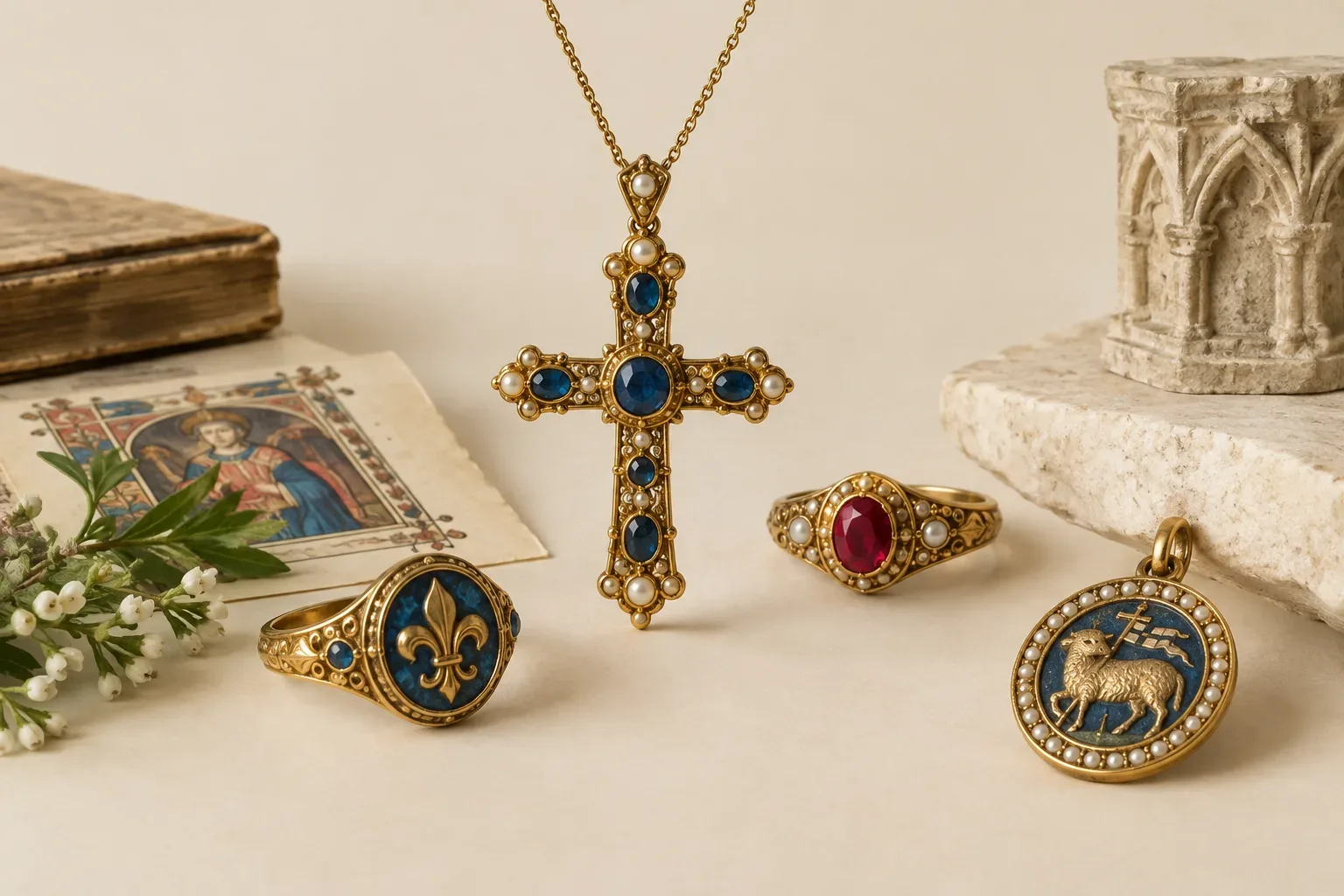
Archaeological finds and museum collections document types of objects that were worn, displayed, or used for devotion. Examples that appear in V&A discussions include religious medallions and crosses, rings and finger-ornaments, brooches and fibulae, and small reliquary pendants. These items were made in gold, silver, and with settings of glass, enamel, and a range of gemstones, and their meanings depended on who owned them and how they were used rather than being fixed universal symbols.
Separating documented historical meanings from later interpretations
Documented meanings are those that contemporary records or close archaeological contexts support: for instance, certain crosses and reliquaries were used in devotional practice, and pilgrim badges recorded pilgrimage routes and shrines. Museums such as the V&A present these functional and social contexts, distinguishing devotional use, status display, and household or civic roles for jewelry.
Modern meanings are often creative re-reads. Revival pieces and fashion adaptations frequently assign generalized ideas—such as “medieval = mysterious” or “ancient spirituality”—that did not belong to all objects historically. Many motifs that are treated today as ‘symbolic’ were sometimes primarily decorative or tied to a specific local custom. Treat modern attributions as personal or contemporary cultural meanings unless a reliable historical source documents the same association.
How motifs, gemstones, and traditions appear in medieval-inspired jewelry
Motifs: Common medieval motifs reproduced in revival jewelry include crosses and small reliquary forms, interlace and geometric patterns drawn from Insular or Norse art, and heraldic or maker’s marks taken from late medieval seals and badges. When designers reference these motifs, they either reproduce historic examples closely or abstract elements into a new aesthetic. Pay attention to whether a piece is presented as a replica of a known object or as an original design ‘inspired by’ a period.
Gemstones and materials: Museum resources that survey gemstones and jewellery techniques explain that medieval objects used a mix of hard stones, glass imitations, pearls, enamel, and goldwork. The Victoria and Albert Museum’s materials guidance describes the historical use and evolving perceptions of gems and glass in jewelry. Contemporary makers using authentic materials may still combine treated or lab-grown stones that mimic historic colors. The Federal Trade Commission requires sellers to disclose treatment, substitutes, and imitations; ask for clear labeling and written confirmation of what a gemstone is and whether it has been enhanced.
Techniques and construction: Medieval jewelry shows period techniques such as cloisonné and champlevé enamel, granulation, and cast or forged metalwork. Revival-makers sometimes apply these techniques authentically, while others suggest a medieval look through surface finishes and modern fabrication. If technique matters to you—for historical fidelity or collector value—request information about how the piece was made, and whether any parts are cast reproductions or hand-finished.
Practical guidance for choosing or gifting medieval-style jewelry respectfully
Define your purpose. Are you seeking a historically faithful replica for study or reenactment, a modern ring inspired by medieval forms, or a piece meant to communicate a personal sentiment? Clarifying purpose changes what to prioritize: provenance and technique for replicas; design and wearability for contemporary pieces.
Ask for documentation. For any piece sold as ‘medieval’ or a reproduction, ask the seller whether it is an original antique, a replica based on a known object, or a modern design inspired by medieval motifs. Reliable sellers and museums will describe the difference. If a piece is an antique, request provenance or a condition report. For modern pieces, request material information and any treatment disclosures consistent with Federal Trade Commission guidance on gemstones and imitations.
Consider cultural and religious contexts. Some medieval items were devotional or associated with specific shrines, saints, or communities. If a motif has clear religious function, consider whether wearing or gifting it would be respectful. When in doubt, ask the seller for background and avoid using devotional symbols in ways that could be insensitive to practitioners or communities linked to that symbol.
Prefer transparency over romantic claims. Marketing that relies on vague claims of ‘mystical lineage’ or unspecified rituals is not a substitute for historical evidence. If you value authenticity, work with reputable dealers, museum shops, or makers who document their sources, and consult museum references for context.
Match scale and function to modern wear. Medieval pieces often had different sizes and uses than contemporary jewelry. For everyday wear, choose pieces designed to modern standards of comfort and durability, or ask a conservator or jeweler about modifications that preserve historic character while making the object wearable.
Gifting ethically. When gifting a medieval-inspired item, communicate whether the piece is a reproduction, a modern design, or an antique. This preserves the recipient’s ability to interpret its meaning accurately. If the wearer observes a religion or cultural tradition connected to the motif, choose an alternative motif or ask discreetly about preferences.
Where to look and whom to trust
Museum shops and reputable dealers who cite specific museum objects or catalogues are usually reliable starting points. The Victoria and Albert Museum provides a reliable overview of jewellery history and gemstones, and its publications and displays can help you identify characteristic forms and materials. For purchases involving gemstones, consult consumer guidance such as the U.S. Federal Trade Commission’s advice on buying gemstones, diamonds, and pearls, which explains required disclosures for treatments, synthetics, and imitations.
Independent makers and small studios often create high-quality, ethically produced revival pieces, but verify material claims and ask about sourcing. If a seller cannot or will not document materials or the origin of an antique, treat that as a warning sign.
Final notes on respectful appreciation
A thoughtful buyer balances aesthetic preference with historical respect. Use museum resources to ground your understanding, ask direct questions of sellers, and be transparent with recipients when pieces reference religious or culturally specific symbolism. Modern interpretations can be meaningful, but do not present contemporary readings as if they were historical fact without supporting evidence from reliable sources such as the Victoria and Albert Museum.
Frequently asked questions
How can I tell if a piece is an authentic medieval antique or a modern reproduction?
Ask the seller for provenance, condition reports, and whether the piece has been dated by a specialist. Museums and reputable dealers will distinguish originals from reproductions; if provenance or expert verification is missing, treat the item as a modern or uncertain piece.
Are certain medieval motifs offensive to wear today?
Some motifs had clear religious or civic functions; wearing them without understanding can be insensitive in particular contexts. If a motif is explicitly devotional, ask for background before wearing it in contexts where worshippers might take offense, and consider choosing a neutral or purely decorative design instead.
What should I ask about gemstones and treatments when buying revival medieval jewelry?
Request written disclosure of gemstone type, any treatments (dyeing, heating, fracture filling), and whether stones are natural, lab-grown, or simulants. The Federal Trade Commission advises sellers to disclose such information; insist on clarity before purchase.
Is it better to buy a faithful reproduction or a modern design inspired by medieval motifs?
It depends on your purpose. For study or historically accurate wear, choose faithful reproductions backed by documentation. For everyday wear or personal meaning, a modern design may be more comfortable and ethically straightforward. Be clear about the piece’s status when gifting.
Where can I research the historical meaning of a particular medieval motif?
Begin with reliable museum resources and catalogues. The Victoria and Albert Museum provides accessible overviews of jewellery history and gem contexts. For deeper research, look for catalogues raisonnés or academic publications that cite archaeological finds and contemporary records.
Sources and further reading
- Bedazzled: A History of Jewellery — Victoria and Albert Museum
- An A-Z of Gemstones — Victoria and Albert Museum
- Buying Gemstones, Diamonds, and Pearls — Federal Trade Commission