Meaning at a glance
This guide explains the documented history and changing contexts of Viking-Age Scandinavian motifs, separates historical evidence from modern interpretations, describes how motifs and gemstones appear in revival pieces, and gives practical buying and gifting advice to help you choose responsibly.
What the historical evidence can and cannot tell us
Archaeological finds, museum research, and conservation work are the primary sources for understanding Viking-Age Scandinavian jewelry. Scholarly and museum summaries emphasize that jewelry in past societies functioned in multiple roles—status markers, personal adornment, identity signals and sometimes ritual objects—and that those roles shift over time and between places. The Victoria and Albert Museum highlights that the social meanings of jewelry change across periods and cultures, so a single motif can mean different things in different contexts.
When we talk about Viking-Age Scandinavian material culture we are referring to Norse-speaking communities in the medieval North, the island and coastal regions of Scandinavia, and related diaspora communities. Museum summaries and catalogues are careful to separate the physical evidence—metalwork styles, brooch types, beads, arm rings and iconography—from later nationalist or popular reinterpretations. Use museum documentation and archaeological publications to confirm where a design or object type was found, how it was made, and how similar items were used in the past.
Documented historical meanings vs modern interpretations
Documented meanings come from contexts recorded by archaeology, burial practices, metalwork typology and contemporaneous written sources when available. Museums and conservators report what objects are, how common they are, and which social settings produce them. That factual record shows that metal brooches, neck-rings and bead strings were widespread and varied in form and quality, which implies differences in status and economic networks rather than a single, fixed symbolic meaning.
Modern popular meanings—such as the use of a specific motif as a straightforward emblem of a modern political, spiritual or romantic identity—are often post-hoc reinterpretations. For example, contemporary revivalers may assign religious or ethnic meanings to runes, Mjölnir (Thor’s hammer) pendants, or interlace motifs that are not consistently supported by the archaeological record. The Victoria and Albert Museum’s work on jewellery history underscores that objects acquire new meanings when reused or imagined in later centuries. Make a clear distinction between what is documented by excavation and museum study, and what is a later or private meaning attached to a design.
How common Viking-Age motifs, gemstones and traditions appear in revival jewelry
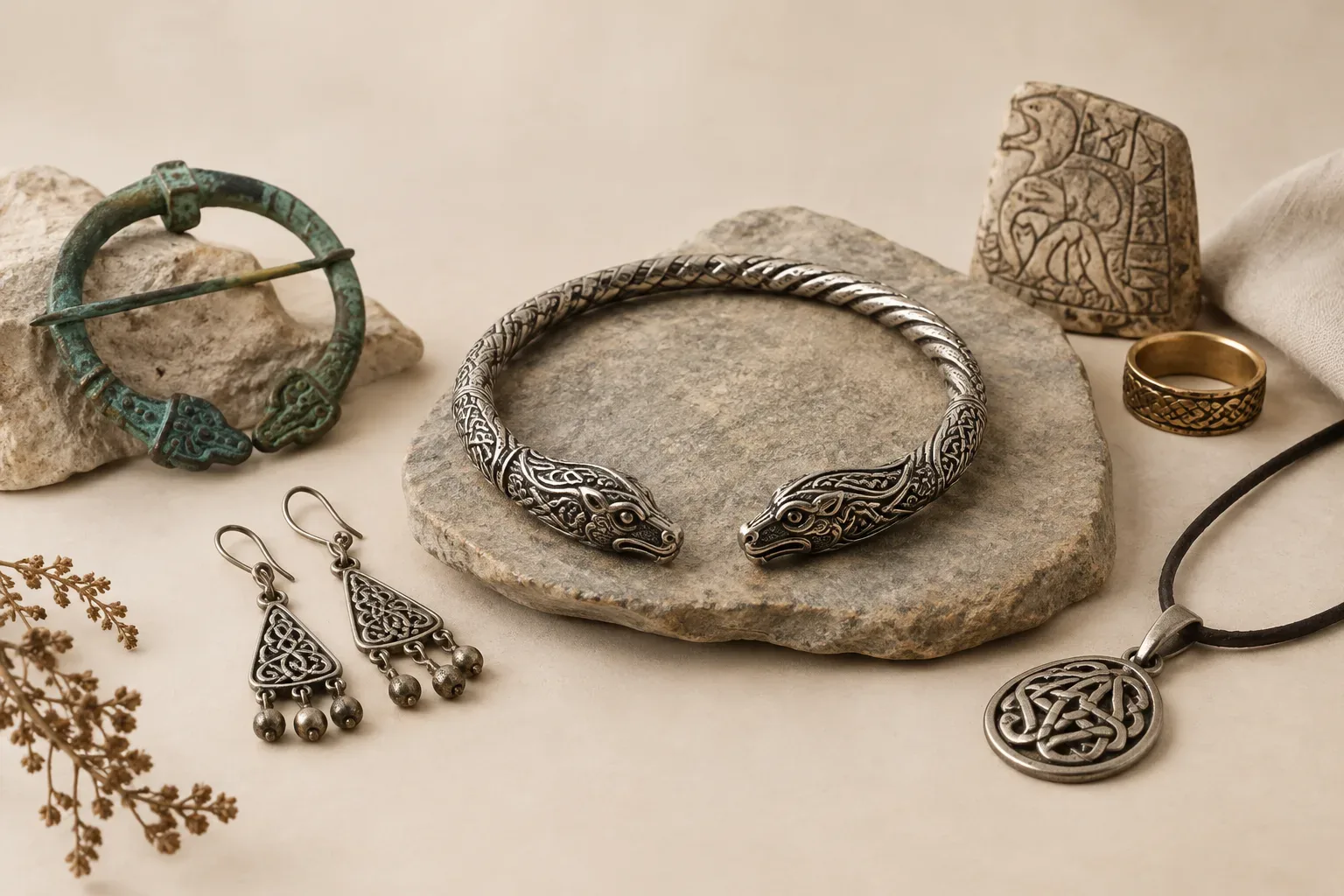
Motifs: Revival pieces commonly use stylized animal interlace, runic inscriptions, Thor’s hammer, simple geometric brooch forms, and coil or arm-ring shapes inspired by finds. In modern pieces these motifs are often simplified, resized, or combined with decorative techniques not used in the original objects. Museums present period examples to show original proportions, production techniques and contexts; use those references when evaluating a revival piece’s faithfulness to historical models.
Metals and finishes: Historical metalwork from the North includes a range of alloys and finishes. Revival pieces may be hand-forged in silver, cast in bronze or produced by machine methods, and they are often plated or oxidized to imitate patina. The Victoria and Albert Museum’s accounts of jewellery history are helpful for understanding how finishing techniques affect appearance and perceived age.
Gemstones and beads: Period jewelry includes glass beads, amber, garnet inlay and other stones; modern revivals sometimes substitute simulated gems, modern-cut stones, or different gem species that change the visual and material character. The Victoria and Albert Museum’s guidance on gemstones describes traditional gem types and their historical contexts, which is useful when assessing authenticity or historical inspiration.
Material honesty, treatments, and what to ask sellers
Ask for clear disclosure about metal composition, gemstone species, treatments and whether the piece is an original antique, a reproduction based on archaeological models, or a modern design inspired by the past. The Federal Trade Commission explains that sellers should disclose treatments, synthetics and imitations for gemstones and clarify the nature of plated finishes or composite pieces. Demand written information about materials and any treatments applied so you can compare claims to museum examples if historical accuracy is important to you.
If provenance matters—if you want an authentic Viking-Age artifact rather than a revival item—insist on documentation from a recognized institution or a qualified provenance chain. True archaeological objects offered on the market may carry legal and ethical issues; consult museum guidelines and local laws before purchasing purported antiquities.
Practical, respectful selection and gifting guidance
Decide your purpose: Are you buying for historical interest, aesthetic preference, costume use, spiritual practice, or as a sentimental gift? Your intent shapes how strictly you should demand historical accuracy and provenance. If the purpose is historical study or a museum-style display, favor pieces accompanied by clear references to museum examples or academic reproductions. If the purpose is personal style, choose a maker whose design intent is transparent about inspiration versus claim of authenticity.
Respect cultural sensitivities: Avoid claiming deep cultural or spiritual authority for a motif unless you have documented evidence and appropriate community endorsement. If gifting a motif with known contemporary religious or cultural meaning to someone who identifies with those traditions, ask how they feel about it. The safest approach is to be transparent about your reasons for the gift, provide context about the piece’s inspiration, and avoid implying that a modern revival object restores an ancient rite or belief.
Consider maker and craft: Supporting skilled contemporary makers—silversmiths, enamellers and beadworkers—helps preserve craft traditions and ensures better material transparency. Many experienced craftspeople will explain how their pieces relate to archaeological models and what has been changed for wearability or cost. Look for sellers who provide measurements, weight, material tests and clear images from multiple angles.
Care, wear and presentation
Understand how modern materials affect care. Silver, bronze and base-metal alloys will age differently than historically patinated objects; plated items may wear to a different color underneath. If a piece uses delicate inlays or glued components, treat it more gently than robust hand-forged metalwork. The Victoria and Albert Museum’s discussions about jewellery materials and construction can help you anticipate long-term behavior.
When wearing revival pieces publicly, be mindful of context. A pendant styled after a past religious symbol may be meaningful to somebody else; wearing it as costume or fashion is generally acceptable, but avoid presenting revival pieces as authentic historical artifacts or as tokens of community membership you do not hold.
How to verify and continue learning
Use museum collections and reputable catalogues as primary references. The Victoria and Albert Museum provides accessible overviews of jewellery history and gemstones that make good starting points for comparing motifs, technique and materials. If you need legal and consumer protection information about gemstones or treatments, consult the Federal Trade Commission’s guidance on buying gemstones, diamonds and pearls.
When in doubt, ask for independent verification. A qualified gemmologist can test stones and treatments; a conservator or historian associated with a museum or university can advise on stylistic claims. For purchasing, request written material disclosures and a returns policy so you can research further after purchase.
Final note
Revival Viking-Age Scandinavian jewelry can be beautiful, meaningful and intellectually engaging. Treat it as a bridge between past and present: use museum resources to ground your understanding, insist on material transparency from sellers, and choose or gift pieces with humility about what is documented history and what is modern interpretation.
Frequently asked questions
Is it cultural appropriation to wear Viking-Age inspired jewelry?
Wearing historically inspired jewelry is not automatically cultural appropriation, but context matters. If you use motifs respectfully, acknowledge their inspiration, and avoid claiming rights or authority you do not have, that is more responsible. If a motif has ongoing contemporary cultural or religious significance for a living community, ask how they feel about its use and consider those perspectives.
How can I tell if a piece is an authentic Viking-Age artifact or a modern reproduction?
Ask the seller for provenance documents and institutional verification. Museum or auction-house documentation is essential for authentic antiquities. For reproductions, sellers should state that a piece is a modern interpretation and describe materials and techniques. If accuracy matters, compare the piece to museum images and descriptions.
What should I ask about gemstones and treatments?
Request written disclosure of the gemstone species, whether it is natural, synthetic or treated, and any dyeing, heat treatment or stabilization. The Federal Trade Commission advises that sellers disclose treatments and imitations so buyers can make informed decisions.
Can runes or Thor’s hammer be worn as meaningful personal symbols today?
Yes—many people wear these motifs for personal, aesthetic or spiritual reasons. Remember that their historical use was varied and not universally fixed. Present modern meanings as contemporary choices rather than asserting single ancient meanings; this helps avoid misleading historical claims.
Where can I learn more about the original objects and motifs?
Start with museum resources and object catalogues. The Victoria and Albert Museum’s overviews of jewellery history and gemstones are reliable starting points. For consumer-facing information about materials, consult government guidance such as the Federal Trade Commission’s advice on buying gemstones.
Sources and further reading
- Bedazzled: A History of Jewellery — Victoria and Albert Museum
- An A-Z of Gemstones — Victoria and Albert Museum
- Buying Gemstones, Diamonds, and Pearls — Federal Trade Commission