Meaning at a glance
Museum evidence (Victoria and Albert Museum) documents Persian-region metalsmithing and gemwork traditions, which evolved through trade and changing social contexts; this article separates documented historical uses from modern personal meanings and offers practical selection and gifting guidance including FTC advice on gemstone disclosure.
What the historical evidence says (and how we know it)
Most of what we can say about Persian jewelry techniques in a publication-ready way comes from museum collections and scholarship that document objects, materials, and trade connections. The Victoria and Albert Museum catalogs, exhibitions, and interpretive material collect examples of metalworking, stone-setting, enamel, and inlay connected to the Persian cultural region and show how those techniques appear across objects and periods. When I cite historical practice below I am summarizing how museum evidence frames craft and circulation rather than inventing new archival claims; those summaries reflect the kinds of documentation and context the Victoria and Albert Museum presents about jewelry history and changing social contexts.
Museum evidence for technique is primarily object-based: surviving ornaments show tool marks, joining methods, and combinations of materials. For example, V&A scholarship and displays typically identify techniques such as filigree, granulation, inlay of stones and glass, enamel work, and sophisticated stone cutting and mounting. Because the objects themselves carry technical evidence and collectors’ records, museums like the V&A can connect particular surface treatments and settings to geographic regions and to trade networks where materials and styles circulated.
Trade and exchange are visible in museum collections too. The routes that carried pearls, lapis, carnelian, turquoise, and other gems across long distances are documented and interpreted in exhibition catalogues and articles, and museums use provenance, material analysis, and comparative design to show how imported gemstones and local metalsmithing traditions combined in the Persian cultural sphere. The V&A’s broad treatment of jewelry history emphasizes that objects must be read in social context—who wore them, how they were acquired, and what status they conferred—rather than assuming a single fixed meaning for any technique or motif.
Distinct cultures and periods: how to read the evidence
When museums describe Persian-region jewelry they separate the material evidence from later storytelling. Objects come with provenances, collection histories, and stylistic comparisons that allow curators to place pieces in particular regions or periods. The V&A’s approach to jewelry history is to locate techniques and styles within social and historical contexts rather than to present a single national narrative.
That means you should expect museum accounts to identify the likely cultural context of an object—whether it belonged to courtly dress, religious costume, urban elites, or mercantile ensembles—and to distinguish courts, city workshops, caravansary trade, and regional artisanal traditions where possible. Because collections are assembled over time, museums also point out later reinterpretations and the movement of objects between cultures. In short, the evidence in museum records should be read as region- and period-specific; it does not imply a single, unchanging Persian technique or meaning across centuries.
Documented historical meanings versus modern personal interpretations
Documented historical meanings are those that museum catalogues and curators can support with provenance, archival records, or consistent textual evidence. For example, the V&A frames many types of jewelry as social markers—objects that signaled rank, marital status, religious affiliation, or economic connections. Such functions are evidenced when objects appear in depictions of court dress, when they are listed in inventories, or when burial and archival data indicate who owned them.
Modern personal interpretations are different: many meanings ascribed to Persian motifs or techniques today—such as universal spiritual properties of a motif or an assumed unbroken line of symbolic intent—are contemporary readings and cannot be treated as historical fact unless supported by documentary evidence. Contemporary wearers and designers often reinterpret historical motifs as personal identity statements, political symbols, or fashion choices; museums like the V&A are careful to separate those contemporary narratives from object-based historical claims.
How motifs, gemstones, and techniques appear in jewelry
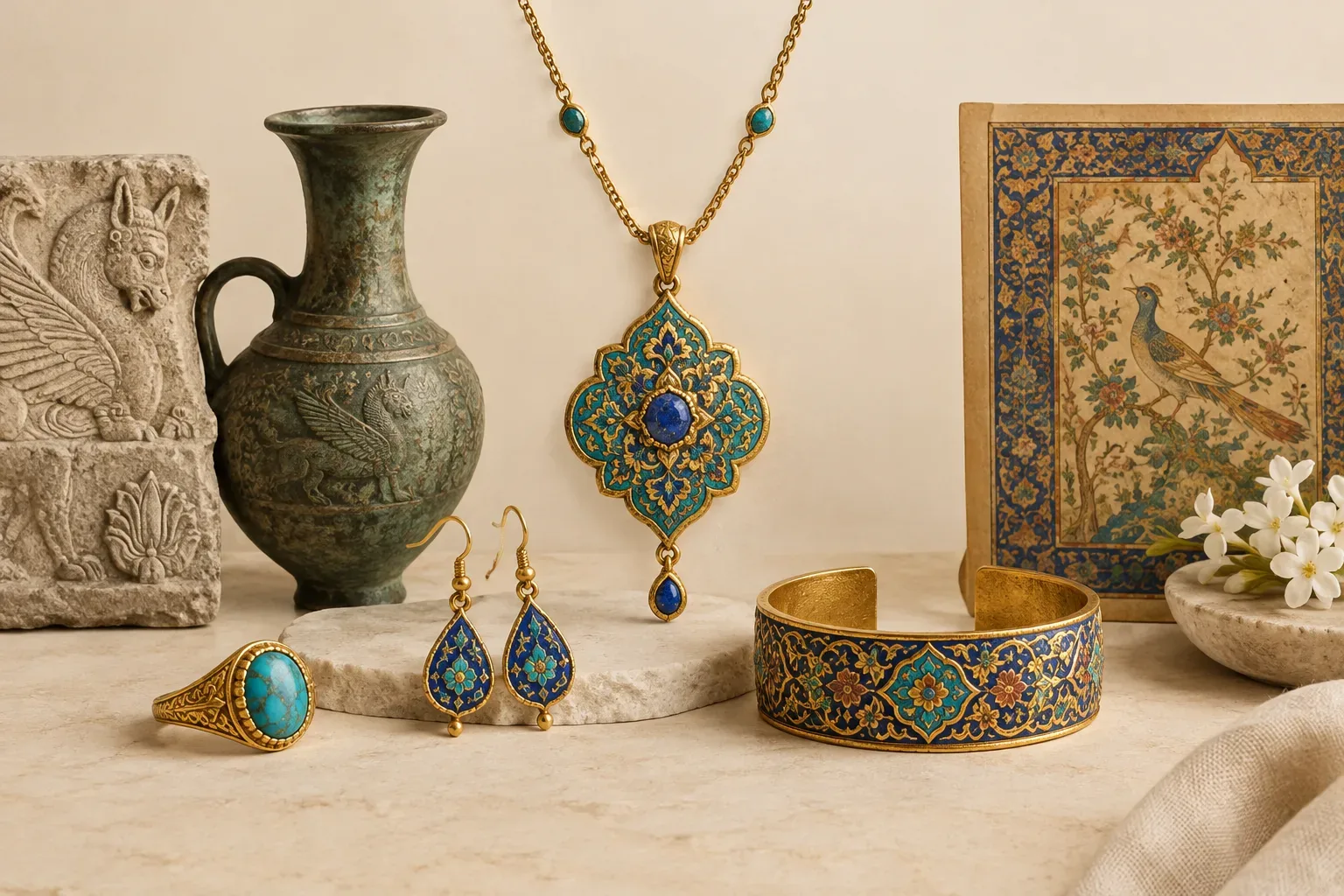
Motifs: Motifs commonly associated with Persian decorative arts—floral stylings, vegetal arabesques, and abstractised forms—appear in surviving metalwork and inlays. Museum objects show motifs worked by chasing, engraving, and enamelling on metal surfaces and reproduced through pierced openwork and attached elements. Motifs travel: decorative patterns seen in textiles and architecture also show up on jewelry, adapted to the scale and working constraints of metal and stone.
Techniques: The techniques recorded in museum collections include fine wirework (filigree), small bead-like applications (granulation), stone-setting and inlay, various enamels, and surface treatments that produce contrast between polished metal and patterned fields. Objects preserved in museum collections demonstrate how combinations of techniques—filigree over a gem-studded backing, or enamel fields framing inlaid stones—produce the visual richness often associated with jewelry from the Persian cultural area. The V&A’s histories of jewellery emphasize such technical complexity as central to how objects were made and read.
Gemstones and materials: Museums including the V&A present gemstones within a technical and trade context. Gemstones appearing in Persian-region pieces include local and imported stones, and they often display cuts, settings, and assemblages that reflect both local aesthetics and access to trade networks. For modern buyers, the V&A’s explanatory articles on gemstones provide a useful overview of historical use and identification, while also reminding readers that gem use changes with availability and taste.
Trade, transmission, and changing design
Trade shaped techniques as much as raw materials did. Museum narratives show that metalworking methods and gem-setting practices spread along routes of exchange where craftsmen, patrons, and merchants met. The V&A emphasizes how changing social contexts—courtly fashions, religious dress codes, and mercantile wealth—altered demand and design over time. Museums use stylistic comparison of objects from different locales to infer how techniques migrated and were adapted locally.
Design changed when different clienteles adopted techniques for new purposes: what may have been a courtly standard could be simplified for urban markets, while certain decorative luxuries persisted in ceremonial contexts. The museum approach is to document these shifts through objects, avoiding blanket statements about continuous tradition and instead showing continuity and change as evidenced by collections.
Practical guidance for selecting and gifting Persian-inspired jewelry respectfully
Be clear about provenance and authenticity. If you care about historical technique or regional craft, ask sellers for documented provenance or clear production notes. Museum literature stresses the difference between historic objects, modern pieces inspired by historic designs, and commercial reproductions. When buying gemstones or antique pieces, follow consumer guidance on material treatments and disclosure: the Federal Trade Commission requires disclosure of treatments and imitations for many gems, so request written information about whether gems are treated, synthetic, or assembled.
Respect cultural context and recipient identity. Consider the recipient’s cultural background and preferences before gifting motifs or symbols that may carry religious or social meaning. Museums caution against assuming one meaning across time or cultures; what a motif meant to a historical patron in a particular social setting may not carry the same meaning today. Ask whether the recipient values historical authenticity, contemporary design, or a symbolic message, and choose accordingly.
Choose quality over hyperbole. When selecting a piece, assess technique and finish: look for clean joins, even granulation or filigree, secure settings, and consistent enamelling. For gemstones, request reports on origin and treatment when relevant. If buying a purported antique, ask for documentation and be aware of restoration that can alter an object’s historical integrity. The V&A’s approach to jewelry history encourages readers to focus on the technical evidence in objects as the primary route to understanding.
Gift thoughtfully. Provide context when you give a piece—note whether it is an antique, a modern artisan piece inspired by Persian techniques, or a mass-market reproduction. A short note explaining the source and why you chose the piece will help recipients appreciate the object and avoid misunderstandings about claimed meanings.
A final word on interpretation and stewardship
Museum scholarship, such as the interpretive material from the Victoria and Albert Museum, teaches us to read jewelry as material culture: technique, trade, and design tell intertwined stories of artisanship and social worlds. At the same time, the modern meanings we attach to motifs and techniques are valid as personal and cultural reinterpretation, provided we keep those interpretations distinct from documented historical evidence.
If you want to learn more about the craft history of jewelry in museum collections or how to research a symbol or motif, see related guides on cultural and historical jewelry and practical selection advice. Treat objects and their histories with curiosity and respect, and prioritize transparent information about origin, materials, and treatment when buying or gifting.
Frequently asked questions
Are there specific techniques that define Persian jewelry?
Museum collections document several techniques commonly found in Persian-region objects, such as filigree, granulation, stone inlay and setting, and various enamel treatments. These techniques appear in combinations that reflect local workshop practice and the availability of materials, but no single technique defines the entire region across all periods.
How can I tell if a gemstone in a Persian-style piece is treated or synthetic?
Ask the seller for written disclosure about treatments or synthesis. The Federal Trade Commission requires disclosure of common treatments and imitations for many gemstones, so request a report or certificate that lists treatments, whether the stone is natural, synthetic, or assembled, and any enhancements.
Does a motif like the boteh (paisley) have one fixed meaning?
Museums caution against assuming one fixed historical meaning for a motif. While motifs such as the boteh appear widely in Persian decorative arts and have long histories, their symbolic meanings varied by time, place, and social context; many modern symbolic readings are contemporary re-interpretations rather than documented historical meanings.
Should I buy antique or modern-made Persian-style jewelry as a gift?
Both can be appropriate. When choosing antique pieces, seek provenance and be mindful of restoration history. For modern-made items, consider the maker’s connection to traditional techniques and whether the piece respectfully acknowledges its inspirations. In all cases, consider the recipient’s cultural background and preferences.
Where can I learn more about the technical history of jewelry?
Museum exhibition pages and articles—such as those produced by the Victoria and Albert Museum—provide accessible overviews of jewelry techniques, gemstones, and the changing social uses of jewelry. For buying and disclosure practices, consult consumer guidance from the Federal Trade Commission.
Sources and further reading
- Bedazzled: A History of Jewellery — Victoria and Albert Museum
- An A-Z of Gemstones — Victoria and Albert Museum
- Buying Gemstones, Diamonds, and Pearls — Federal Trade Commission