Meaning at a glance
This article explains documented history and shifting contexts for Persian jewelry symbols, distinguishes museum-documented evidence from later popular or personal interpretations, describes how motifs and gemstones appear in contemporary pieces, and offers practical, respectful guidance for choosing and gifting them.
What the historical evidence shows (and how it is documented)
Major museum and curatorial work treats jewelry as an evolving cultural practice: forms, techniques, and the social uses of ornaments shift with fashion, patronage, and technology. The Victoria and Albert Museum frames jewellery history as a sequence of changing social contexts in which objects can signal rank, identity, religious affiliation, or personal taste rather than a fixed list of symbolic meanings.
For gemstones and materials specifically, museum resources that survey gem history and identification describe how different stones were prized for their rarity, color, and perceived qualities in assorted cultures and periods. The V&A’s A–Z of Gemstones provides context for why some gems appear repeatedly in high-status pieces, and how cutting, setting, and trade routes affected availability and choice.
Where solid historical evidence exists, it generally comes from documentary sources (inventories, wills, court records), surviving objects in museum collections, and contemporary accounts. Museum interpretations emphasize object biography—who commissioned a piece, how it was used, and how design features fit broader artistic trends—rather than asserting universal spiritual meanings across centuries and regions.
Cultural and period distinctions: avoid broad generalizations
The term Persian covers many periods and polities—from pre-Islamic imperial courts through medieval Persianate dynasties to Qajar and Pahlavi-era Iran—and motifs can shift in meaning from one period, region, or social group to another. Museum scholarship cautions against treating a single motif as carrying the same symbolism across all these times and contexts.
When discussing symbolism, say explicitly which culture or period you mean. For example, a motif appearing on a Safavid textile or a Qajar pendant may have a different intended audience and social message than the same motif used in 20th-century fashion jewelry. The V&A’s historical overview of jewellery stresses that uses and meanings evolve with changing social contexts.
Documented historical meanings versus modern interpretations
Documented historical meanings are those supported by archival records, inscriptions, provenance, or consistent interpretation by curators and scholars tied to a specific time and place. For instance, if a jewel is recorded in an inventory as a dynastic emblem or appears in a court portrait with explicitly stated symbolism, that contextual evidence supports the historical meaning.
Modern interpretations—popular attributions circulated in media, tourist literature, or personal storytelling—are often meaningful to wearers and buyers but are not the same as historically documented functions. Contemporary meanings may layer onto older motifs: an ancestral motif may be repurposed as a symbol of ethnic pride, a talisman, or a fashion statement, depending on the wearer.
For buyers and givers, this distinction matters. If you need a historically grounded meaning for academic or conservation reasons, rely on museum catalogs, provenance records, and specialist publications. If you want a motif for its contemporary or personal resonance, it is valid to choose a piece for that modern meaning—just be clear about the distinction when you discuss it.
Common motifs and how they appear in jewelry (forms and techniques)
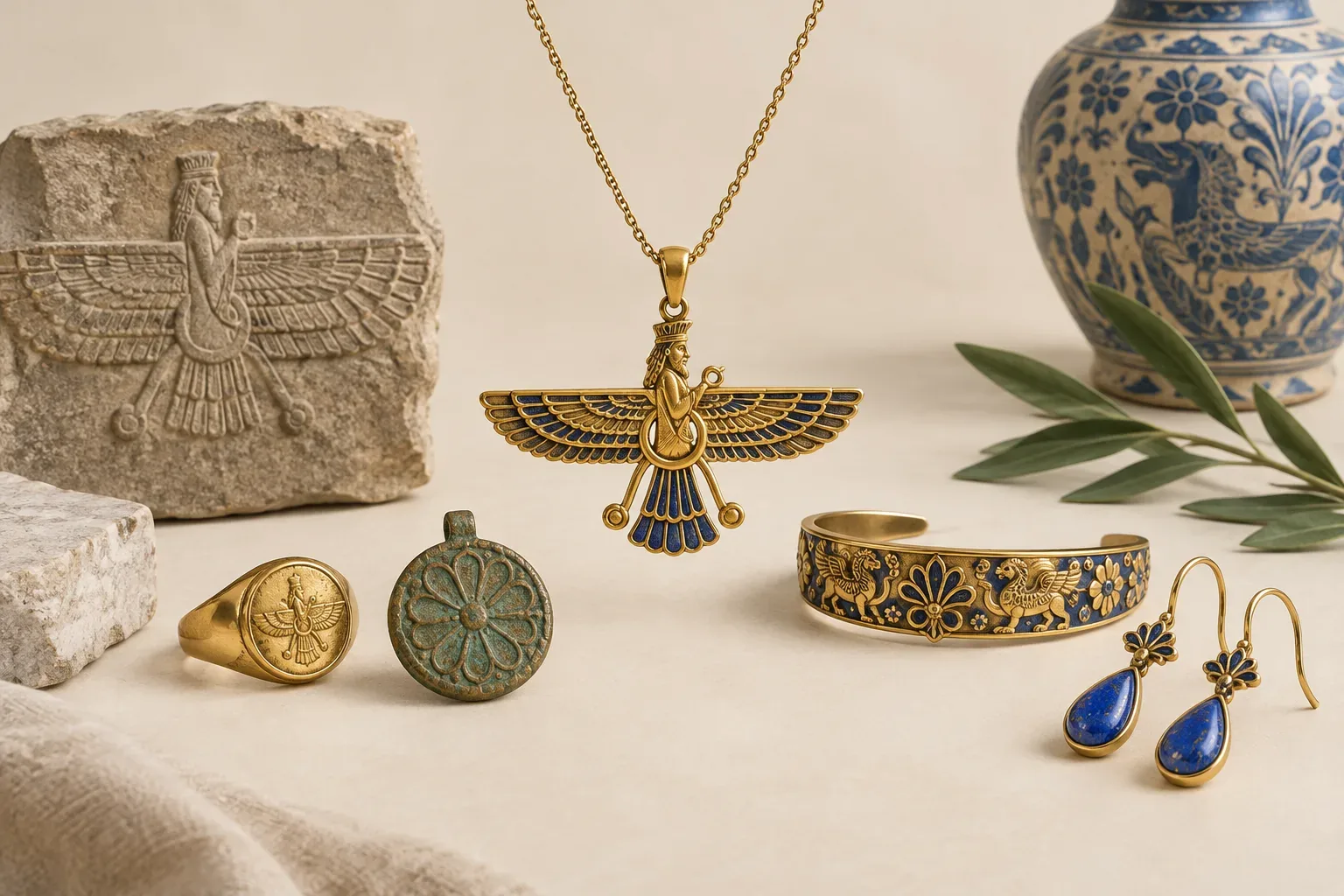
Motifs associated with Persian decorative arts frequently appear in jewelry as stylized motifs, calligraphic bands, repeating patterns, and figural scenes, translated into pendants, rings, belt buckles, brooches, and amulets. In many museum collections, such designs are executed in metalwork techniques including engraving, filigree, openwork, and niello, and often combined with enameling or gem inlay.
Gemstones appear in these designs both as focal points and as elements of color and texture. The V&A’s A–Z of Gemstones explains how different stones were selected for hue, hardness, and symbolic associations in later interpretations, and how cutting and setting methods affected their appearance. Modern reproductions often use alternate materials—glass, simulated stones, or treated gems—to achieve similar visual effects.
Inscribed pieces—signed dedications, poetic lines, or Quranic verses—also occur. Where inscriptions are present, their literal text provides direct evidence about the intended message or ownership; museums treat inscriptions as primary evidence when attributing meaning.
Gemstone and material considerations
Gem choice in historical pieces depended on availability, fashion, and patron resources; turquoise, agate, ruby, emerald, and pearls, for example, have long histories of use in the region, often prized for color and rarity. The V&A’s gemstone guide discusses how particular stones were identified, valued, and worked in historical settings.
Be aware that modern pieces may use treated, synthetic, or imitation stones. The Federal Trade Commission provides guidance on disclosure: reputable sellers should state whether gems are natural, treated, lab-grown, or simulants and disclose any enhancements. When symbolism is tied to a particular natural stone, clarify whether the stone in a given piece is the real mineral or a substitute.
Practical and respectful selection or gifting guidance
Start by asking or learning: does the recipient identify with a Persian cultural heritage or a particular meaning attached to a motif? If a design carries religious inscriptions or sacred text, consider whether it is appropriate for everyday wear and whether the recipient would welcome that use. When in doubt, ask or choose a motif and design known to be decorative rather than explicitly devotional.
Confirm materials and disclosures. Request written information about metal fineness, gemstone identity, and any treatments, and keep receipts. The FTC recommends clear disclosure of gem treatments and whether a stone is natural, synthetic, or a simulant; this protects both buyer and recipient and preserves trust.
Respect provenance and intellectual property. If a piece is presented as an antique or as coming from a particular region or workshop, ask for provenance or a condition report. For higher-value gifts, consider purchasing from dealers who provide documented provenance or from museum shops and established artisans who are transparent about sources and techniques.
Mind cultural sensitivity. Wearing motifs from another culture can be an expression of appreciation but can also raise questions of appropriation if used without regard for cultural significance. Choose makers from the relevant community where possible, or opt for contemporary designs that acknowledge inspirations openly.
How to research a specific motif further
Begin with museum catalogs and reputable institutional resources to find documented examples and curator notes. The Victoria and Albert Museum’s exhibitions and object entries are useful starting points for understanding a motif’s material and stylistic history in a broader context.
If you need authentication or conservation advice for a particular object, consult a qualified conservator or a recognized academic specialist in Persian art. For buying and consumer protection questions about gemstones and treatments, consult federal guidance such as the FTC’s consumer advice on buying gemstones, diamonds, and pearls.
Summary
Persian jewelry symbols inhabit a spectrum between documented historical use and evolving modern interpretation. Museums emphasize changing social contexts and material evidence as the basis for historical claims, while contemporary meanings are often personal or community-based. When choosing or gifting, be explicit about whether you prize a motif for its documented history or for a present-day meaning, check materials and disclosures, and act respectfully toward cultural and religious contexts.
Frequently asked questions
Are Persian jewelry symbols always religious?
No. While some pieces include religious inscriptions or devotional imagery, many motifs have decorative, social, or personal uses. Museums emphasize that context—inscription, provenance, or archival record—determines whether a piece is explicitly religious.
How can I verify if a gemstone in a Persian-style piece is natural or treated?
Ask the seller for written disclosure about the stone’s identity and any treatments. The Federal Trade Commission advises that sellers should state whether gems are natural, treated, lab-grown, or simulants; reputable dealers will provide this information and, for higher-value stones, a gemological report.
Is it respectful for non-Iranians to wear Persian motifs?
Wearing designs from another culture can be respectful when done thoughtfully: learn about the motif’s meanings, avoid items with sacred inscriptions unless you understand their use, and prefer pieces made by or in partnership with artisans from the culture when possible.
How do museums distinguish historical symbolism from modern interpretations?
Curators rely on primary evidence—provenance, inscriptions, inventories, and contemporary descriptions—plus comparison with other dated objects. The Victoria and Albert Museum highlights that jewellery’s meanings change with social context, so museums prioritize documentary and object-based evidence.
What should I ask a seller before buying a Persian-style antique?
Request provenance or a condition report, written information on metal purity and gemstone identity, and any documentation of previous ownership. For valuable items, consider a specialist appraisal or confirmation from a recognized museum or academic expert.
Sources and further reading
- Bedazzled: A History of Jewellery — Victoria and Albert Museum
- An A-Z of Gemstones — Victoria and Albert Museum
- Buying Gemstones, Diamonds, and Pearls — Federal Trade Commission