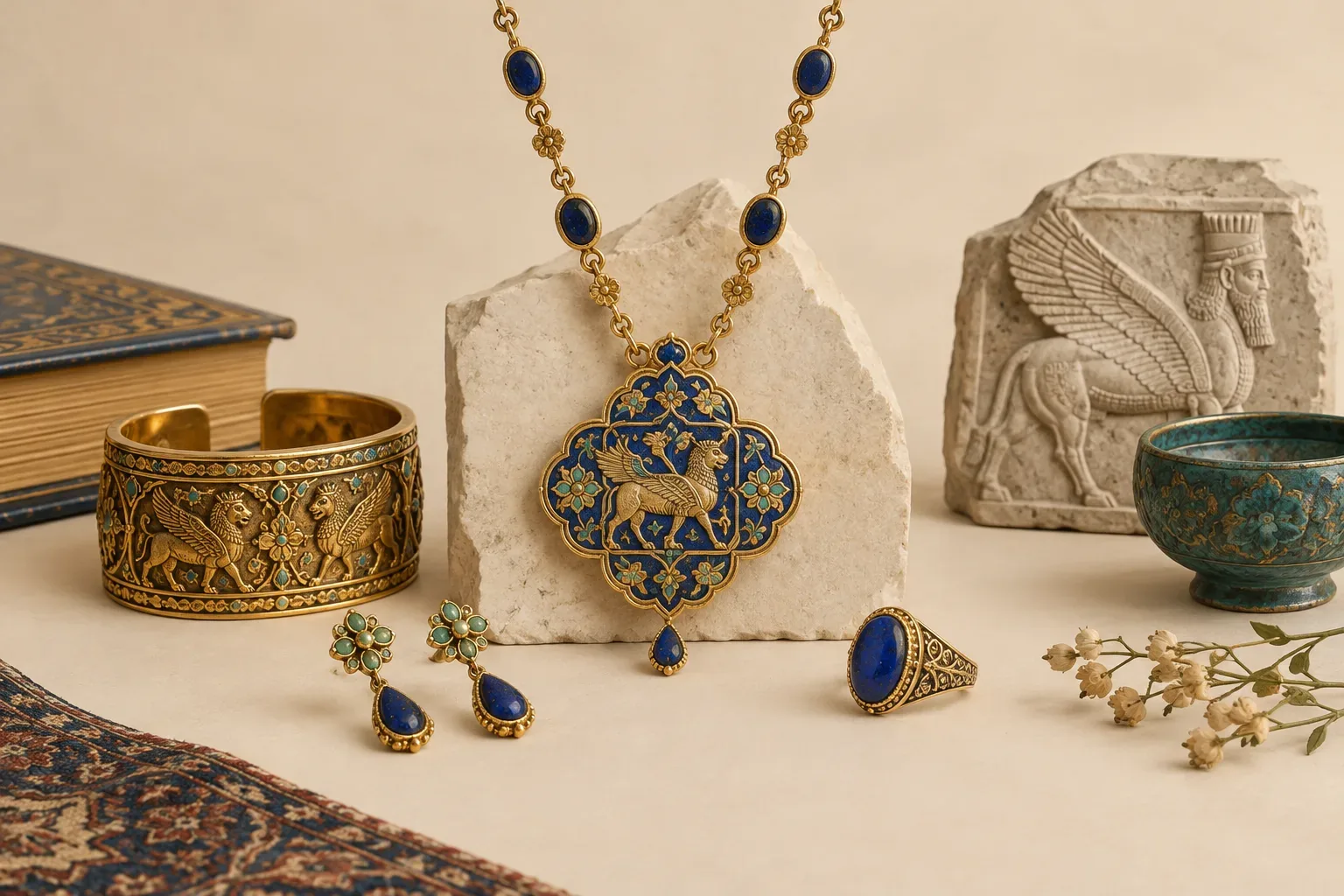
Meaning at a glance
Explain the documented history and changing contexts of the persian jewelry history motif, separate cultural or religious evidence from later popular interpretations, and give practical guidance for choosing and wearing the motif in modern jewelry.
Direct answer — what this article will show
Museum collections and published gemstone guides document that Persian jewelry history is best understood as a long sequence of changing materials, techniques, and social uses rather than a single fixed symbolism. The Victoria and Albert Museum shows how metals, enamels, and a range of gemstones were chosen for aesthetic, technical, and status reasons; later religious or popular meanings are often modern reinterpretations layered onto those material practices. This article separates the documented evidence recorded by museums from newer personal or commercial meanings, explains how motifs and gems appear in surviving pieces, and gives respectful, practical advice for choosing or gifting Persian-inspired jewelry today.
What the historical evidence shows (and how we know it)
Documentation for Persian jewelry comes primarily from surviving objects in museum collections, archaeological finds, and the descriptive scholarship that accompanies exhibitions and museum catalogues. The Victoria and Albert Museum’s work on jewellery history emphasizes that objects must be read in their material and social contexts: the same form can mean different things in different periods or settings, and museum descriptions focus on materials, technique, and provenance rather than universal symbolic claims.
Because museum documentation records objects and their manufacture, conservation, and recorded provenance, it allows us to identify which materials and motifs recur across Persian contexts and how those items were used as personal ornament, status display, or functional objects. Where museums can demonstrate an inscription, maker’s mark, or an archaeological find-spot, those facts form the basis of documented historical interpretation; later symbolic readings are separate and often speculative.
Identifying cultures and periods precisely (use museum evidence)
Surviving objects attributed to Persian polities and cultures are usually dated and attributed by museums through a combination of stylistic analysis, documented provenance, and scientific study. Museum descriptions commonly group objects by archaeological or historical period rather than by a single shorthand “Persian” identity, and this practice helps keep cultural differences clear when describing jewelry across time.
When discussing particular items, museum catalogues and exhibitions tend to specify the period or cultural context (for example, a court workshop, an urban craftsman’s output, or regional metalwork tradition). For readers wanting to trace a piece’s cultural attribution, the Victoria and Albert Museum and similar institutions provide object records and exhibition descriptions that note where and how attributions were made.
Materials and techniques documented in museum records
Museum surveys of jewellery history show that Persian objects use a wide range of metals and surface techniques, including gold and silver working, granulation, filigree, chasing, inlay, and enamel. The choice between heavier, richly worked metal and lighter, more practical forms often reflects intended use—court display or ceremonial wear versus daily personal ornament—and this is how museums interpret function from form.
Gemstones and organic materials appear widely in Persian jewellery. Guides to gemstones from the Victoria and Albert Museum describe how lapis lazuli, turquoise, carnelian, agate, pearls, and other stones were used for color, hardness, and availability. The selection of a particular stone in surviving objects can reflect trade connections, regional taste, or technical suitability (for example, cabochon cutting or bead drilling) rather than a single symbolic meaning.
Status, display, and daily wear in documented contexts
Museum records indicate that jewelry functioned as both a marker of social status and a part of everyday dress. Heavily worked pieces with elaborate settings and high-value stones are typically interpreted in museum descriptions as court or ceremonial jewellery where display of wealth and connection mattered. Simpler metalwork, bead strings, and practical fastenings in museum collections are usually described as items for daily wear.
Descriptions in jewellery history exhibitions emphasize that status was signalled through visible craftsmanship, precious metals, and imported stones. At the same time, objects intended for daily use show adaptations for comfort and durability—flat-backed settings, secure clasps, and the use of stronger metals—details that museums record when distinguishing function.
Motifs and gemstones: how they actually appear on objects
Museum displays and object labels highlight recurring decorative motifs in Persian decorative arts that were adapted into jewellery: stylized floral or vegetal arabesques, geometric patterning, animal forms, and calligraphic bands. These motifs appear in metalwork engraving, enamel panels, openwork, and stone settings. The way a motif appears—repeated border pattern, central medallion, or small inlay—affects the piece’s visual language and probable use.
Gemstones appear in a variety of ways on surviving pieces. Some are used as central focal stones set as cabochons or faceted cuts, while others appear as strings of beads or as inlaid panels. Museum gemstone guides note that certain stones were selected for particular technical reasons: pearls for their organic sheen, lapis for deep blue color, and turquoise for its readily workable nature. How a stone is mounted and finished on an object is a key piece of museum evidence about the intended look and handling of the item.
Documented historical meanings versus modern interpretations
Museum documentation is cautious about attributing fixed symbolic meanings to motifs or stones unless there is corroborating textual or archaeological evidence. When museums describe an inscription or a funerary context, they will link form to function or belief where the evidence supports it. Otherwise, museums emphasize materials, technique, and provenance rather than claiming universal symbolism.
Modern personal, spiritual, or commercial interpretations of Persian motifs and stones are common and meaningful to many wearers today, but they are not the same as documented historical meanings. Contemporary buyers and designers often layer new meanings—such as assigning specific spiritual properties to a stone or a motif—onto objects whose original use may have been primarily decorative, indicative of status, or practical. Treat these contemporary meanings as valid personal expressions, but recognize they are separate from the descriptions found in museum scholarship.
Practical guidance for choosing and gifting Persian-inspired jewelry
Choose with attention to materials and documented origin. If you care about historical authenticity or conservation value, ask sellers for provenance, detailed images, and any museum-style condition reports. For modern-made items inspired by Persian motifs, request information on metal purity, gemstone identification, and maker details so you understand what you are buying.
Be mindful of cultural context when gifting. A respectful approach is to learn and mention what you know about a motif’s documented history as recorded by museums, and to avoid claiming a single, ancient meaning unless scholarship supports it. When gifting to someone from the culture in question, a considerate conversation about preference and meaning is usually better than an assumption about symbolism.
Verify treatments and imitations. The Federal Trade Commission recommends that buyers ask about gemstone treatments, dyed materials, assembled stones, and synthetic substitutes. Sellers should disclose treatments and imitations; when in doubt, request third-party gemstone reports for high-value purchases. This protects both the buyer and the cultural integrity of the piece.
Care, wearing, and conservation considerations
Daily wear and conservation needs differ by material. Museums document that softer gemstones and delicate enamels require more protection from knocks and chemicals than sturdy gold or silver. If you intend to wear a historic or antique piece regularly, consult a conservator or a qualified jeweller about safe cleaning and the effects of repeated wear on settings and junctions.
For modern pieces inspired by historical forms, ask about repairability and if the piece was constructed with wear in mind. Well-made contemporary jewellery will balance historical aesthetic with modern techniques that improve durability for daily use.
Summary and how to continue researching a piece
Persian jewelry history, as documented in museum collections, is a story of materials, technique, and shifting social uses. The Victoria and Albert Museum’s work on jewellery history and gemstones provides a reliable baseline for identifying materials and understanding how objects were made and worn. Modern symbolic readings can be meaningful today but should be kept distinct from the documented evidence recorded by museums.
If you want to research a specific piece further, consult museum object records, published exhibition catalogues, and reputable gemological or conservation reports. For practical buying guidance, follow FTC recommendations on disclosure of treatments and request verifiable provenance for antique items.
Frequently asked questions
Is Persian jewelry suitable for everyday wear?
It depends on the object's materials and construction. Museum records show that many historic pieces were designed for occasional or ceremonial use, while simpler metalwork and bead jewellery were intended for daily wear. For contemporary pieces inspired by Persian forms, check construction quality, secure settings, and the hardness of any gemstones before wearing them daily.
How can I tell if a gemstone in a Persian piece is treated or synthetic?
Ask the seller for disclosure of treatments and any gemological reports. The Federal Trade Commission advises buyers to request information about dyeing, heating, impregnation, and synthetic or assembled stones. For high-value items, obtain a third-party laboratory report from a recognized gemological institute.
Do floral or calligraphic motifs have fixed meanings in Persian jewellery history?
Museums generally avoid assigning a single fixed meaning to motifs unless there is corroborating textual or archaeological evidence. While certain motifs recur and may be associated with particular contexts, documented museum descriptions focus on function, technique, and provenance rather than claiming universal symbolic meanings.
How should I gift a Persian-inspired piece respectfully?
Learn what is documented about the motif or style from reputable museum sources and avoid asserting unfounded historical claims. Ask the recipient about their preferences and consider a piece that clearly states whether it is antique, a reproduction, or contemporary inspired work. Providing provenance or maker information is a respectful practice.
Where can I find reliable information about a specific historic piece?
Consult museum object records and exhibition catalogues, which provide provenance, material descriptions, and curatorial notes. The Victoria and Albert Museum’s published materials on jewellery and gemstones are examples of reliable starting points for further research.
What conservation concerns should I consider if I own an antique piece?
Softer stones, enamels, and fragile metalwork require careful handling. Avoid harsh chemicals and persistent exposure to water or sunlight, and consult a conservator or qualified jeweller for cleaning and repairs to preserve the piece’s integrity.
Sources and further reading
- Bedazzled: A History of Jewellery — Victoria and Albert Museum
- An A-Z of Gemstones — Victoria and Albert Museum
- Buying Gemstones, Diamonds, and Pearls — Federal Trade Commission