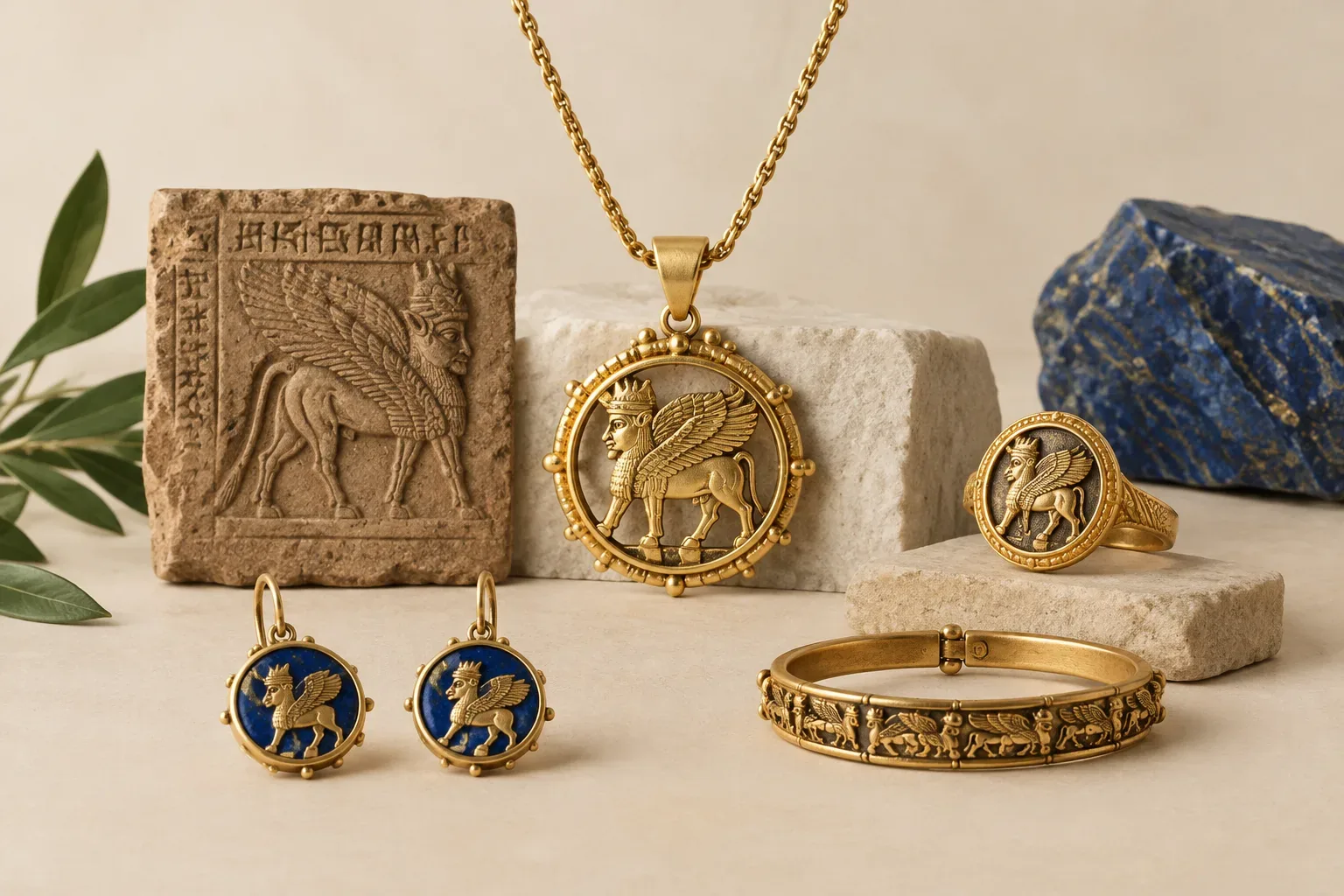
Meaning at a glance
Explain the documented history and changing contexts of the babylonian jewelry identification motif, separate cultural or religious evidence from later popular interpretations, and give practical guidance for choosing and wearing the motif in modern jewelry.
What we mean by "Babylonian" and why precision matters
“Babylonian” as a label can mean several things: an object excavated in Babylonia (a historical region of southern Mesopotamia), a piece made during a particular Mesopotamian period, or a modern object inspired by motifs associated with that region. The label alone does not prove age, origin, or cultural function. The Victoria and Albert Museum emphasizes that jewellery’s style and social role change over time; museum curators and archaeologists therefore rely on careful provenance, typology, and scientific study rather than a single visual cue when assigning cultural attributions.
How historical evidence is documented and what it shows
Museums and archaeological reports document jewellery by combining excavation records, comparative typology, and material analysis. The Victoria and Albert Museum describes how jewellery history is reconstructed by placing objects in their wider social and chronological contexts rather than reading a single motif as definitive proof of origin. For pieces claimed to be ancient Babylonian, a documented find-provenance (excavation records, museum accession data) and laboratory testing of metals and stones provide the most reliable evidence.
Because museum collections and catalogues are the baseline for historical identification, attributions based only on visual similarity—especially from the commercial market—are weak. When a seller or owner claims a piece is “Babylonian,” ask whether that claim rests on excavation documentation, a published catalogue entry, or scientific testing rather than stylistic resemblance alone.
Separating documented historical meanings from modern interpretations
Historical functions and symbolic meanings recorded in archaeological contexts are not the same as modern personal or commercial interpretations. Museums show that meanings attached to jewellery—religious, funerary, status-related, or decorative—are inferred from burial contexts, inscriptions, and contemporary texts where they exist. Absent those contexts, modern narratives about what a motif ‘‘means’’ are contemporary interpretations and may reflect modern taste or marketing.
When encountering claims about the religious or magical power of a motif labeled “Babylonian,” treat those claims as modern interpretations unless grounded in documented archaeological context or explicit contemporary texts. The V&A’s work on jewellery history cautions readers that meanings shift and that current popular readings often project modern values onto ancient designs.
Common motifs associated with Mesopotamian-inspired jewellery and how they appear
In the market, certain motifs are frequently described as Mesopotamian or Babylonian: stylized rosettes, palmettes, animal figures, and geometric bands. These motifs appear in modern jewellery as engraved or cast surface decoration, intaglio or relief on processed stone, or as shapes repeated in metalwork. While visually evocative, these motifs alone do not confirm ancient origin—context and material analysis do.
Cylinder-seal impressions and bead patterns are another class of imagery connected to Mesopotamia. In modern jewellery, such imagery is often reproduced as engraved or cast pendants, signet-style rings, or beads that mimic ancient bead-strings. The presence of a motif derived from a seal design does not prove antiquity unless the object itself is a documented seal or was excavated with archaeological provenance.
How gemstones and materials appear and what their presence implies
Gemstones and materials can help with identification but are not definitive proof of age or origin on their own. The Victoria and Albert Museum’s guidance on gemstones notes that certain stones were used in different historic periods and regions, but trade and reuse mean any single stone type can appear in many contexts. Modern workshop techniques also allow the replication or simulated assembly of ancient-looking materials.
For gemstone authentication and disclosure of treatments or imitations, consult consumer-protection guidance. The U.S. Federal Trade Commission requires disclosure of treatments, synthetics, and imitations when marketed to consumers. A buyer should therefore request written details about gemstone identification, any treatments, and whether the stone is natural, synthetic, or assembled.
Common mislabels and how to spot them
“Babylonian” is commonly used as a selling term for pieces that are historicist (19th–20th century revivals), modern fantasy jewellery, or contemporary designs inspired by Mesopotamian forms. Warning signs include grand historical claims without provenance, vague sourcing language, or dramatic price discounts that seem inconsistent with documented antiquities markets.
Other mislabels include assigning a religious or magical meaning without archaeological evidence and describing modern reproductions as ‘‘originals’’ because they imitate an ancient motif. Demand documentation: published provenance, a museum accession number, lab reports for materials, or high-quality photographic documentation from an excavation record.
Practical, respectful selection and gifting guidance
If you want an item with a genuine archaeological history, request proven provenance documentation and consider purchasing from established museums, reputable auction houses, or dealers who provide verifiable records. The Victoria and Albert Museum’s curatorial approach shows why established institutions and published catalogues are valuable for reliable attributions.
If your intent is symbolic or aesthetic rather than archaeological, choose modern pieces described honestly as “inspired by Mesopotamian motifs,” and focus on craftsmanship, materials, and the story you want to convey to the recipient. For gemstones, follow the Federal Trade Commission’s advice: ask about treatments and certifications to ensure you know what you are buying. When gifting culturally significant motifs, do so with respect for their historical origins and an acknowledgment that modern meanings are personal, not universally historical.
Practical steps for verifying a claim of Babylonian origin
Ask for written provenance: excavation records, a museum accession number, or a published catalogue citation. Compare the piece to museum images and descriptions; museums emphasize context over resemblance. Request scientific testing where appropriate—metallurgical analysis, gemological reports, or thermoluminescence dating for fired materials—and seek an independent laboratory if the price justifies it.
If a seller is unwilling to provide documentation or independent testing information, treat the Babylonian label as unverified. For less expensive purchases where full verification is impractical, prefer items candidly marketed as inspired reproductions and document the purchase for future reference.
Respectful use: cultural sensitivity and contemporary wear
Wearing or gifting motifs associated with ancient Mesopotamia can be meaningful, but remember that the original cultural contexts may include religious, funerary, or status-related functions that are not transferable. The safest approach is transparency: when presenting a piece as historical, be clear about what is known and what is interpretation. When presenting a modern piece as inspired by Babylonian design, acknowledge the inspiration rather than implying archaeological origin.
Museums and curators stress that jewellery’s social meaning is context-dependent. A respectful approach recognizes the difference between antiquity and inspiration and avoids asserting universal or ancient spiritual meanings without documented support.
When to consult experts
Consult a certified gemologist for stones and a conservator or qualified archaeologist for claims of antiquity. Established museums and accredited laboratories are the best routes for high-value or historically significant claims. Use museum catalogues and specialist literature when possible; the Victoria and Albert Museum’s resources are a good starting point for understanding how curators place jewellery in historical context.
Frequently asked questions
How can I tell if a piece labeled "Babylonian" is really ancient?
Request written provenance such as excavation records or a museum accession number, compare the object to museum catalogues, and seek scientific testing for materials when appropriate; a credible claim of antiquity relies on documentation and analysis rather than visual resemblance alone.
Are there specific gemstones that prove an item is Mesopotamian or Babylonian?
No single gemstone proves origin. Museums note that certain stones were used historically in different regions, but trade, reuse, and modern treatments mean a stone’s presence is not definitive; gemological reports and provenance are necessary to support claims about origin.
What questions should I ask a seller who offers "Babylonian" jewellery?
Ask for provenance documentation, any lab or conservation reports, clear statements about whether the piece is an original, a reproduction, or simply inspired by ancient motifs, and details about gemstone treatments or synthetic materials in accordance with consumer-protection guidance.
Is it okay to wear a Babylonian-inspired motif as a fashion or symbolic choice?
Yes, provided you present the piece honestly as inspired design if it is modern, and avoid claiming ancient religious or universal meaning. A respectful approach acknowledges the motif’s historical origins and recognizes modern meaning as personal.
Where can I get reliable information on jewellery history and gemstones?
Museum resources and catalogues are reliable starting points for historical context, and gemstone guides and consumer-protection agencies provide practical identification and disclosure advice; for example, the Victoria and Albert Museum’s articles and the U.S. Federal Trade Commission’s guidance on buying gemstones are useful references.
Sources and further reading
- Bedazzled: A History of Jewellery — Victoria and Albert Museum
- An A-Z of Gemstones — Victoria and Albert Museum
- Buying Gemstones, Diamonds, and Pearls — Federal Trade Commission