Meaning at a glance
This guide explains the documented history and changing contexts of Etruscan and Etruscan‑style jewelry, separates historical evidence from later popular interpretation, and offers practical guidance for choosing, authenticating, and respectfully gifting revival pieces.
Direct answer — the concise thesis
A clear Etruscan jewelry buying guide recognizes three threads: the documented ancient production techniques and social uses described by museum historians, the later nineteenth‑ and twentieth‑century revival fashions that reinterpreted Etruscan forms, and modern personal meanings layered onto both; a responsible buyer evaluates provenance, materials, and maker disclosure, and chooses or gifts pieces with awareness of that changing context.
What the historical evidence shows (and how to read it)
When scholars and curators describe ‘‘Etruscan’’ jewelry, they are referring originally to objects associated with the pre‑Roman peoples of central Italy and to later archaeological finds and classifications. The Victoria and Albert Museum treats these items as part of a long history of jewellery-making and changing social context, and uses museum research to situate ancient techniques and the later fashions that revived them rather than presenting a single unchanging meaning.
Museum histories emphasize that ancient Etruscan and related Italic work is best understood through material study: the techniques used, the objects’ find contexts, and their associations with funerary, civic, or domestic use. The V&A frames those objects within broader histories of production, consumption, and revival, which helps explain why similar visual elements reappear in very different periods with different social meanings.
Keep cultures and periods distinct
Separate the ancient Etruscan period from later movements that imitated or revived its styles. The ancient objects are archaeological artifacts with a specific cultural and material context. By contrast, nineteenth‑century and later ‘‘Etruscan revival’’ jewellery is modern work inspired by ancient forms; museums such as the Victoria and Albert Museum present revival pieces alongside originals to show how meanings change.
When you encounter a description that calls a piece ‘‘Etruscan’’ without provenance or scholarly attribution, treat that as a stylistic label rather than evidence of age or original cultural function. Labels in the marketplace may collapse distinct periods and cultures into a single shorthand; museum practice underscores the importance of provenance, cataloguing, and technical study to tell those stories apart.
Documented functions and meanings versus modern interpretations
Documented historical meanings of ancient Etruscan jewellery come from archaeological and curatorial study: objects are interpreted through find context, associated grave goods, inscriptions where present, and comparative typology. The Victoria and Albert Museum presents those methods as the basis for historical assertions rather than as universal symbolic dictionaries.
Modern personal interpretations—such as choices to wear an ‘‘Etruscan’’ motif for luck, heritage expression, or fashion—are valid as contemporary meanings but should not be conflated with documented ancient religious or social functions unless supported by archaeological evidence. In short: museum documentation supports claims about ancient use; contemporary wearers create new, personal layers of meaning.
How Etruscan motifs, techniques and gemstones appear in jewellery today
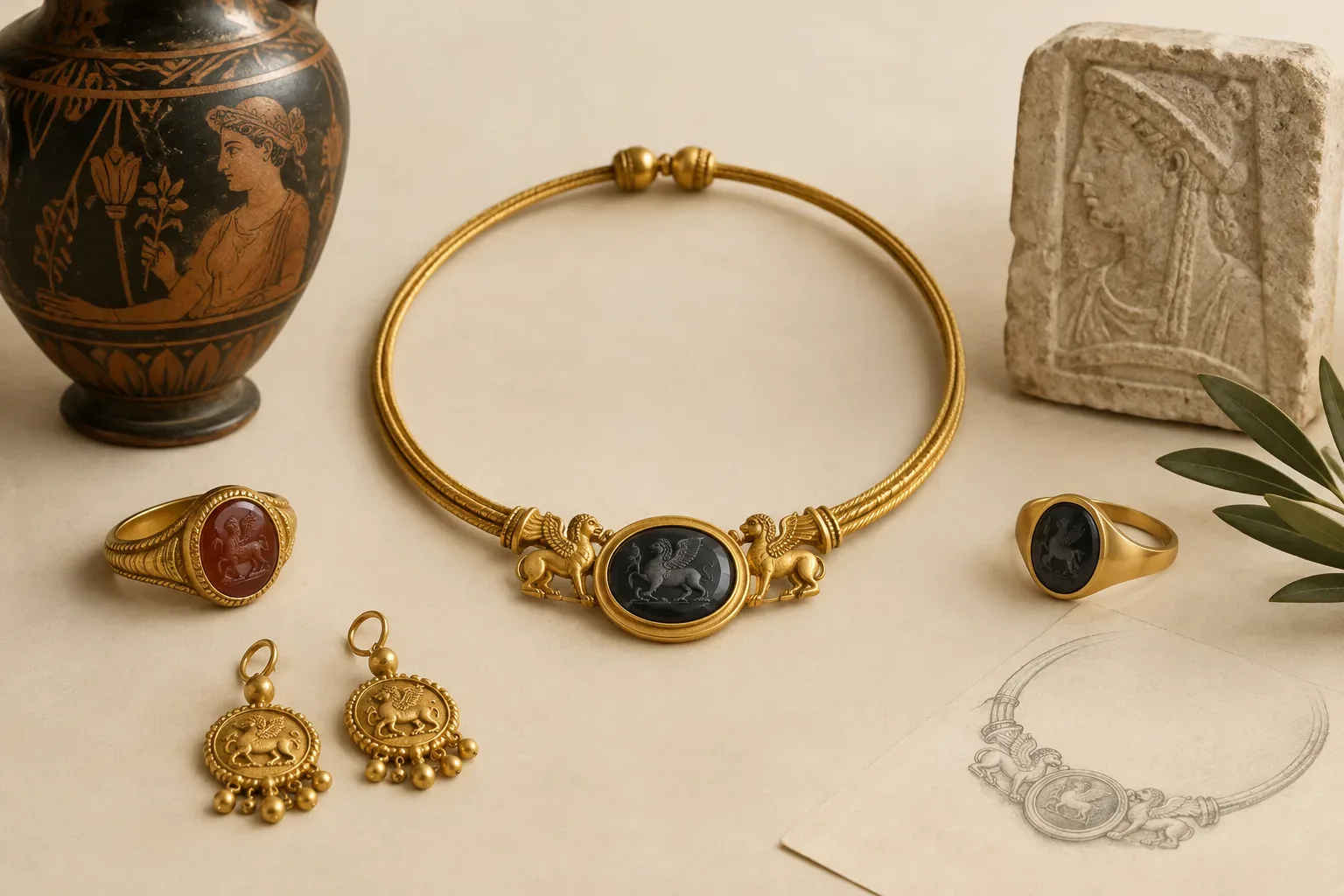
Design motifs and surface techniques associated with ancient Etruscan work appear in revival jewellery as stylized ornament: granulation effects, fine filigree, round or repoussé decoration, and simplified animal or vegetal forms often reference ancient aesthetics. Museums demonstrate these continuities by showing originals and revival pieces side‑by‑side to highlight technique and adaptation, as described by the Victoria and Albert Museum.
Gemstones in revival pieces are chosen for visual effect and historical reference. The V&A’s A–Z of Gemstones provides context on how particular stones have been used through history and how their color, clarity, and cutting style contribute to period appearance. Modern makers may use historical cuts, modern faceting, glass imitations, or treated stones to achieve an antique look, so visual similarity does not guarantee historical material.
Practical authentication, materials and disclosure guidance
Ask for provenance and documentation when authenticity or age matters to you. Provenance records, clear photos of marks, lab reports, or museum catalogue references are the kinds of evidence curators use to differentiate ancient objects from later work. When dealers or sellers describe a piece as ‘‘Etruscan’’ or ‘‘Etruscan revival,’’ request explicit wording about age and origin so the label is not ambiguous.
For gemstone and material disclosure, follow the Federal Trade Commission’s guidance that sellers must truthfully disclose treatments, imitations, and substitutions. The FTC’s consumer advice stresses asking whether a gemstone has been treated, whether it is natural, synthetic, or an imitation, and whether a statement of origin or laboratory report accompanies the sale. When a seller cannot provide clear disclosure, consider that a risk to authenticity and to later resale value.
Selection criteria: what to look for in revival and historic‑style pieces
Decide which attribute matters most to you: historical authenticity, craft technique, or contemporary wearable design. If you want an original ancient object, focus on verifiable provenance, conservation condition, and documentation from a trusted institution or dealer. If you prefer a revival piece, evaluate the maker’s workmanship, the accuracy of technique (for example, hand‑worked granulation or filigree versus modern casting), and the quality and disclosure of stones and metals.
Check for consistent hallmarks or maker’s marks on metal, request independent lab reports for valuable gemstones, and ask about soldering and repair history. If a piece is described as ‘‘antique style’’ or ‘‘Etruscan inspired,’’ confirm whether this is a new maker’s interpretation rather than an archaeological find. Museum treatment descriptions and cataloguing practices can help you form the right questions to ask a seller.
Buying ethically and respectfully
Buying responsibly includes respecting source communities, avoiding illicit trade, and supporting makers who disclose materials and labor practices. Provenance not only affects authenticity but also addresses legal and ethical concerns around cultural property. Museum narratives emphasize provenance and lawful acquisition as central to responsible collecting.
When choosing a modern Etruscan‑style piece, prefer makers who clearly identify their inspiration, credit archaeological sources where appropriate, and avoid marketing that exoticizes or claims unverified sacred meanings. If a piece draws on a living tradition, consult or acknowledge those communities; for ancient Italic motifs, be aware that museums rely on archaeological context to explain historical uses rather than spiritual claims for modern uptake.
Gifting guidance: practical and respectful choices
Match the gift to the recipient’s values: choose an authenticated antique only if the recipient appreciates historical objects and understands conservation constraints; choose a well‑made revival piece when you want wearable durability and contemporary repairability. For sentimental gifting, explain the piece’s context—whether it is an archaeological original, a museum‑inspired reproduction, or a contemporary designer’s homage.
Include documentation when possible: a note about the design’s inspiration, a copy of any provenance or treatment reports, and a short explanation differentiating the historical source from modern meaning. That information helps the recipient appreciate both the aesthetic and the responsible context of the gift.
Maintenance, repairs and conservation
Understand that true antiques may require conservation; avoid using harsh cleaners or home repairs on archaeological objects. For revival pieces, choose jewelers who can work with traditional techniques if repairs are needed. Museum conservation practice, as discussed by institutions like the Victoria and Albert Museum, treats original materials and historical finishes with particular care, and those practices inform how collectors should manage historic objects.
For gemstones, follow seller disclosure about treatments and appropriate care; treated stones or imitations may have different cleaning and setting limitations than untreated natural stones. When in doubt, ask for a jeweller’s recommendation and keep all documentation with the piece.
A short buying checklist
Before purchase, ask for provenance or a clear statement of origin, documentation of materials and any gemstone treatments, maker information, and any lab reports. Confirm return and authenticity policies. Prefer sellers and makers who disclose methods and inspiration, and treat the piece as either a historical object or a modern interpretation rather than both. This approach protects both the buyer and the cultural context the design references.
Frequently asked questions
How can I tell if a piece is genuinely ancient or a modern revival?
Ask the seller for provenance documents, condition reports, and any cataloguing references. Request clear language about age—whether the piece is an archaeological object or a later ‘‘Etruscan revival’’—and look for independent verification such as photographs in a museum catalogue. Museums like the Victoria and Albert Museum distinguish originals from later work through technical study and provenance, and similar standards should guide buyer inquiries.
Are gemstones in Etruscan‑style jewellery the same as those used historically?
Not necessarily. Contemporary makers may use the same types of stones for visual authenticity, but they may also use modern cuts, treated stones, synthetics, or glass imitations. The Victoria and Albert Museum’s A–Z of Gemstones offers historical context; for purchasing, follow the Federal Trade Commission’s advice to ask sellers about treatments, whether a stone is natural or synthetic, and to request lab reports for valuable gems.
What disclosures should a seller provide for Etruscan or Etruscan‑style pieces?
Sellers should clearly disclose whether a piece is an original archaeological object, a later antique, or a modern reproduction inspired by Etruscan motifs. For gemstones and metals, the Federal Trade Commission recommends disclosure of treatments, imitations, and substitutions. If the seller cannot provide that information, treat the listing as incomplete and consider seeking another source.
Is it disrespectful to wear Etruscan‑inspired jewellery?
Wearing an item inspired by ancient Etruscan forms is not inherently disrespectful, but respectful practice includes understanding and conveying the piece’s origins, avoiding claims of unverified sacred meaning, and choosing makers who credit their inspirations. Museums present ancient objects with contextual information; emulating that transparency in purchase and gifting helps maintain respectful use.
Should I buy originals or high-quality modern reproductions?
If historical authenticity and collecting are your priority, seek originals with clear provenance and be prepared for conservation constraints. If you want a wearable, durable piece for daily use, a well-made modern reproduction by a skilled maker often provides better value and easier maintenance. Decide based on your budget, intended use, and the importance of historical context.
What questions should I ask before gifting an Etruscan‑style piece?
Ask the recipient whether they prefer authentic antiques or wearable contemporary design, and include documentation on the piece’s origin and materials. When gifting something inspired by a historical culture, provide a brief note explaining the design’s source and whether it is an original or a revival; that transparency helps the recipient appreciate both the aesthetic and the responsible context.
Sources and further reading
- Bedazzled: A History of Jewellery — Victoria and Albert Museum
- An A-Z of Gemstones — Victoria and Albert Museum
- Buying Gemstones, Diamonds, and Pearls — Federal Trade Commission