Meaning at a glance
This article explains the documented history and changing contexts of Celtic jewelry, distinguishing archaeological and museum-supported evidence from later and personal interpretations, outlining how common motifs and gemstones appear in historic and modern pieces, and giving practical guidance for selecting and gifting Celtic-style jewelry responsibly.
What the historical evidence shows, and which cultures or periods it represents
Scholarly collections and exhibitions summarise material evidence rather than single authoritative narratives. Museum documentation and surveys show that what is often described as 'Celtic' jewelry spans a range of peoples and periods across Britain, Ireland, and parts of continental Europe. Objects associated with Iron Age communities, early medieval Insular societies, and later vernacular traditions reflect different technologies and social circumstances (Victoria and Albert Museum).
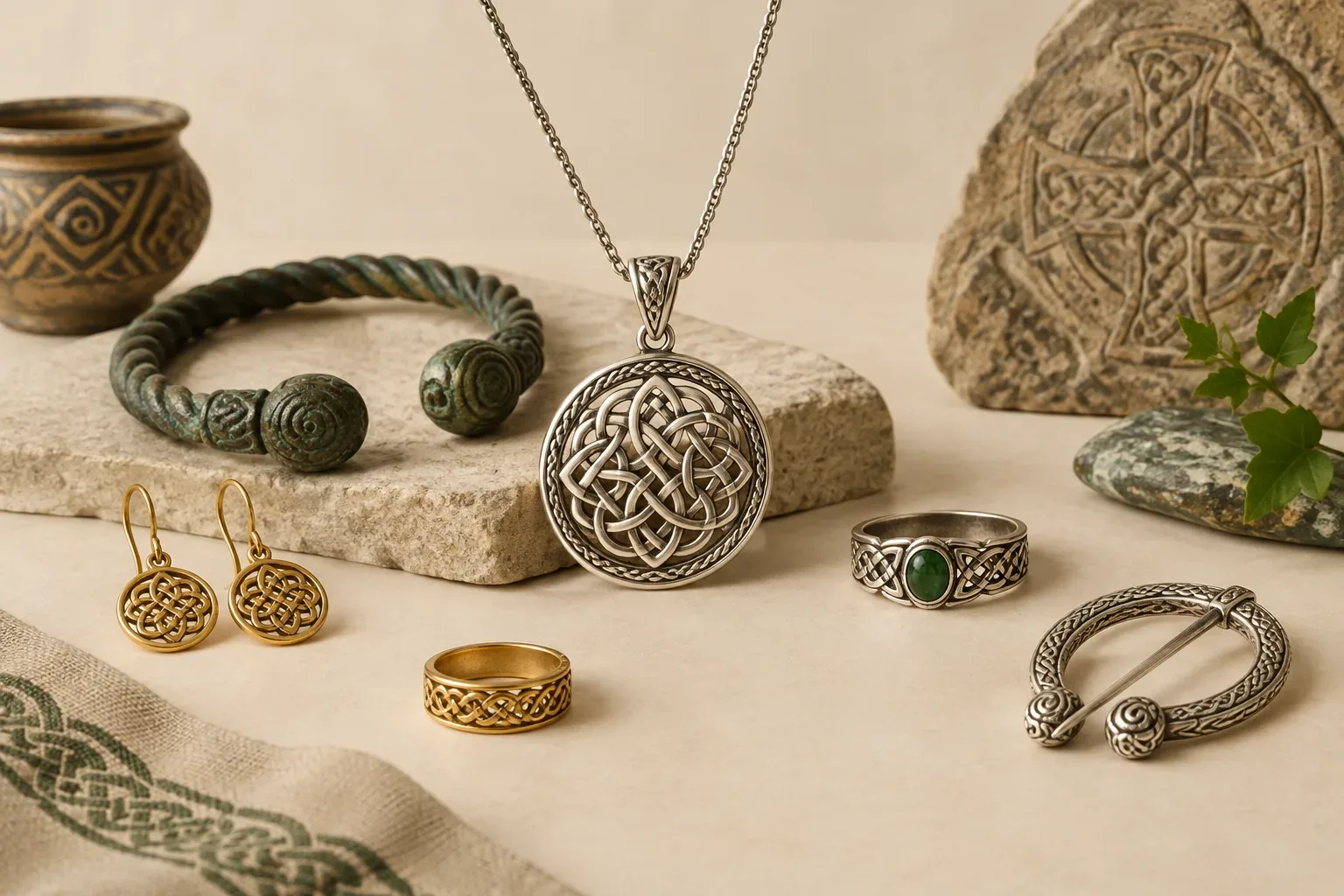
Archaeological finds frequently cited in museum collections include neck rings (torcs), penannular and annular brooches, and metalwork with ornament drawn from spirals, triskele forms, and later interlace or knotwork motifs. The contexts recorded by museums show these items appear in burials, hoards, and as portable wealth, which indicates roles in display, identity, and exchange rather than a single, fixed meaning (Victoria and Albert Museum).
The V&A’s historical overview emphasises how jewelry’s social functions—display of status, signifiers of kinship or allegiance, and portable wealth—changed as materials and techniques evolved. The objects we label 'Celtic' are therefore best understood as products of particular communities and moments rather than an unbroken or uniform Celtic tradition (Victoria and Albert Museum).
Materials and gemstones in historical context
Museum catalogues and gemstone guides explain that historic 'Celtic' objects were made from the materials available to craftsmen and valued by patrons: gold and electrum for high-status pieces, bronze and iron for more common items, and organic materials such as amber or glass beads for personal ornament. Working techniques included casting, hammering, chasing, and later the use of inlay and enamel in medieval periods (Victoria and Albert Museum).
Gemstone treatments and identifications have their own histories. The V&A’s A–Z of Gemstones provides context for how materials like rock crystal, amber, and glass were used for ornament historically, while modern gemology now distinguishes natural stones from treated or synthetic materials. For contemporary buyers, government guidance from the Federal Trade Commission sets out responsibilities for disclosure regarding treatments, synthetics, and imitations, and that guidance applies when shopping for historically inspired pieces as well (Victoria and Albert Museum; Federal Trade Commission).
Documented historical meanings versus modern interpretations
Historical evidence reliably shows that jewelry functioned as dress, visible wealth, and sometimes as a marker of rank or affiliation. Museum records and archaeological contexts support these practical and social uses: large gold torcs and elaborately decorated brooches frequently appear in contexts associated with elite burials or hoards, suggesting high status or ceremonial use (Victoria and Albert Museum).
By contrast, many contemporary ascriptions of universal spiritual meanings—claims that specific knotwork patterns always represent eternal life, or that a single motif carried the same meaning across all Celtic-speaking regions and centuries—are modern interpretations rather than consistent historical facts. Museums caution that meanings shifted by time and place, and that modern symbolism often reflects 19th–21st century revivals and personal spiritual practices more than continuous ancient beliefs (Victoria and Albert Museum).
How motifs, gemstones, and traditions appear in jewelry—historic and modern examples
Motifs now associated with a 'Celtic' aesthetic—spirals, triskele, key patterns, and interlace or knotwork—appear in historic objects in different forms. Spiral and triskele shapes are prominent in earlier Iron Age metalwork, whereas complex interlace becomes especially visible in Insular art and metalwork of the early medieval period. Museum descriptions note that craftsmen adapted these motifs to the materials and techniques available, carving them in stone, chasing them into metal, or rendering them in enamel and inlay (Victoria and Albert Museum).
Gemstones and beads were used as set stones or as inlays, but often ornament depended more on metalwork skill than on large gem settings. Amber, glass, and small polished stones are commonly recorded in archaeological assemblages while richly decorated surfaces and patination were prized in metalwork (Victoria and Albert Museum). Modern makers translate these motifs into rings, pendants, bracelets, and brooches using contemporary methods such as casting, laser engraving, and stone setting, often blending historic visual language with current jewellery practice.
Practical and respectful guidance for choosing and gifting Celtic-style jewelry
Be clear about what you are buying: is it a historical reproduction, a contemporary design inspired by historic motifs, or a mass-produced piece using 'Celtic' styling? If provenance or authenticity matters to you, consult museum catalogues or reputable dealers and ask for documentation about materials and production methods. The V&A highlights the importance of understanding historical context when interpreting objects, and the FTC advises buyers to seek full disclosure about gemstone treatments and synthetic materials (Victoria and Albert Museum; Federal Trade Commission).
Choose materials and makers responsibly. If the piece uses gold, gemstones, or other regulated materials, ask whether they are certified, recycled, or responsibly sourced and whether any gems have been treated or are synthetic; the FTC describes disclosure responsibilities for these issues. For costume or lower-cost pieces, be mindful that plating and base metals have different wear and allergy profiles than solid precious metals.
Select a motif with attention to its specific history and modern meanings. If you are gifting a piece as a symbol—for example, of love, friendship, or heritage—state that the symbolism you intend is a contemporary choice. Avoid framing a motif as a fixed ancient belief; instead, explain why the design feels meaningful for the recipient.
Respect cultural context. Many designs associated with 'Celtic' identity are part of living cultural traditions in Ireland, Scotland, Wales, and elsewhere. Buying from craftspeople who acknowledge those traditions and who either live within those communities or work with them can be more respectful than purchasing anonymous mass-produced items. Museums encourage learning about the regional and historical contexts of motifs before asserting definitive cultural meanings (Victoria and Albert Museum).
Care and longevity. Match the purchase to the recipient’s lifestyle. Solid precious metals and well-set stones will hold up to everyday wear better than plated or glued settings. Ask sellers about cleaning and repair options and retain documentation for any warranties or care instructions.
When historical accuracy matters—and when personal meaning is valid
If your interest is historical accuracy—collecting reproductions, supporting archaeological interest, or acquiring museum-quality work—seek out documented reproductions made by craftspeople with clear references to source objects and museum records. Museums’ catalogues and exhibitions can be a starting point for identifying exemplary pieces and understanding the range of forms and functions associated with different periods (Victoria and Albert Museum).
If your interest is personal meaning, that is valid and widespread, but it should be described as a contemporary practice. Many people today adopt historic motifs to express identity, memory, or personal values; these modern uses enrich the living history of the designs even as they differ from specific ancient contexts. When combining personal meaning with cultural symbols, do so transparently and respectfully.
Final practical checklist before buying or gifting
Confirm whether the item is a historic original, a museum reproduction, a handcrafted contemporary piece, or a mass-produced fashion item and adjust your expectations for price and longevity accordingly. Ask sellers to disclose materials, treatments, and any synthetic stones, since modern regulation and best practice require clarity about such matters (Federal Trade Commission).
Consider provenance and respect for living traditions by preferring makers who acknowledge the sources of their designs or who work within the communities that maintain these visual languages. Finally, match the piece’s durability and care needs to the recipient’s intended use so that the jewelry can be appreciated and preserved over time.
Frequently asked questions
Is there a single, documented meaning for common Celtic motifs like knotwork or the triskele?
No. Museum documentation shows that motifs such as knotwork, spirals, and the triskele appear across different times and places with differing contexts. While archaeological and museum evidence indicates these designs featured in decoration and possibly conveyed local identity or prestige, assigning a single, universal meaning to any motif is a modern simplification rather than a documented historical fact (Victoria and Albert Museum).
Were Celtic pieces always made in gold and gemstones?
No. While high-status objects in some contexts were made in gold or with valuable inlays, many pieces were made in bronze, iron, glass, and organic materials such as amber. The choice of material depended on local resources, social rank, and the intended function of the object, as noted in museum surveys of historic jewelry (Victoria and Albert Museum).
How can I tell if a gemstone in a Celtic-style piece is natural or treated?
Ask the seller for disclosure about treatments and origin. The Federal Trade Commission provides guidance that sellers should disclose heat treatments, dyes, and synthetic stones. For high-value purchases, request a laboratory report or a qualified appraisal that identifies treatments and whether a gem is natural or synthetic (Federal Trade Commission).
Is it disrespectful to wear Celtic symbols if I am not of Celtic heritage?
Wearing motifs inspired by Celtic art is common and can be respectful if done with awareness. Learn about the design’s history, avoid presenting modern personal meanings as ancient facts, and consider buying from makers who acknowledge the cultural sources of their designs or who are part of those cultural traditions. Transparency and respect for living communities are the guiding considerations (Victoria and Albert Museum).
Should I buy a historic original or a modern reproduction?
Decide based on purpose and budget. Originals belong in collections and often require conservation; reproductions allow everyday wear and can faithfully echo historical appearance. If provenance or academic accuracy is important, seek documented reproductions and reputable sources; for everyday jewelry, handcrafted contemporary pieces can offer a respectful and durable option (Victoria and Albert Museum).
What practical care tips apply to Celtic-style jewelry?
Care depends on materials. Solid precious metals resist wear better than plating, and stones set in secure settings will tolerate daily wear more readily than glued or glued-in settings. Ask sellers for cleaning recommendations and whether the piece is suitable for continuous wear or should be reserved for occasional use.
Sources and further reading
- Bedazzled: A History of Jewellery — Victoria and Albert Museum
- An A-Z of Gemstones — Victoria and Albert Museum
- Buying Gemstones, Diamonds, and Pearls — Federal Trade Commission