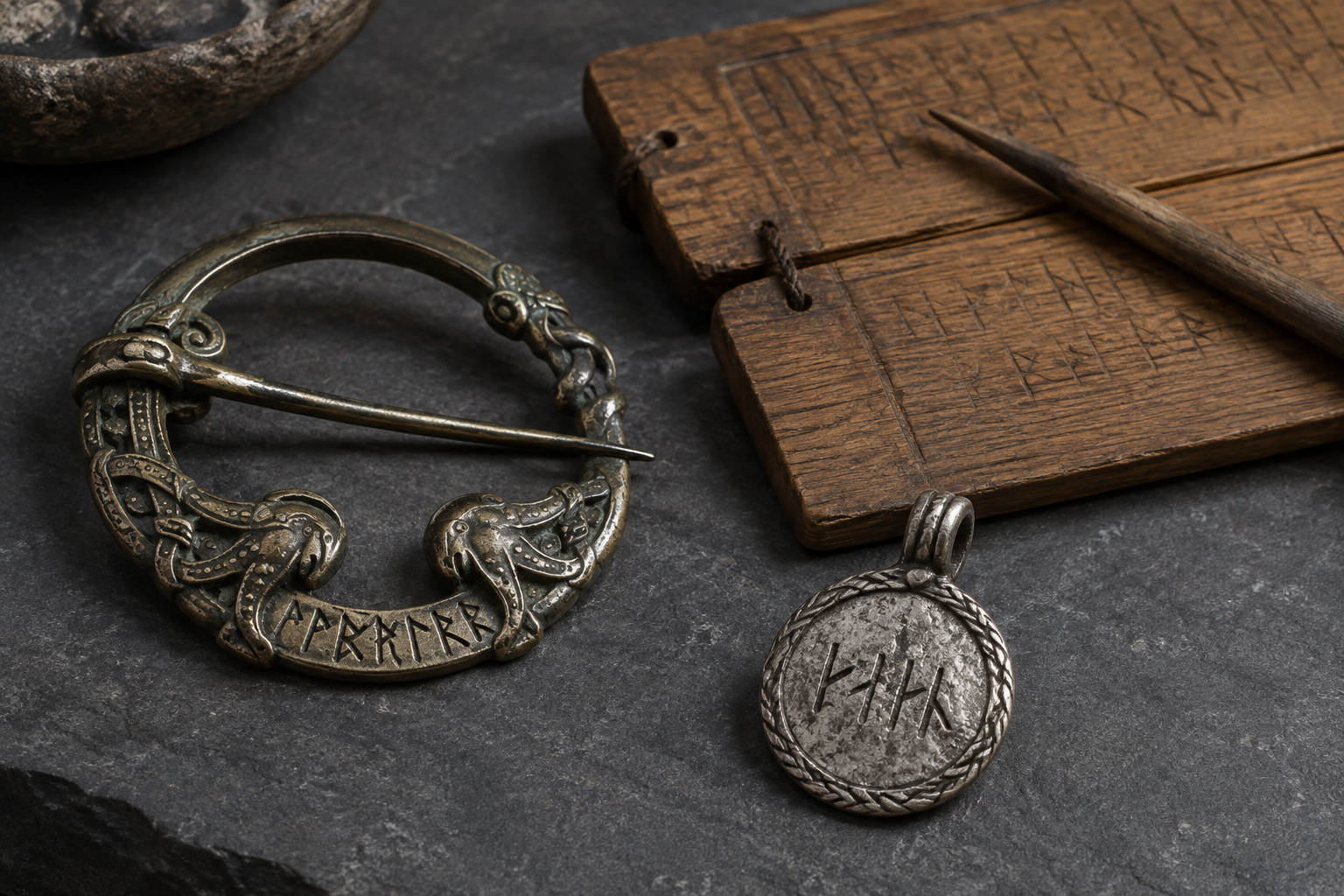
Meaning at a glance
Runes in Norse jewelry started as a practical Scandinavian writing system used for names, ownership marks, short messages and sometimes formulaic or protective inscriptions; today designers and wearers add personal or spiritual meanings that should not be treated as a single, historic Viking belief system.
What the historical evidence shows
Archaeological and museum research shows that runes were a working script used across Scandinavia and beyond. The Swedish History Museum describes runes as a Scandinavian writing system and documents examples carved on wood, bone, metal and stone. The museum also notes that everyday objects, including jewelry and small personal items, sometimes carry runic inscriptions. The National Museum of Denmark similarly treats runes as a writing system attested in Viking Age sources and reconstructions of the runic row used in that period.
In the Viking Age specifically, the row of runes typically used in many Scandinavian inscriptions had sixteen signs, a fact supported by both the Swedish History Museum and material assembled by the National Museum of Denmark. Archaeological finds include rings, pendants, brooches and amulets inscribed with clear letters. Those inscriptions often record a name, state an ownership claim, mark a maker, or deliver a brief statement. Museums caution that while some inscriptions may have a ritual or formulaic character, not every runic inscription has a magical purpose.
Which cultures and periods used runes on jewelry
Runic writing predates the Viking Age and appears in different forms across Germanic-speaking regions, but in the scope of "Norse" jewelry the most directly relevant period is the Viking Age (roughly late 8th to 11th centuries). The Swedish History Museum frames many of the extant examples within Scandinavian contexts and the National Museum of Denmark compiles Viking Age sources that show the use of runes in that era. Earlier Elder Futhark variants appear on continental finds and later medieval runic traditions also continued in northern regions, so the practice evolved and varied by time and place.
Because runes were used by diverse Germanic groups, it is important to avoid conflating a single uniform "Norse" practice across centuries. The objects curated by Scandinavian museums come from distinct local traditions and timeframes; the meaning and style of an inscription depend on when and where it was made.
Documented historical meanings versus modern interpretations
Documented historical meanings are the kinds of texts and functions preserved on archaeological objects and reliably reported by museums. These include personal names carved on rings or pendants to identify the owner, phrases that mark a gift or dedication, statements of maker or place, and short conventional formulas. The Swedish History Museum explicitly notes that many runic inscriptions are straightforward records rather than magical spells, and curators emphasize the practical uses of runes on small objects.
Modern interpretations, by contrast, are how contemporary designers, spiritual practitioners and wearers choose to read or repurpose runes today. For example, a modern pendant that foregrounds the rune for Gebo (often associated in modern sources with 'gift' or 'partnership') may be worn as a symbol of love or union. Those meanings are contemporary readings layered onto a historical script. Such personal symbolism can be meaningful for the wearer, but it should not be presented as an authoritative or universal "Viking" meaning unless supported by direct historical evidence.
Appearance of runes, motifs and gemstones in jewellery
Historically, runes were incised, scratched or cast into metal surfaces, and they appear on rings, arm-rings, brooches and amulets. The form of the letter, the spacing and the material affect legibility and interpretation. Museums display examples where a simple name or ownership mark is clearly cut into a ring or a small plate. In modern jewelry, runes are reproduced in many techniques: laser engraving on metal, hand-carving into silver or bronze, cast motifs, and printed or enamelled designs. Modern pieces may show single runes, bindrunes (combinations of runes into a single motif), or longer inscriptions inspired by historical examples.
Gemstones and materials change contextual meaning. Viking Age jewelry often used gold, silver, glass, amber and semi-precious stones, and the material could signify status or trade connections. Contemporary rune jewelry may set a rune motif against settings of amber, labradorite, garnet or other stones that have their own modern associations. When a designer pairs a rune with a particular gemstone, that combination reflects current aesthetics and modern symbolic systems rather than an unbroken historical practice.
How to choose or gift rune jewelry—practical and respectful guidance
If you are choosing runic jewelry for yourself or buying a gift, begin by deciding whether you want a piece that follows a historical model or one that expresses a contemporary meaning. A historically framed piece will reproduce an inscription form, runic row or object type similar to what museums document. A modern symbolic piece may select runes or bindrunes for personal themes such as protection, love, or identity. Be explicit about which approach you prefer and why.
Respect cultural context. If historical authenticity matters, consult reliable museum references or makers who specialise in historically informed reproductions. Avoid presenting modern symbolic attributions as if they were authoritative Viking beliefs. If the recipient has cultural ties to Norse heritage, ask whether they would value a historically accurate reproduction or prefer a modern interpretation. Some people appreciate the historical link, others find modern meanings more personally significant.
Check the inscription before purchase. If an item advertises a runic inscription, ask the maker or seller for a clear image and, if possible, a transliteration and brief translation. Modern makers sometimes use stylised runes or errors that change meaning, so verifying prevents accidental misreading. For custom inscriptions, confirm spelling and letter orientation, and consider consulting a specialist if authenticity matters to you.
Consider materials, wearability and symbolism together. Choose metals and stones that suit the recipient’s lifestyle and sensitivities. If the piece is a wearable talisman for everyday use, durable metals like sterling silver or solid gold and secure settings for stones will suit daily wear. Match scale and style—delicate rune engravings read well on rings and narrow bands, while larger pendants allow more complex bindrunes or short phrases.
Design ethics and cultural sensitivity
Be mindful when commercialising or stylising runes. Using runes in fashion and design is legitimate, but avoid appropriating them in a way that erases historical context or misattributes universal spiritual power. Presentations that explicitly claim a single, uniform "Viking magic" meaning for particular runes go beyond what the archaeological record supports. Museums such as the Swedish History Museum and the National Museum of Denmark present runes primarily as a script; where ritual or protective content exists, they note it as one possible function among others.
When commissioning or gifting a piece with sacred or spiritual intent, discuss the recipient’s beliefs and preferences. Some contemporary spiritual communities adopt runes as part of modern practices; when engaging with those practices, respect their boundaries and the difference between revivalist spirituality and historical evidence.
Care, authentication and further reading
To care for runic jewelry, treat the object like any fine metal or gemstone piece: clean according to the metal type, avoid harsh chemicals with porous stones like amber, and store pieces to prevent abrasions to incised designs. If you suspect an item is a historical artifact rather than a modern replica, seek professional authentication through a museum or qualified antiquities specialist and do not remove it from legal or ethical transfer channels.
For historically grounded context, see the Swedish History Museum’s materials on the first runes and runes in everyday life, and the National Museum of Denmark’s compilation on Viking Age sources. These museum resources make clear that runes functioned as a script in many everyday contexts and that not every inscription was intended as a magic formula.
Closing thought
Norse runes in jewelry connect two kinds of meaning: the tangible historical fact that runes were a working script used on small objects, and the modern layer of personal or spiritual symbolism that wearers and designers may add today. Honouring both aspects—by respecting the archaeological record while allowing for contemporary personal meaning—gives runic jewelry richer and more honest significance.
Frequently asked questions
Were runes originally magical symbols?
Not necessarily. Museum evidence indicates runes were primarily a writing system used for names, ownership marks and short messages, though some inscriptions may have had formulaic or ritual purpose.
Did Vikings wear runes as talismans?
Some archaeological finds suggest runes appeared on amulets and objects that could have been used for protection or ritual, but many inscriptions are mundane records. The presence of a rune on an object does not automatically mean it was a talisman.
Can I wear runes if I am not of Norse descent?
Yes. Contemporary use of runes in jewelry is common and often personal. Be respectful of the cultural context and avoid claiming historical meanings that are not supported by evidence.
What is a bindrune?
A bindrune is a modern or historic graphic combining two or more runic characters into a single symbol. Historical bindrunes exist but modern designers also create new combinations for personal symbolism.
How can I verify a runic inscription on a piece I want to buy?
Ask the seller for a close photograph, a transliteration of the runes into Latin letters, and a translation. If the piece claims to be historic, seek authentication from a museum or qualified specialist.
How should I care for runic jewelry?
Care for runic jewelry according to the materials used: clean metals and stones with methods appropriate to their type, avoid harsh chemicals on porous materials like amber, and store pieces to prevent abrasion of incised designs.
Sources and further reading
- The first runes — Swedish History Museum
- Runes in everyday life — Swedish History Museum
- Sources of the Viking Age — National Museum of Denmark