Meaning at a glance
Cassiopeia jewelry meaning blends a literal reference to the W-shaped constellation with later aesthetic and personal symbolism; documented historical links between this specific constellation motif and premodern jewelry are limited, and most associative meanings—such as ties to Greek myth or personal navigation metaphors—are modern interpretations layered on the motif. Museum research on jewellery history and gemstone use helps place constellation motifs in social context, and consumer guidance on gemstone disclosure informs practical buying decisions.
Quick answer
Concise answer: 'Cassiopeia jewelry' most often names or evokes the W-shaped constellation and its star pattern; historically there is little evidence that this specific constellation carried a single, consistent symbolic meaning in premodern jewelry, and most of the symbolic associations popular today — including mythic or navigational metaphors — are modern interpretations layered onto a long tradition of using stars and celestial motifs in decorative jewellery.
What the Cassiopeia motif refers to
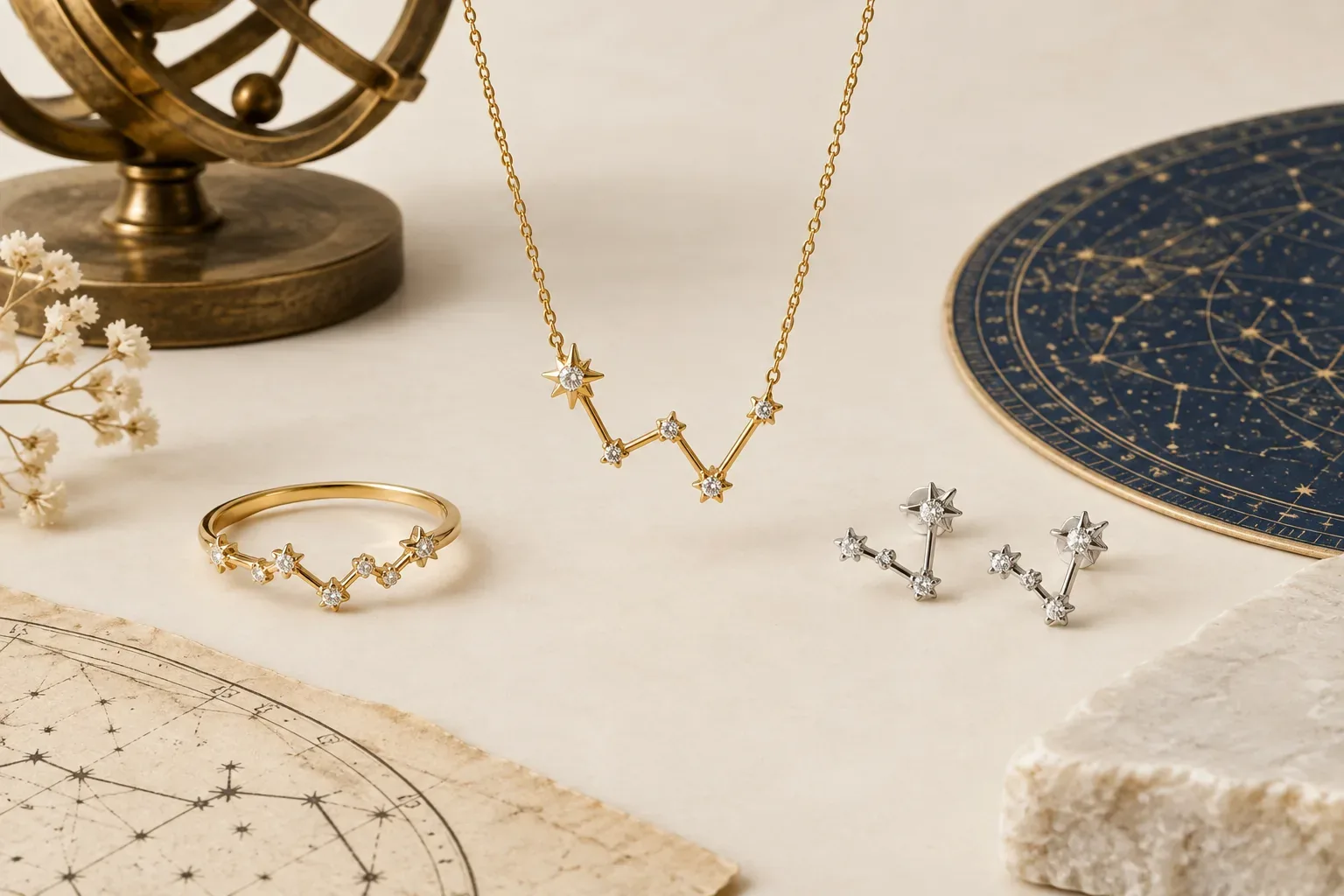
When modern designers refer to 'Cassiopeia' on a pendant, ring or brooch they are usually invoking the recognizable W-shaped arrangement of bright stars seen on northern-hemisphere star charts. The motif appears in contemporary jewellery as a stylized star pattern, linear arrangement of gemstones, or as a symbolic reference in engraving and enamelling.
Because museums and jewellery historians group constellation and celestial motifs together, research into the history of astronomical motifs in jewellery provides the best available documented context for Cassiopeia-style designs rather than evidence that a discrete, named 'Cassiopeia' motif was a stable, named symbol across many historical cultures.
Documented historical evidence and cultural periods
The Victoria and Albert Museum places star- and celestial-themed jewellery within a broad changing social context of ornament and meaning rather than treating every named star pattern as a historically discrete symbol. The V&A’s exhibitions and articles on jewellery history show that makers in different periods adopted stars, comets, suns and moons for a range of reasons including fashion, scientific interest and sentimental symbolism, and that meanings shifted with social context and taste.
In practical terms this means documented historical evidence supports the use of celestial imagery in jewellery across periods such as the late 18th and 19th centuries and into the 20th century within European and later popular contexts, but the V&A does not treat the constellation Cassiopeia as having a uniquely documented role separate from other celestial motifs. Where a jeweller or patron in a particular time used star imagery, the meaning often depended on that time’s cultural language: scientific curiosity and observatory discoveries in one period, sentimental or metaphysical associations in another.
Separating documented meanings from modern interpretations
Documented historical meanings: Museum scholarship, including work published by the Victoria and Albert Museum, documents when and how makers used celestial imagery and connects those uses to observable social currents such as fashion trends, technological advances in gem cutting and the popularity of astronomy as a subject. These are tangible, documented links between motif and context rather than a single, universal symbolic definition.
Modern interpretations: Contemporary designers and wearers commonly layer additional meanings onto a Cassiopeia motif that are not documented historically. Typical modern associations include linking the motif to the Greek mythic name 'Cassiopeia' and its narrative, reading the motif as a symbol of guidance or navigation, or using the pattern as a personal emblem for family, direction, or resilience. These modern meanings are valid as personal or cultural expressions today, but they should be distinguished from what the historical record documents about jewellery use.
How the motif, gemstone, and tradition appear in jewellery
Design forms: Cassiopeia-inspired jewellery typically manifests as a W-shaped arrangement of stones set on a delicate bar pendant, a curved line of diamonds or gems on a ring, or an engraved or enamelled motif on a brooch. Designers translate the constellation’s linear geometry into a composition that reads as both astronomical and decorative.
Gemstone choices and visual effects: Museum resources on gemstones, such as the Victoria and Albert Museum’s A–Z of Gemstones, explain that makers select stones for optical qualities as much as for lore. Diamonds and white stones are commonly chosen to suggest stars through sparkle. Sapphires and other blue stones can provide a 'night-sky' field contrasted against bright stones. Iridescent materials such as opal or mother-of-pearl are sometimes used to give a luminous backdrop. These choices reflect long-standing jewellery practices of selecting materials to achieve visual effects rather than fixed symbolic codes.
Techniques and traditions: Historically, jewellers combined gem setting, engraving, enamelling and metalwork to evoke celestial subjects. Today’s makers use the same repertoire alongside modern techniques such as micro-pavé settings or laser engraving to render a constellation precisely or abstractly. The V&A’s work on jewellery history highlights how makers reuse and adapt familiar motifs across periods, which helps explain why constellation designs are readily reinterpreted today.
Practical and respectful selection or gifting guidance
Consider the intended meaning: Decide whether you are choosing a Cassiopeia piece for its literal astronomical reference, for a specific modern metaphor (such as guidance or family), or for purely aesthetic reasons. Because historical evidence does not establish a single traditional meaning for the motif, be explicit if gifting with a particular message. A short note that explains your intended meaning prevents accidental miscommunication and makes the gift more meaningful.
Match form to lifestyle and age: For everyday wear, choose durable settings and modest stone sizes that fit the recipient’s routine. For special-occasion pieces, heavier settings and larger stones allow for more dramatic interpretations of the motif. If you are unsure of style preferences, a small pendant that evokes the constellation in a subtle way is a respectful compromise between symbolism and wearability.
Gemstone transparency and provenance: Follow consumer-protection best practice when buying gemstones. The Federal Trade Commission recommends that sellers disclose treatments, imitations and enhancements. Ask about heat treatment, coatings, composite stones and whether laboratory-grown gems are being offered so you can make an informed decision that matches your budget and values.
Cultural sensitivity and personal beliefs: Because the constellation’s name and some contemporary narratives draw on mythic sources, be mindful when gifting to people with specific religious or cultural sensibilities. If you are aware that the recipient prefers not to wear myth-referencing imagery, choose an abstract star motif instead or explain the personal, non-religious reasoning behind your choice.
Personalisation and storytelling: If you want the piece to carry a personal story, commission engraving with a relevant date, initials or a short line that anchors your chosen meaning. This approach makes the modern association explicit rather than relying on an assumed historical symbolism that may not exist.
Care, authentication, and verifying materials
Care and maintenance: Because many Cassiopeia designs rely on small stones set closely together, regular inspection by a qualified jeweller will reduce the risk of lost stones. Routine cleaning appropriate to the stone type will preserve sparkle and colour; museum conservators and jewellery professionals emphasize gentle, material-specific care.
Verifying materials and treatments: The Federal Trade Commission’s consumer guidance on buying gemstones, diamonds and pearls advises asking for written disclosure about material treatments and clarifying whether a stone is natural, treated or laboratory-grown. Request invoices or certification that name any treatments and clearly state the seller’s return policy so that you have recourse if the piece is not as represented.
Bringing historical awareness into modern practice
Using museum research as a guide: The Victoria and Albert Museum’s approach to jewellery history encourages readers to see motifs like stars and constellations as mobile symbols whose meanings change with time and social context. A historically informed choice respects that mobility: it acknowledges that a Cassiopeia motif can be a fashionable motif, a personal emblem, or a deliberate reference to myth or astronomy depending on maker and wearer.
Final note: If you want a piece that carries a clear, personal message, make that meaning explicit through a note, engraving, or conversation with the recipient. That way you build modern significance on top of an established visual tradition rather than assuming a single historic meaning where none is documented.
Frequently asked questions
Does Cassiopeia have a single traditional meaning in jewellery history?
No. Museum research indicates that while celestial imagery has been used in jewellery across many periods, there is little evidence that the constellation Cassiopeia carried a single, consistent symbolic meaning in premodern jewellery. Most specific associations attributed to Cassiopeia in jewelry today are modern interpretations.
What gemstones are commonly used to represent the Cassiopeia motif?
Designers commonly choose bright, white stones such as diamonds to suggest stars and darker stones such as sapphires to suggest the night sky; iridescent materials like opal or mother-of-pearl are also used for luminous effects. The Victoria and Albert Museum’s resources explain that gemstone choice is typically driven by optical effect and fashion as much as by symbolic intent.
How should I verify a gemstone or disclose treatments when buying Cassiopeia jewellery?
Follow consumer guidance from the Federal Trade Commission: ask the seller to disclose any treatments, enhancements or imitations, request written details if available, and clarify whether stones are natural or lab-grown so you can make an informed purchase.
Is it appropriate to give Cassiopeia jewellery as a meaningful gift?
Yes, provided you are thoughtful about the recipient’s beliefs and preferences. Because modern meanings can vary, explain the message you intend—whether astronomical, navigational, mythic, or simply aesthetic—or personalise the piece with engraving or a note to make your meaning explicit.
How can I care for jewellery that uses many small stones to depict a constellation?
Have the piece checked periodically by a jeweller to secure settings and clean it in a way appropriate to the specific stones and metals. Small, closely set stones benefit from gentle, regular care to preserve sparkle and prevent loss.
Sources and further reading
- Bedazzled: A History of Jewellery — Victoria and Albert Museum
- An A-Z of Gemstones — Victoria and Albert Museum
- Buying Gemstones, Diamonds, and Pearls — Federal Trade Commission