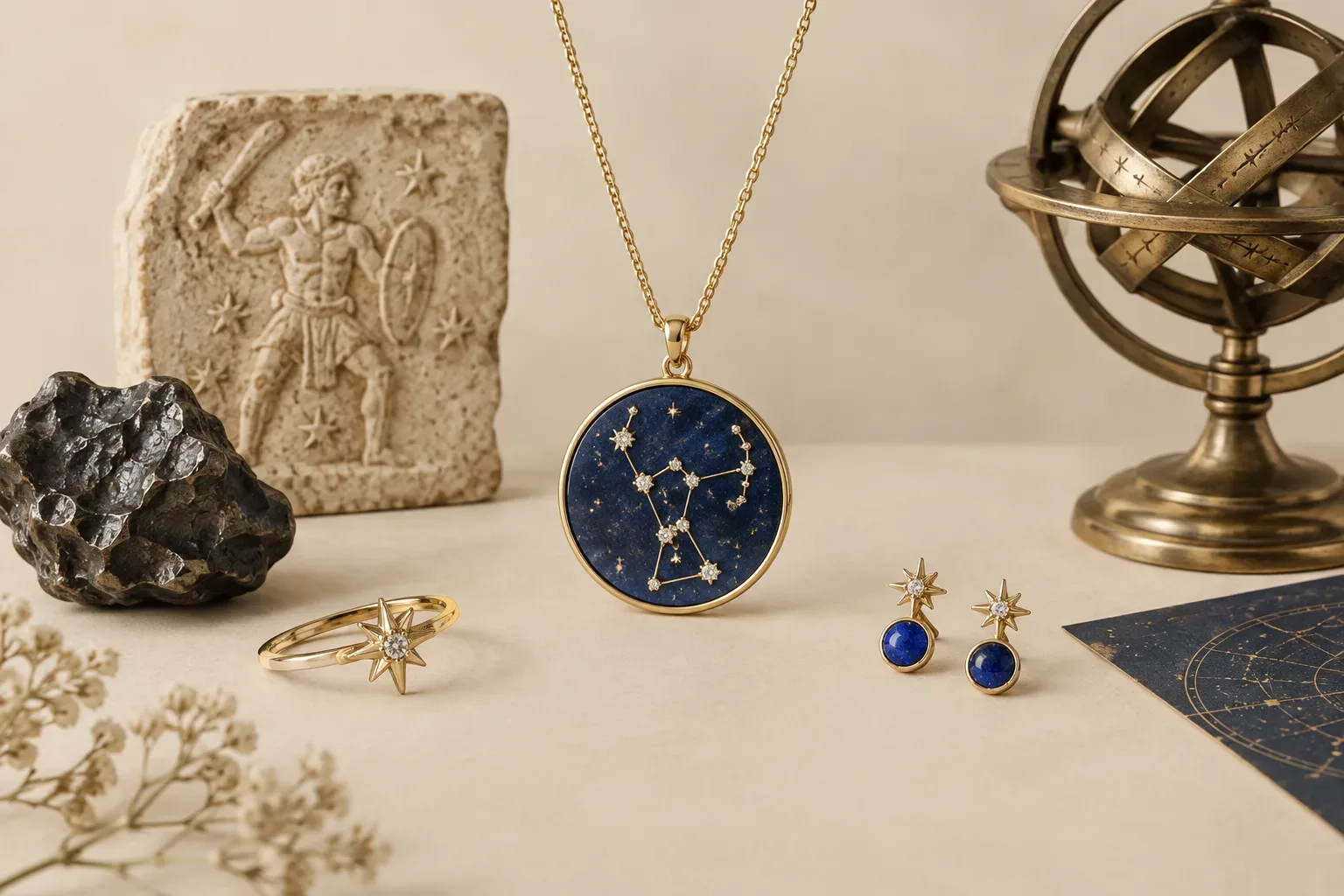
Meaning at a glance
The documented meaning of the Orion motif in jewelry is primarily as a celestial or star motif whose significance has changed with time; museums record the motif as part of broader star- and sky-inspired jewellery traditions rather than a single, universal religious or cultural symbol. Modern meanings are largely personal and fashion-driven. Practical selection should combine design intent, gemstone and treatment disclosure, and respect for any specific cultural associations the recipient values.
What the historical record shows (and what it doesn't)
Museum documentation and exhibitions place the Orion or star motif within a long history of celestial imagery in jewellery rather than isolating it to one fixed religious meaning. The Victoria and Albert Museum frames star and celestial motifs as recurring themes that reflect changing tastes and social contexts in jewellery history (Victoria and Albert Museum). This perspective is important: curatorial records emphasize material and design trends, provenance, and changing social uses, but they rarely treat a single constellation motif as carrying the same symbolic content across cultures.
Specifically, museum collections and historical surveys tend to document the motif's appearances—such as star-set brooches, pendants, and necklaces—within particular periods (for example, the star- and comet-inspired jewels that were fashionable in the 19th century). Those records focus on craftsmanship, materials, and the role of jewellery in social signaling rather than asserting an unbroken symbolic tradition from antiquity to the present (Victoria and Albert Museum). Where ancient cultures attached particular meanings to the stars, that evidence is recorded in separate archaeological and textual sources rather than being a generalized attribute of a jewellery motif in museum catalogs.
Astronomy, motif origin, and how historians treat the link
The motif called “Orion” in contemporary jewellery usually references the distinctive three-star alignment known from the constellation commonly called Orion. Jewellery historians and curators describe this as an instance of designers borrowing a recognisable star pattern to create an easily readable motif for wearers and viewers (Victoria and Albert Museum).
Historical scholarship accessible through museum writing tends to separate astronomical observation from the later, decorative adaptation of those observations. Curators note that jewelers have long used simplified star patterns and grouped stones to suggest constellations without claiming the objects carry a stable religious or cosmological meaning over centuries. In other words, the jump from seeing a pattern in the sky to wearing it on a pendant is often a modern act of representation and design rather than direct evidence of a shared ancient symbolic tradition (Victoria and Albert Museum).
Documented historical uses of star- and constellation-style motifs in jewellery
Across museum collections, star motifs appear in many cultures and periods, but their meanings differ by context. The Victoria and Albert Museum’s historical accounts treat star jewellery as a recurring decorative vocabulary: stars and celestial imagery were popular motifs in certain European periods such as the 18th and 19th centuries and enjoyed revivals tied to fashion and technological developments in gem cutting and setting (Victoria and Albert Museum).
In the Victorian era, for example, jewellers experimented with new settings and small diamonds that made delicate star- and comet-shaped designs technically possible and fashionable. Exhibitions and collection notes emphasize technique, materials, and social use—mourning, sentiment, display—rather than presenting the motif as carrying a single, universal spiritual meaning (Victoria and Albert Museum).
Modern interpretations versus documented historical meanings
Modern readings of Orion-themed jewellery are often personal, astrological, or stylistic. Contemporary wearers might choose an Orion pendant because they are fond of the night sky, they identify with the mythic figure of Orion from popular retellings, or they appreciate the three-stone belt aesthetic. These modern interpretations are valid personal meanings, but they are distinct from what museum documentation records as historical use: decorative fashion and social signaling (Victoria and Albert Museum).
It is important not to conflate modern popular or astrological meanings with documented historical religious or cultural significance unless a specific provenance supports that claim. Museum catalogs and exhibition materials distinguish design and social function from later personal or zodiacal interpretations (Victoria and Albert Museum).
How the Orion motif, gemstones, and traditions appear in jewellery
Designers and artisans adopt the Orion idea in several common ways. A literal approach is to set three stones in a straight line to hint at the constellation’s belt; a looser approach uses clusters of small stones to suggest a starfield or to stylize the constellation within a pendant or brooch. The star-set technique—cutting metal to form rays around a central stone or using tiny pavé stones to create a sparkly field—is familiar in historical pieces and in contemporary jewellery (Victoria and Albert Museum).
Gemstone choices follow aesthetic and practical considerations. Diamonds are frequently used for their brilliance in star and constellation motifs; coloured stones such as sapphires, topaz, or garnet may be chosen to echo the night sky or personal preference. The Victoria and Albert Museum’s overview of gemstones helps identify stones historically used in decorative jewellery and notes how cutting and treatments shaped design possibilities across periods (Victoria and Albert Museum).
In addition to settings and stones, the ‘Orion’ idea appears in techniques: small pavé clusters, three-stone rings, starburst motifs with engraved rays, and compact pendants meant to be read at a glance. These choices tie directly to the visual language of celestial jewellery recorded by museums as part of changing design practice (Victoria and Albert Museum).
Practical guidance for selecting or gifting Orion-themed jewellery
Start by separating meanings you want to convey. If you choose an Orion motif for aesthetic reasons, make that clear in your gift note or explanation. If you intend an astrological or cultural meaning, confirm that the recipient holds or appreciates that interpretation to avoid unintended appropriation or misunderstanding. Museum practice encourages careful provenance and contextual information for culturally specific items, and the same caution translates to personal gifting (Victoria and Albert Museum).
Ask about materials and treatments. The Federal Trade Commission provides practical guidance on disclosure: reputable sellers should disclose gemstone treatments, imitations, and metal content. For example, heat treatments, clarity enhancements, or the use of simulants should be made clear at the point of sale (Federal Trade Commission).
Match metal and gemstone to use and budget. For everyday wear choose sturdier stones and secure settings; for an heirloom-style gift, consider traditional choices like diamonds or sapphires set in gold or platinum. The Victoria and Albert Museum’s gemstone overview can help you identify stones by visual characteristics and historical use, which is useful when you want an authentic historical feel (Victoria and Albert Museum).
Personalize respectfully. If you commission a piece that references a specific cultural story or myth, work with a designer knowledgeable about that tradition and willing to document sources and permissions. For purely decorative or astronomical references, personalization such as engraved coordinates of the recipient’s birthplace or a date can tie meaning to the wearer without making cultural claims.
Care, disclosure, and ethical considerations
Check treatment and imitation disclosures before purchase. The FTC emphasises that sellers must disclose known treatments and synthetic or simulated materials, and buyers should ask specific questions if a certificate or report does not address those issues (Federal Trade Commission).
Consider provenance where cultural significance is claimed. Museum curators document provenance carefully when a piece has clear cultural or ritual function; buyers should ask similar questions when presented with jewellery marketed as culturally or spiritually significant. If an item is framed as a rediscovered ‘traditional’ design, seek corroborating sources or ask the maker for a documented inspiration to avoid misrepresentation (Victoria and Albert Museum).
Care for star and constellation designs as you would other delicate jewels: follow standard cleaning guidance for the stone and metal type, and ensure settings are regularly checked by a jeweller familiar with small pavé and star settings.
Styling and wearing tips
Orion motifs can read as subtle and modern if rendered in small pendants or three-stone rings, or as vintage and statement-making when rendered as larger starburst brooches or cluster pendants. Consider scale relative to the wearer’s wardrobe and lifestyle: small, flat pendants suit everyday wear, while higher-profile star motifs often pair well with evening or formal attire.
Layering works well: a delicate Orion pendant can sit among chains and lockets to create a personal constellation of meanings. If the piece uses coloured stones, coordinate metal tone and outfit palette to let the stones read clearly.
Final thoughts
Orion jewellery meaning is not a single, universal message. Museum documentation encourages reading the motif as part of a broader history of celestial decoration, influenced by technical possibilities in gem cutting and by changing fashion rather than by one continuous spiritual tradition (Victoria and Albert Museum). Modern wearers and givers create new, personal meanings every time they choose a star-motif piece. When selecting, ask about materials and treatments (Federal Trade Commission), be clear about the meaning you wish to convey, and respect any specific cultural associations the recipient may hold.
Frequently asked questions
What does Orion jewelry typically symbolize?
Orion jewellery typically symbolizes a celestial or star motif and is often chosen for aesthetic, sentimental, or astrological reasons; museum documentation treats such motifs as decorative and fashion-driven rather than as a single, universal spiritual symbol (Victoria and Albert Museum).
Is Orion jewellery an ancient cultural symbol?
Museum records do not support a single continuous, ancient jewellery tradition tied exclusively to the Orion motif; curatorial work treats star motifs as recurring decorative elements whose meanings vary by culture and period (Victoria and Albert Museum).
Which gemstones are commonly used for Orion or star motifs?
Diamonds are commonly used for their brilliance in star and constellation motifs, while coloured stones such as sapphires, topaz, and garnet are chosen for palette and personal preference; the Victoria and Albert Museum’s gemstone guide explains historic and aesthetic uses of different stones (Victoria and Albert Museum).
What should I ask the seller before buying an Orion-themed piece?
Ask for disclosure of treatments, whether stones are synthetic or simulants, metal content, and any provenance or cultural attribution. The Federal Trade Commission advises buyers to request information on treatments and imitations at the point of sale (Federal Trade Commission).
How can I gift Orion jewellery respectfully?
Be explicit about the meaning you intend—stylistic, astrological, or cultural—and confirm the recipient’s appreciation of that meaning; if the design references a specific cultural story, seek documentation or work with a maker knowledgeable about that tradition (Victoria and Albert Museum).
Sources and further reading
- Bedazzled: A History of Jewellery — Victoria and Albert Museum
- An A-Z of Gemstones — Victoria and Albert Museum
- Buying Gemstones, Diamonds, and Pearls — Federal Trade Commission