Meaning at a glance
Capricorn jewelry meaning reflects a long-running link between the constellation Capricornus and decorative arts; museums document how celestial motifs entered jewelry, while modern personal meanings layer ambition, steadiness, and identity onto the motif. This article separates documentary evidence from later interpretations and explains how the motif and related gemstones appear in contemporary pieces, with practical buying and gifting guidance.
Short answer
Capricorn jewelry meaning: Historically, the capricorn motif derives from astronomical and zodiacal imagery tied to the constellation Capricornus; museums and jewelry historians trace the broader use of star- and zodiac-themed imagery into decorative arts and personal adornment. Modern symbolism—traits such as discipline, ambition, or emotional depth—arises largely from later astrological and personal interpretations rather than a single universal historical meaning.
Historical evidence and cultural context
Documented evidence for zodiac and celestial motifs appearing in personal adornment comes from long-standing museum collections and catalogues that place such imagery across different periods and places. The Victoria and Albert Museum records how jewellery has adopted symbolic motifs from astronomy and mythology as decorative themes as tastes and social functions changed over time, showing a continuity of celestial imagery moving from public iconography into private jewellery (Victoria and Albert Museum).
When discussing the capricorn motif specifically, it is important to separate two strands of evidence. One strand is astronomical and astrological iconography—images of the constellation and its associated hybrid creature—which influenced illustrated manuscripts, prints, and decorative arts. The other strand is jewellery practice: makers and patrons adopted celestial motifs (including zodiac signs) at particular moments, such as Renaissance revivalism, nineteenth-century interest in astrology and esoterica, and twentieth-century commercial zodiac jewellery. The V&A source documents how changing social contexts and tastes determine which motifs become fashionable in jewellery at different times (Victoria and Albert Museum).
Documented historical meanings versus modern personal interpretations
Documented historical meanings come from the contexts in which a motif was used. For example, when jewelled objects display zodiac signs as part of a larger astrological program—on an illustrated calendar, a medieval astrolabe, or a Renaissance table clock—the symbol participates in a learned or calendrical system rather than expressing a personal trait. Museum descriptions and catalogues emphasize these contextual readings, noting that such motifs often served decorative, calendrical, or emblematic functions in their original settings (Victoria and Albert Museum).
Modern personal interpretations, by contrast, are the associations individuals today attach to the Capricorn motif—qualities like ambition, persistence, pragmatism, or emotional reserve. These associations largely derive from contemporary astrology and popular culture rather than direct documentary evidence tying the motif to those personality traits across historical cultures. It is therefore accurate to say that modern symbolic meanings are layered onto a historically older motif; they are meaningful to wearers now but are not universal historical facts.
How the capricorn motif, gemstones, and traditions appear in jewelry
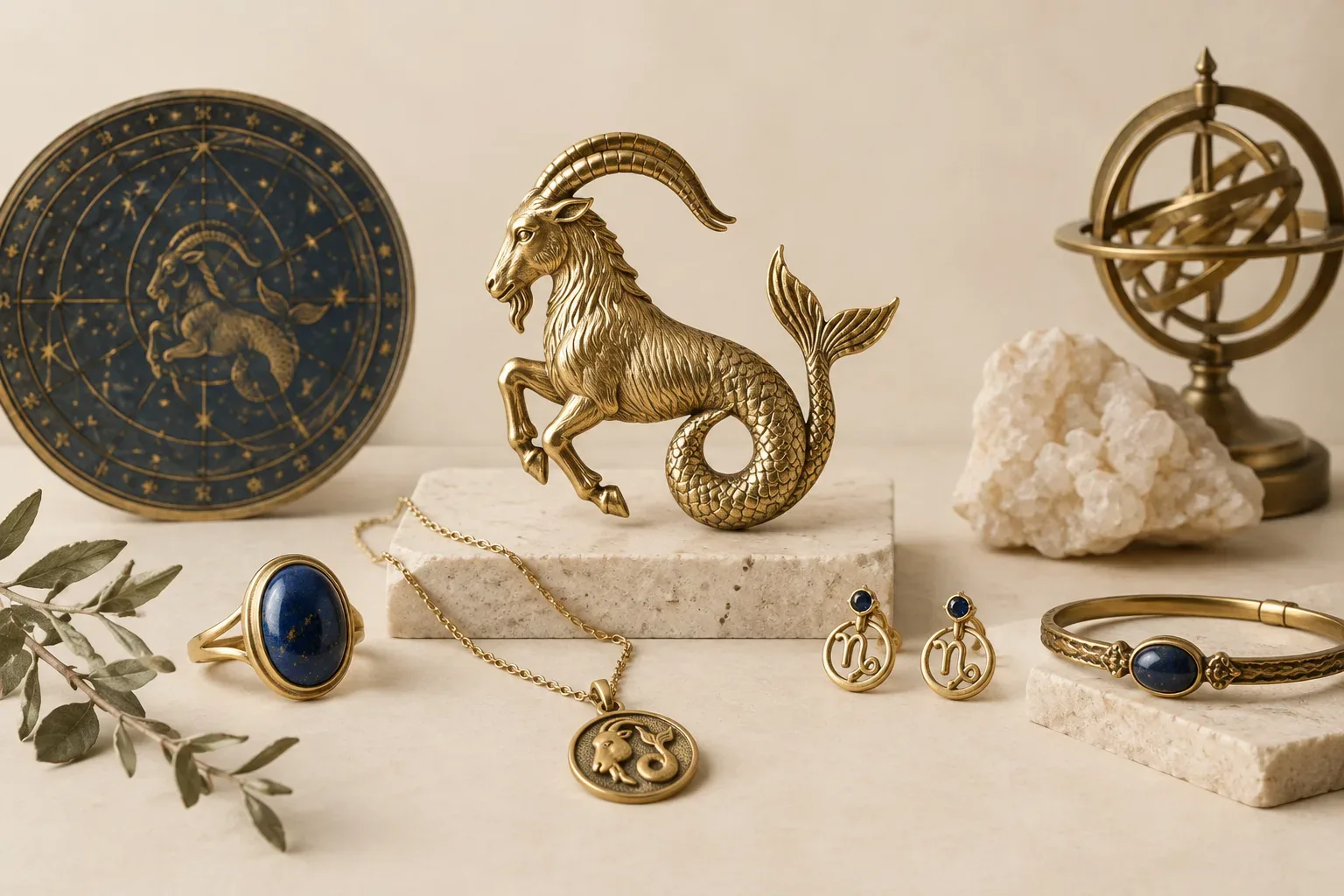
The capricorn motif appears in jewellery in several visual ways: stylized representations of the sea-goat or goat, engraved constellation maps on lockets or pendants, zodiac discs set into signet-style jewellery, and abstract glyphs derived from astrological notation. Jewelry designers borrow the motif’s hybrid imagery or its simplified astrological glyph depending on style—figurative for expressive, narrative pieces and glyph-based for minimal, modern designs.
Gemstones are commonly paired with zodiac jewellery for decorative and personal reasons. Museums’ gemstone overviews show how particular stones have long been valued for color, durability, and working properties, which influences modern choices in zodiac pieces (Victoria and Albert Museum). Contemporary makers often select stones that match a sign’s month or color palette familiar from modern popular guides, but such pairings are modern conventions and vary by maker and buyer preference. When selecting pieces identified as zodiac or birth-sign jewellery, buyers should expect a range of materials from sterling silver and gold to enamel, glass paste, and a variety of gems or simulated stones.
Practical selection and gifting guidance
Start by deciding what reading of the motif matters to the recipient. Do you want the piece to signal astrological identity (a clear Capricorn glyph or sea-goat), express a personality trait (a minimalist, disciplined aesthetic), or function as a stylish, wearable motif? Matching that intent to the piece’s style will make a gift feel considered rather than generic.
Consider materials and durability. If the piece is intended for daily wear, choose hard precious metals (sterling silver, gold) and secure settings for stones. The Victoria and Albert Museum’s overview of gemstones explains historically how materials were chosen for their visual and working properties; apply that by choosing materials appropriate to the recipient’s lifestyle and skin sensitivities (Victoria and Albert Museum).
Check disclosure about treatments and imitations. The Federal Trade Commission reminds buyers to ask sellers about gemstone treatments, synthetic stones, and plating so you understand what you are purchasing and how to care for it (Federal Trade Commission). For higher-value pieces, request written details or certification about materials.
Respect cultural and personal meaning. Not everyone who wears astrology jewellery endorses astrological claims; some wear a sign as a sentimental marker of birth dates or as a design element. When gifting, avoid presuming the recipient embraces specific spiritual beliefs; instead choose a neutral, well-crafted piece unless you know a personal preference.
Care, authenticity, and buying tips
Ask about materials and manufacturing: is the metal stamped for purity, are stones natural or lab-grown, and are any gems heat-treated or dyed? The FTC recommends clear disclosure from sellers on treatments and imitations to avoid surprises and to inform proper care (Federal Trade Commission).
For antique or historically styled pieces, consult descriptions from reputable museums or dealers. The Victoria and Albert Museum’s catalogues and exhibitions are useful references for how zodiac and celestial motifs were used in different periods, which helps set expectations for style and technique (Victoria and Albert Museum).
Finally, consider scale and daily wear. A small pendant or simple glyph is suitable for layered everyday wear; a figurative or heavily embellished sea-goat motif suits occasional or statement wear. If engraving a personal message, keep it short and relevant to the recipient rather than assuming a symbolic meaning.
Frequently asked questions
Is the Capricorn symbol historically tied to a single meaning?
No. Historically, the capricorn motif stems from astronomical and zodiac imagery and appears in different contexts—calendar art, learned texts, and decorative programs—each giving it specific meanings. Modern personality traits attached to Capricorn are later astrological and popular interpretations rather than a single historical meaning.
What gemstones are appropriate for Capricorn jewelry?
There is no single historically mandated gemstone for Capricorn across cultures. Contemporary pieces often use January birthstones like garnet for aesthetic or commercial reasons, but choice of stone should be guided by durability, color preference, and whether a stone is natural, treated, or synthetic. Ask sellers about treatments and origins, per FTC guidance.
How do I know if a zodiac piece is authentic or well-made?
Check material stamps and seller disclosures. For higher-value purchases, request paperwork on metal purity and gemstone treatments. Museum resources can help set expectations about styles and techniques for antique or historically inspired pieces (Victoria and Albert Museum).
Is it respectful to gift zodiac jewelry to someone?
Yes, if done thoughtfully. Consider whether the recipient appreciates astrology or prefers symbolic jewellery as a design element. Choose neutral, high-quality materials and avoid assuming spiritual beliefs; an explanatory note that frames the piece as a personal token rather than a definitive statement helps ensure respect.
How should I care for Capricorn jewelry with gemstones?
Care depends on materials. Precious metals generally need occasional polishing; softer stones require more protection from knocks and chemicals. Ask the seller about any treatments (e.g., dyeing, fracture filling) that affect cleaning and storage, following FTC recommendations for disclosure.
Sources and further reading
- Bedazzled: A History of Jewellery — Victoria and Albert Museum
- An A-Z of Gemstones — Victoria and Albert Museum
- Buying Gemstones, Diamonds, and Pearls — Federal Trade Commission