Meaning at a glance
Leo zodiac jewelry meaning combines a long history of animal and solar motifs in jewellery documented by museums, later popular astrological associations linking Leo to the lion and the sun, and contemporary personal symbolism; choose and gift Leo pieces with attention to craft, gemstone disclosure, and the recipient's cultural context.
What the historical evidence actually shows
Scholarly collections and major museums document that people have used animals, human figures and celestial imagery in personal ornament for millennia and that those motifs change meaning with time and culture. The Victoria and Albert Museum, for example, frames jewellery history as a record of shifting social, religious and aesthetic contexts rather than a single, continuous symbolism. That institutional perspective is the appropriate starting point when we ask how a 'Leo' motif came to appear in jewellery.
From that museum perspective, motifs such as lions and suns appear in many periods and places, but their meanings vary. A lion carved into a signet ring in one region might have represented royal power at a particular time, while in another context a lion could be a protective symbol, a family emblem, or simply an artistic motif. The museum's work shows how form, technique and social function all matter when interpreting a piece of jewellery.
Separating documented historical meanings from modern interpretations
Documented historical meanings come from material culture, inscriptions, contemporary texts and curatorial study. The evidence collected and interpreted by institutions such as the Victoria and Albert Museum supports statements about how motifs were used in specific places and times, but it does not automatically validate the contemporary, generalized personality claims found in popular astrology.
Modern popular astrology overlays a consistent set of personality traits and life advice on zodiac signs, and it is correct to treat those as a later interpretive layer rather than as direct continuations of any single ancient practice. Where a modern Leo pendant claims to 'bring courage' or 'reflect leadership,' that is a contemporary symbolic use of the lion and solar imagery, meaningful to wearer and giver, but not an archaeological claim supported by museum evidence.
How Leo motifs, gemstones and traditions appear in jewellery
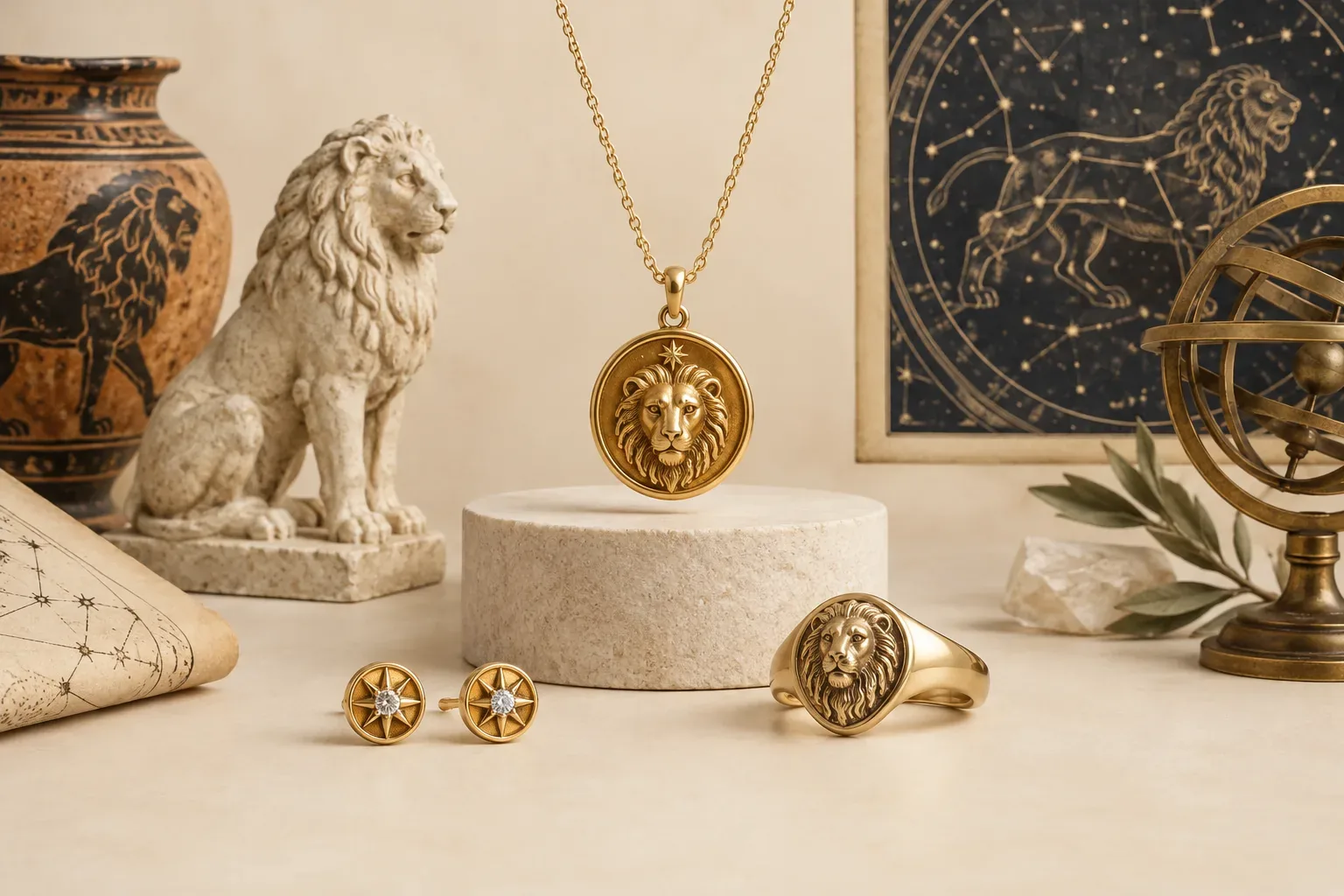
In jewellery practice the Leo sign is most commonly rendered as a lion motif, a stylized glyph (the Leo astrological sign), or solar imagery such as a sunburst. These are design choices that reference the constellation and the astrological tradition rather than material evidence of past ritual use. The lion motif appears in many forms: engraved, cast, set with gems, or suggested through mane-like textures and curves.
Gemstones associated with personal meaning are used alongside motifs to add color, perceived energy or birth‑month connections. The Victoria and Albert Museum's overview of gemstones explains how different stones have been chosen historically for color, rarity and craftsmanship as much as for symbolic meaning. In modern Leo pieces, warm-colored stones such as citrine, garnet, or yellow sapphires are sometimes paired with lion or sun designs, but that pairing is a contemporary aesthetic choice rather than a universal historical rule.
Technique matters: makers use engraving, enamelling, cabochon and faceted settings, or three‑dimensional casting to convey the motif. A small signet-style Leo ring will read differently from a birthstone pendant set beneath a three-dimensional lion in high relief. The visual language of jewellery—scale, finish, and setting—shapes how the motif will be perceived and how wearable it is for daily use or ceremonial occasions.
Practical guidance for choosing or gifting Leo zodiac jewellery
Start with what the recipient values. If the person wears minimalist jewellery, choose a subtle glyph or small lion motif in a metal they prefer. If they favour statement pieces, a larger sculptural lion or a sunburst pendant with a bold gemstone may be appropriate. Consider size, weight and how the piece will be worn; these practical aspects often matter more to the recipient than symbolic intention alone.
Ask about metal and gemstone disclosure. The Federal Trade Commission provides guidance on buying gemstones, diamonds and pearls: ask the seller about treatments, whether stones are natural, synthetic, or simulants, and request written confirmation when appropriate. For example, many gemstones are heat-treated or otherwise enhanced to improve color and durability; those treatments should be disclosed at point of sale.
Think about provenance and craftsmanship. Museum narratives emphasise that jewellery is also a craft and that technique carries meaning. A well-made piece by a known maker or from a trusted atelier can communicate care and thoughtfulness. If budget or ethical sourcing is important to your recipient, ask the seller about origin and responsible practices.
Be culturally respectful. Because animal and solar imagery can carry specific religious or cultural meanings in particular communities, avoid assuming a motif is neutral. If the recipient comes from a cultural or religious background where a symbol has sacred significance, it is considerate to check whether such a gift would be welcomed or whether it might feel inappropriate.
Personalize where meaningful. Modern interpretations of Leo are often personal rather than historical. A short inscription, choice of metal, or a favored stone can make the piece resonate for the wearer. If the gift is intended to mark a life event, consider selecting a form of the motif that matches the tone you want—intimate and subtle for personal milestones, or bold and celebratory for major achievements.
Caring for Leo jewellery and verifying value
Treat jewellery as both an aesthetic object and a material one. The V&A’s coverage of gemstones and jewellery history highlights the role of materials and technique in how objects survive and are displayed. Clean and store pieces according to the materials used: porous or soft stones need different care from hard, faceted gems.
When purchasing gemstones, use the FTC’s guidance: request written disclosure about treatments and whether stones are natural, synthetic, or simulants. Keep receipts and any certificates with the piece, and consider professional appraisal if the item is of significant monetary or sentimental value.
Frequently asked questions
Is the lion motif in Leo jewellery historically an astrological symbol?
No single historical source establishes the lion as a uniform astrological symbol across all cultures. Museums such as the Victoria and Albert Museum document widespread use of animal motifs, including lions, in jewellery, but meanings differ by time and place. The specific tie between the lion and the astrological sign Leo is a later interpretive layer present in modern astrology and popular culture.
Which gemstones are best for Leo jewellery?
There is no single historic gemstone exclusively tied to Leo across cultures. Contemporary Leo pieces often use warm-colored stones for aesthetic effect, but a better approach is to choose a gemstone the wearer likes and to ask the seller about any treatments. The Victoria and Albert Museum provides context on how gemstones have been historically selected, and the Federal Trade Commission recommends requesting disclosure on treatments and whether a stone is natural, synthetic, or a simulant.
How can I verify a gemstone’s authenticity when buying Leo jewellery?
Ask for written confirmation from the seller about treatments and the stone’s nature. The Federal Trade Commission advises consumers to request disclosure about enhancements and to keep receipts and any certificates. For higher-value purchases, consider an independent appraisal or laboratory report.
Is it appropriate to gift Leo zodiac jewellery to someone of another culture?
Gifting a Leo piece is often meaningful, but be mindful that animal or solar symbols may have specific cultural or religious significance in some communities. It’s considerate to check whether a particular motif might be sensitive to the recipient’s background before giving the gift.
How should I care for a Leo pendant set with a gemstone?
Care depends on materials. The V&A’s guidance on gemstones and jewellery history underscores that different stones and settings need different care. Avoid harsh chemicals, store pieces to prevent scratches, and follow the maker’s instructions for cleaning. For soft or porous stones, seek professional advice.
Sources and further reading
- Bedazzled: A History of Jewellery — Victoria and Albert Museum
- An A-Z of Gemstones — Victoria and Albert Museum
- Buying Gemstones, Diamonds, and Pearls — Federal Trade Commission