Meaning at a glance
Explain the documented history and changing contexts of the cancer zodiac motif, separate cultural or religious evidence from later popular interpretations, and give practical guidance for choosing and wearing the motif in modern jewelry.
Documented history and cultural contexts
Surviving jewelry and museum scholarship show that celestial and zodiac imagery recur across many times and places, and that their social roles shifted over time. Museum presentations and cataloguing by the Victoria and Albert Museum note that jewellery’s meaning changes with social context, serving as personal ornament, religious or magical object, and public display of identity or status. The V&A describes this long view of jewellery history and how motifs are reused, revived, and reinterpreted in different eras.
Because the Victoria and Albert Museum deals with objects from many periods, its work is a reliable guide to how motifs—including stars, constellations, and other celestial symbols—move through stylistic trends and cultural uses. Museum collections make clear that when an astronomical or zodiac motif appears on a piece of jewellery, the object’s intended meaning depends on the maker’s culture and period: it could be a practical astronomical reference, an astrological talisman, a fashionable emblem, or simply decorative embellishment.
Separating documented historical meanings from modern interpretations
Documented historical meanings come from how objects were used and recorded in their own context. For example, some historical pieces that incorporate celestial motifs were made with astrological or religious purposes in mind, while others used the same motifs as fashionable ornament. The Victoria and Albert Museum’s curatorial perspective emphasizes that jewellery’s social function must be read from provenance, materials, inscriptions, and the historical record rather than assumed from later beliefs.
Modern interpretations—what many people now think of as the “meaning” of Cancer zodiac jewellery—are often personal or products of contemporary astrology and popular culture. These modern layers commonly connect Cancer with traits such as emotional sensitivity, home and family, or lunar association. Those are valid contemporary uses and personal symbols, but they are not universal or intrinsic to every historical object that bears a crab, a constellation, or a glyph associated with Cancer. Distinguishing documented, period-specific evidence from later personal or mass-market symbolism helps avoid attributing a single timeless meaning to every piece.
How the Cancer motif, gemstones, and traditions appear in jewellery
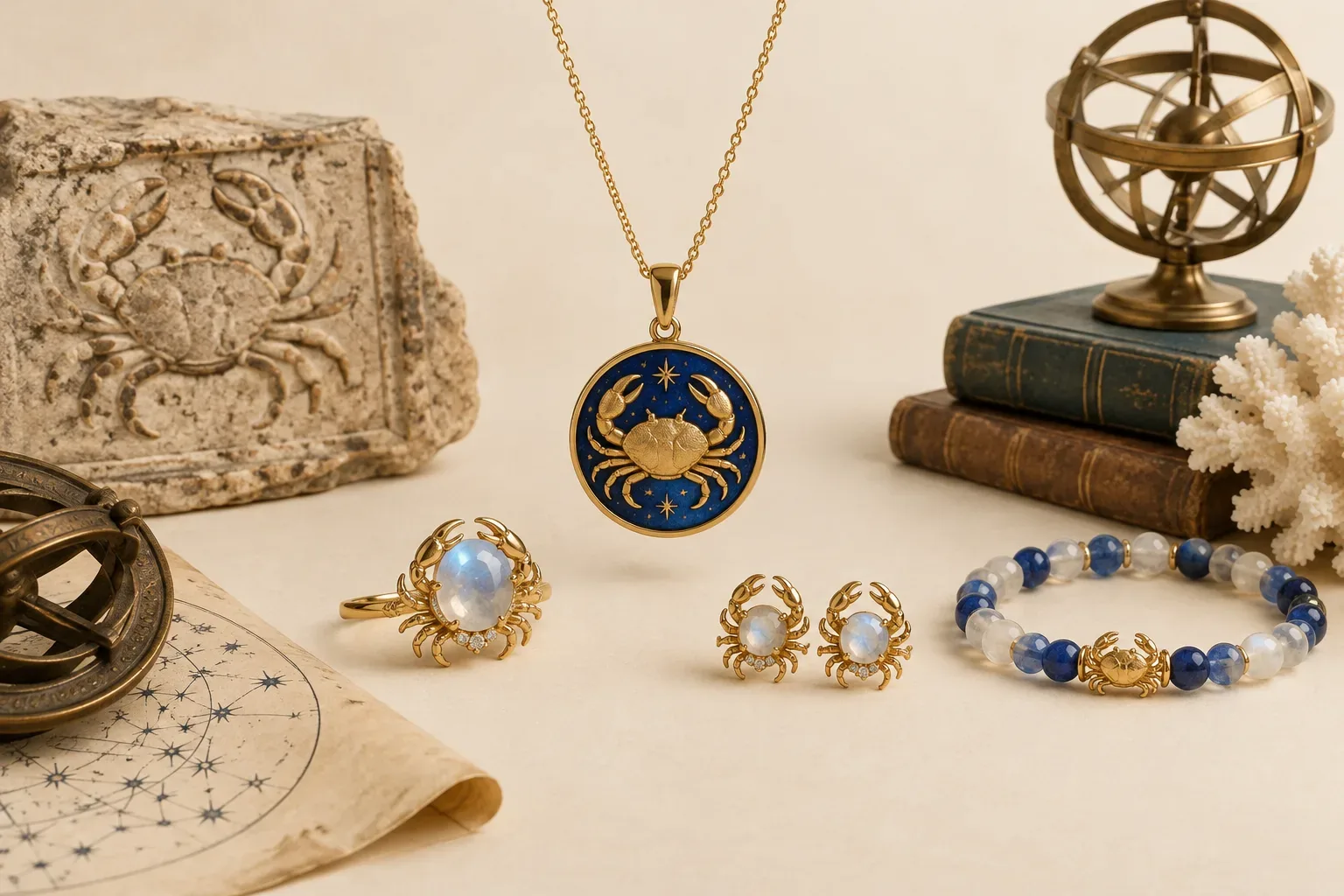
Design motifs. In jewellery, Cancer-themed imagery appears in a few common visual forms: a pictorial crab, the stylized zodiac glyph, a rendered star pattern representing the constellation, or broader water and moon motifs that contemporary makers associate with the sign. Historically, makers used whichever visual language matched their period’s taste—naturalistic depictions in some eras, simplified glyphs or engraved constellations in others. Museum collections tracked by the Victoria and Albert Museum show this variety and the way motifs recycle through revival styles and fashion.
Materials and treatments. Makers have executed zodiac and celestial designs in a wide range of materials: gold and silver work, enamel decoration, gem-set panels, engraved metal, and later mass-produced alloys and castings. For gem choices, modern Cancer-themed jewellery often favors stones that connect visually to water or the moon—cool blues, pearlescent whites, and soft pastels—as well as traditional birth-month gems chosen for the wearer. For historical context on gemstones, the Victoria and Albert Museum’s 'An A–Z of Gemstones' is a useful reference for how particular stones were regarded and used across periods.
Consumer protections and authenticity. When selecting gem-set Cancer jewellery, be aware that treatments, enhancements, and imitations are common in the gemstone trade. The U.S. Federal Trade Commission’s consumer guidance on buying gemstones, diamonds, and pearls explains the importance of asking sellers to disclose treatments, origins, and whether stones are synthetic or imitation. That guidance helps buyers evaluate both historical pieces and contemporary work.
Practical and respectful selection or gifting guidance
Know the recipient and the context. Before buying Cancer zodiac jewellery, consider whether the intended wearer values astrological symbolism, prefers subtlety, or would appreciate a purely decorative item. Some people cherish zodiac pieces as personal identity markers; others may find them frivolous or culturally loaded. Choosing a design that matches the recipient’s style—minimalist glyph, a small crab charm, or a gemstone pendant—shows respect for personal taste.
Prioritize documented quality and disclosure. For gem-set or antique pieces, ask for documentation about the stone’s treatment, whether it is natural, synthetic, or simulant, and for any provenance or appraisal paperwork. The Federal Trade Commission advises buyers to request clear disclosures from sellers about treatments and imitation materials. For precious metals, look for hallmarks and ask trusted vendors for testing certificates when authenticity is important.
Consider cultural and religious sensitivity. Zodiac imagery has associations in different cultural and religious contexts. If you are gifting across cultures or to someone with strong religious beliefs, a discreet conversation or a thoughtful choice—such as a piece focused on personal meaning rather than asserting astrological authority—shows care.
Choose personalization thoughtfully. Small customizations can make a zodiac piece meaningful without imposing a broad set of beliefs: an engraved date, initials, a subtle constellation map on the reverse of a pendant, or pairing a modest gemstone that has personal resonance. If selecting an antique piece, research its period and intended use so the gift can be described accurately and respectfully.
Closing: how to think about meaning and use
Cancer zodiac jewellery can be read in many ways: as a historical motif whose meaning changed over time, as a modern personal emblem, or simply as wearable art. Museum scholarship, notably the Victoria and Albert Museum’s work on jewellery history, encourages reading pieces in their social and material context rather than assuming a single, fixed meaning.
If you are buying, wearing, or gifting Cancer-themed jewellery, combine respect for the object’s documented context with attention to the recipient’s values and the FTC’s practical advice on gemstones and disclosure. That approach keeps the piece both meaningful and responsibly chosen.
Frequently asked questions
Does the crab symbol always mean the same thing historically?
No. Historical meanings vary by culture and period. Museum scholarship, such as that of the Victoria and Albert Museum, shows that the same motif can serve decorative, astrological, religious, amuletic, or social-signalling roles depending on context.
If I’m not a Cancer, is it appropriate to wear Cancer zodiac jewellery?
Yes—many people wear zodiac symbols for aesthetic reasons, personal resonance, or to honor someone else. Be mindful when borrowing motifs from cultures or faiths where the symbol has a specific sacred or communal meaning; opt for respectful choices and ask questions if unsure.
How should I check a gemstone in Cancer jewellery for authenticity?
Ask the seller for disclosures about treatments and whether a stone is natural, synthetic, or an imitation. The Federal Trade Commission advises requesting clear information and documentation. For valuable purchases, seek an independent appraisal or certification.
Are there traditional gemstones specifically tied to Cancer jewellery?
Different periods and markets have favored different stones. Contemporary makers often choose stones that evoke water or the moon or the wearer’s birth month. For historical information about specific gemstones and their uses, consult authoritative sources such as the Victoria and Albert Museum’s 'An A–Z of Gemstones.'
How can I gift Cancer zodiac jewellery respectfully?
Consider the recipient’s beliefs and style, choose a design that fits their tastes, ask sellers for disclosure on materials and provenance, and include a note explaining your choice so the recipient understands whether the piece is meant as a personal emblem, decorative object, or heirloom.
Sources and further reading
- Bedazzled: A History of Jewellery — Victoria and Albert Museum
- An A-Z of Gemstones — Victoria and Albert Museum
- Buying Gemstones, Diamonds, and Pearls — Federal Trade Commission