Meaning at a glance
Explain the documented history and changing contexts of the gemini motif, separate cultural or religious evidence from later popular interpretations, and give practical guidance for choosing and wearing the motif in modern jewelry.
What the historical record shows (and how scholars present it)
Museum research and curatorial overviews make clear that jewelry designs change with social context. The Victoria and Albert Museum frames jewellery as a craft and an expression that shifts meaning over time; motifs such as animals, human figures, and celestial symbols recur because of their visual potency and adaptability rather than because they carry a single immutable significance (Victoria and Albert Museum).
Specific motifs associated with twins or dual figures appear in a number of historical cultures. In decorative arts and personal ornament these images could reference family lineage, mythic figures, protective emblems, or simply a fashionable pattern. The V&A collection and its interpretive materials note that the same visual motif may serve commemorative, political, or aesthetic purposes in different eras, and that jewelry often borrows and reworks classical and medieval imagery in later centuries (Victoria and Albert Museum).
The appearance of star, planet and constellation imagery in jewellery also has a long presence in material culture. Astronomical motifs have been adopted at different times to express cosmological beliefs, curiosity about the heavens, fashionable “celestial” aesthetics, or personal associations with a particular night sky figure. Again, the V&A presents this as part of jewellery’s shifting social meanings rather than proof of a single, continuous religious or cultural message (Victoria and Albert Museum).
Separating documented historical meanings from modern interpretations
Documented historical meanings: museum scholarship documents that motifs are reused and reinterpreted, and that the original meanings of a motif are not always preserved. For example, an image of two figures on a brooch in one period could commemorate a pair of siblings or recall a myth in another period; the V&A emphasizes changing contexts in its accounts of jewellery history (Victoria and Albert Museum). The documentation supports describing historical use, craftsmanship, and the social role of jewellery, but it rarely supports a single symbolic reading that applies across cultures and centuries.
Modern interpretations: contemporary “Gemini” jewelry—pieces explicitly marketed as zodiac, horoscope, or birth‑sign jewellery—is largely a modern phenomenon in which astrological systems and commercial design intersect. Wearing a Gemini pendant today typically signals a personal or cultural identification with the astrological sign, a birthday range, or an affinity for the twin motif. These meanings are contemporary and personal rather than historically continuous. When discussing what a modern wearer intends, it is accurate to call those meanings personal, cultural, or fashionable rather than intrinsic to the object by historical necessity.
When you see a twin image, the Gemini glyph, or a small cluster of stars on a 19th- or 20th‑century piece, the safest historically grounded statement is that the motif was chosen for its visual or symbolic resonance in that period; any astrological attribution should be noted as a later or modern layer of meaning unless the object is explicitly labelled by archival documentation as astrological by its maker or owner.
How the Gemini motif, gemstones, and traditions appear in jewelry
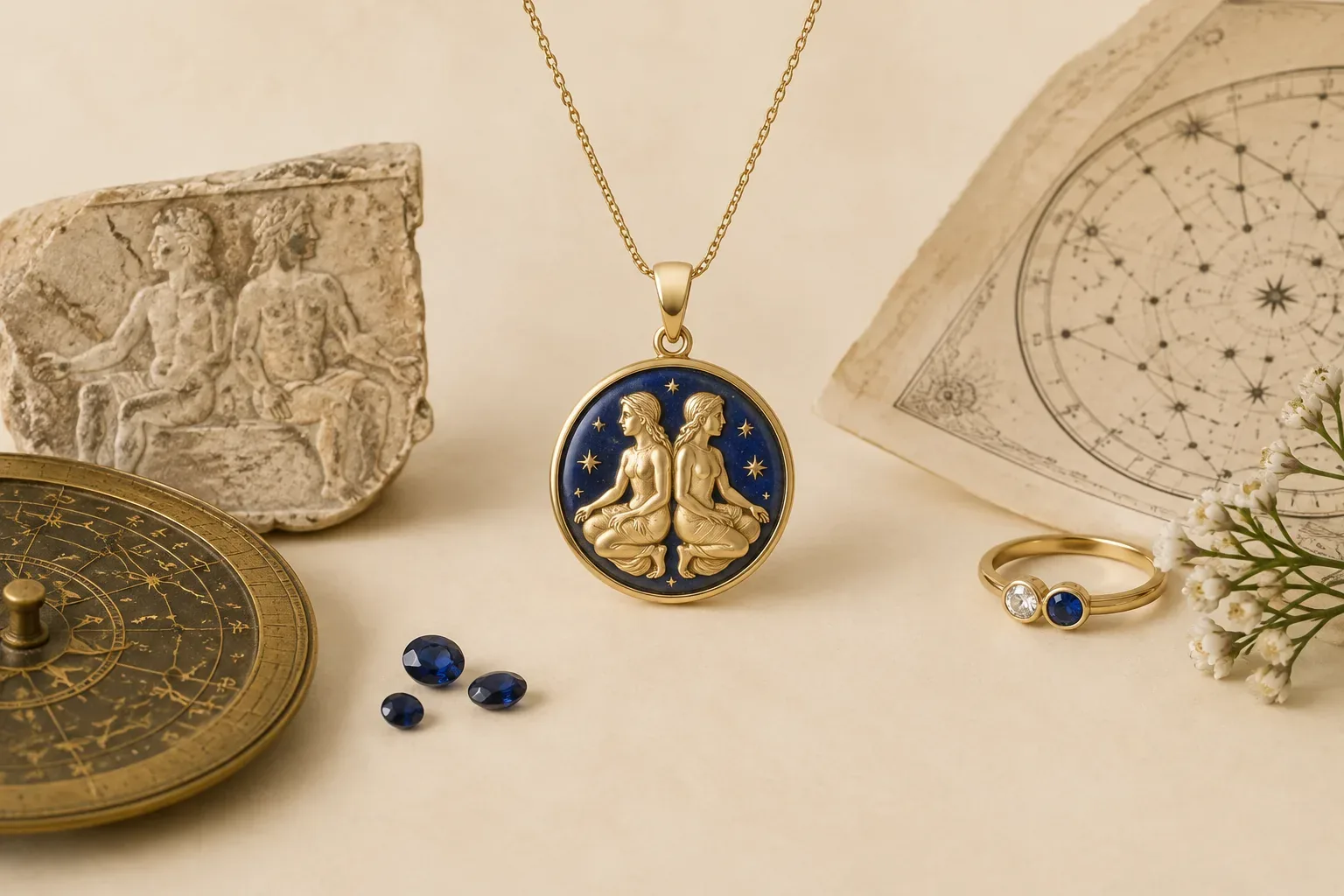
Motifs: Designers represent Gemini in several visual languages. The most literal motif is a pair of figures or 'twins' rendered as silhouettes, cameos, or reliefs. A simpler and very common visual shorthand is the Gemini glyph—a stylized Roman numeral II or two parallel lines—which appears on pendants, rings, and charms. Constellation renditions arrange small stones or metal dots to suggest the star pattern associated with Gemini. Contemporary makers also combine twin imagery with other celestial elements such as stars, moons, and suns.
Gemstones and materials: Historical use of certain gems and materials in jewellery is documented and described by museum resources. The Victoria and Albert Museum’s overview of gemstones highlights how different stones were prized for colour, rarity, and cultural associations across periods, and how gem fashions changed with trade, technology, and taste (Victoria and Albert Museum). In modern Gemini jewellery, makers commonly choose stones that are visually evocative—yellow topaz, citrine, or peridot for a warm palette; blue topaz or aquamarine for a cooler look; or small diamonds and white sapphires to suggest stars. These choices reflect contemporary aesthetics more than an ancient, fixed meaning attached to specific stones for the Gemini sign.
Techniques and traditions: Twin or celestial motifs appear in many jewelry types: pendants and lockets that reference personal identity, signet or engraved pieces that carry initials or dates, charm bracelets with zodiac charms, and costume jewellery where astrological fashion is a theme. The V&A emphasizes the role of technique and social use: settings, cut, and metalwork styles help date a piece and indicate its social function—whether intimate, ceremonial, or decorative (Victoria and Albert Museum).
Practical guidance for choosing or gifting Gemini jewelry
Match intent to object. If you want to honor an astrological identity—such as giving a birthday gift to someone born between May 21 and June 20—choose an item that clearly signals that intent, like a pendant with the Gemini glyph or a constellation necklace. If you want a more subtle gift, consider a locket, a paired‑element design (two stones or twin motifs), or an item whose materials suit the wearer’s taste and lifestyle.
Consider durability and daily wear. Decide whether the recipient will wear the piece daily. Fine jewellery in solid gold or platinum with securely set stones will withstand more wear than plated or costume pieces. For those who want everyday wear, select durable settings and harder gemstones; the Victoria and Albert Museum’s materials guidance on gemstones shows how historical and contemporary choices reflect the needs of the wearer and the technical properties of materials (Victoria and Albert Museum).
Check material disclosures. If gemstone authenticity or treatment matters to you or the recipient, consult the Federal Trade Commission’s guidance: sellers must disclose treatments, imitations, and synthetic stones, and responsible vendors will make those details available before purchase (Federal Trade Commission). Ask for certification or written disclosure on treatments, origin, and metal content when buying higher‑value gemstones or precious metals.
Respect religious and cultural differences. Twin motifs and star imagery may have different resonances for different people. When you are gifting across cultural or religious lines, ask or consider whether the zodiac or twin symbolism will be appreciated. If you are unsure, choose a neutral design or a customizable piece that allows the recipient to add a personal engraving or stone.
Personalize thoughtfully. Small custom touches increase meaning: an engraved date inside a locket, choosing the recipient’s favourite stone, or combining the Gemini motif with another family symbol. These additions create a personal narrative without asserting a universal symbolic meaning.
Budget and ethical considerations. Set a budget and seek transparent sourcing. For gemstones and precious metals, request information on treatments and origin and prefer reputable sellers who disclose that information. If mid‑range or costume jewellery suits the occasion, choose a reputable maker whose materials and workmanship match the intended use.
Care and authentication basics
Care follows materials: polished precious metals and faceted stones require routine gentle cleaning, while costume pieces may deteriorate faster and should be stored separately to avoid abrasion. The Victoria and Albert Museum’s material notes show why conservators recommend storing pieces carefully and avoiding exposure to chemicals and sunlight (Victoria and Albert Museum).
Authentication and buying tips: for purchases where the value or authenticity matters, request written disclosures and lab reports for gemstones and hallmarks for metal. The Federal Trade Commission explains consumer protections and the expectation that sellers disclose treatments, synthetic materials, and imitations, which helps buyers evaluate claims about a piece’s authenticity and value (Federal Trade Commission).
Final note on meaning
Jewellery carries layered meanings: historical, personal, and commercial. The museum record shows motifs are remade across time, and modern zodiac jewellery adds a contemporary layer of astrological identity that is meaningful to many wearers. When interpreting a Gemini piece, it is helpful to distinguish what is documented about the object’s period and materials from the personal meanings a wearer attaches today.
Frequently asked questions
Does Gemini jewelry have a single historical meaning?
No. Museum scholarship shows that motifs are reused and reinterpreted across time; twin imagery or star motifs in historical pieces often served different social or aesthetic purposes in each period rather than a single universal meaning (Victoria and Albert Museum). Modern astrological readings are a later layer of interpretation.
What motifs commonly signal Gemini in contemporary jewelry?
Contemporary Gemini pieces typically use twin figures, the Gemini glyph (II), or constellation arrangements of small stones to signal the sign. Designers also pair twin motifs with other celestial elements such as stars and moons to reinforce the theme.
What gemstones are appropriate for Gemini jewelry?
There is no historically fixed gemstone for Gemini that applies across cultures. Modern makers often choose stones by colour and durability—topaz, citrine, aquamarine, or small diamonds are common choices. Consult reputable guides on gemstones for material properties and historical context (Victoria and Albert Museum).
How can I verify a gemstone or treatment claim?
Ask the seller for written disclosure and, where appropriate, a laboratory report. The Federal Trade Commission requires sellers to disclose treatments, imitations, and synthetics, so request that information before purchase (Federal Trade Commission).
Is it appropriate to give zodiac jewelry as a gift?
Yes, when chosen respectfully. Match the design to the recipient’s taste, consider cultural or religious sensitivities, and prefer clear material disclosures for valuable pieces. Personalization—an engraving or thoughtful stone choice—can increase meaning.
How should I care for Gemini jewelry?
Care depends on materials. Precious metals and hard stones tolerate regular gentle cleaning and safe storage. Costume pieces need gentler handling and separate storage to prevent wear. The V&A material guides explain why different gems and metals require different care (Victoria and Albert Museum).
Sources and further reading
- Bedazzled: A History of Jewellery — Victoria and Albert Museum
- An A-Z of Gemstones — Victoria and Albert Museum
- Buying Gemstones, Diamonds, and Pearls — Federal Trade Commission