Meaning at a glance
This article explains the documented history and changing contexts of the raindrop motif, separates cultural or religious evidence from later popular interpretations, and gives practical guidance for choosing and wearing the motif in modern jewelry.
What the historical evidence shows
Museum scholarship and public displays that survey jewellery history show that drop-shaped motifs — including teardrop, pear and pendant forms — recur in many periods and regions because the shape is simple to fashion and pleasing to the eye. The Victoria and Albert Museum presents these recurring shapes within a broad social and technological history of jewellery, noting how decorative tastes, metalworking techniques and gemstone cutting evolved together and how certain shapes became fashionable in different eras. The V&A's overview of gemstones also places cuts and forms in the context of available lapidary techniques and consumer demand rather than treating any single motif as having a single, unbroken symbolic meaning.
That means the presence of a drop form in a piece of jewellery is often as much a statement about style, available materials or technical innovation as it is about symbolic meaning. Museums like the V&A document examples from European and global collections where pendant and drop shapes appear in brooches, earrings and necklaces, but their publications emphasize changing social contexts — for example, how mourning jewellery, portrait lockets or fashionable pendant styles developed — rather than asserting a single, ancient spiritual meaning for 'raindrops.'
Which cultures or periods used drop shapes (and what the evidence actually says)
The V&A's surveys of jewellery history demonstrate that drop and pendant shapes appear across many cultures and periods, from historical European pendant gems to decorative metalwork in other world traditions. Those museum resources document the presence of the motif and explain it through fashion, technique and material availability rather than by attributing a single shared symbolic message across cultures.
Because the V&A frames these shapes within museum collection histories and changing social uses, scholars and curators tend to identify the meaning of a drop-shaped object by its object type and context — for example, whether it is part of a mourning set, a fashionable court pendant, a domestic amulet or a purely decorative earring — rather than by assuming a continuous, cross-cultural spiritual significance for the raindrop form.
Documented historical meanings versus modern interpretations
Documented historical meanings in museum literature typically come from object provenance, inscriptions, contemporary inventories and the social contexts that museums like the Victoria and Albert Museum describe. For example, where a pendant in the shape of a drop forms part of a mourning ensemble or contains an inscription, the documentary evidence supports a specific commemorative meaning tied to that period and owner. These are historical meanings grounded in documented use and provenance.
By contrast, many contemporary meanings attached to raindrop or teardrop shapes — such as universal associations with renewal, cleansing, fertility or sadness — are often modern sentimental readings or personal metaphors. These modern interpretations are valid at a personal level but are not always supported by the object-level evidence that museums cite. It is important not to conflate a popular or marketing-driven symbolic message with the kinds of documentary sources that underpin museum attributions.
How the raindrop motif appears in jewellery: forms, gemstones and techniques
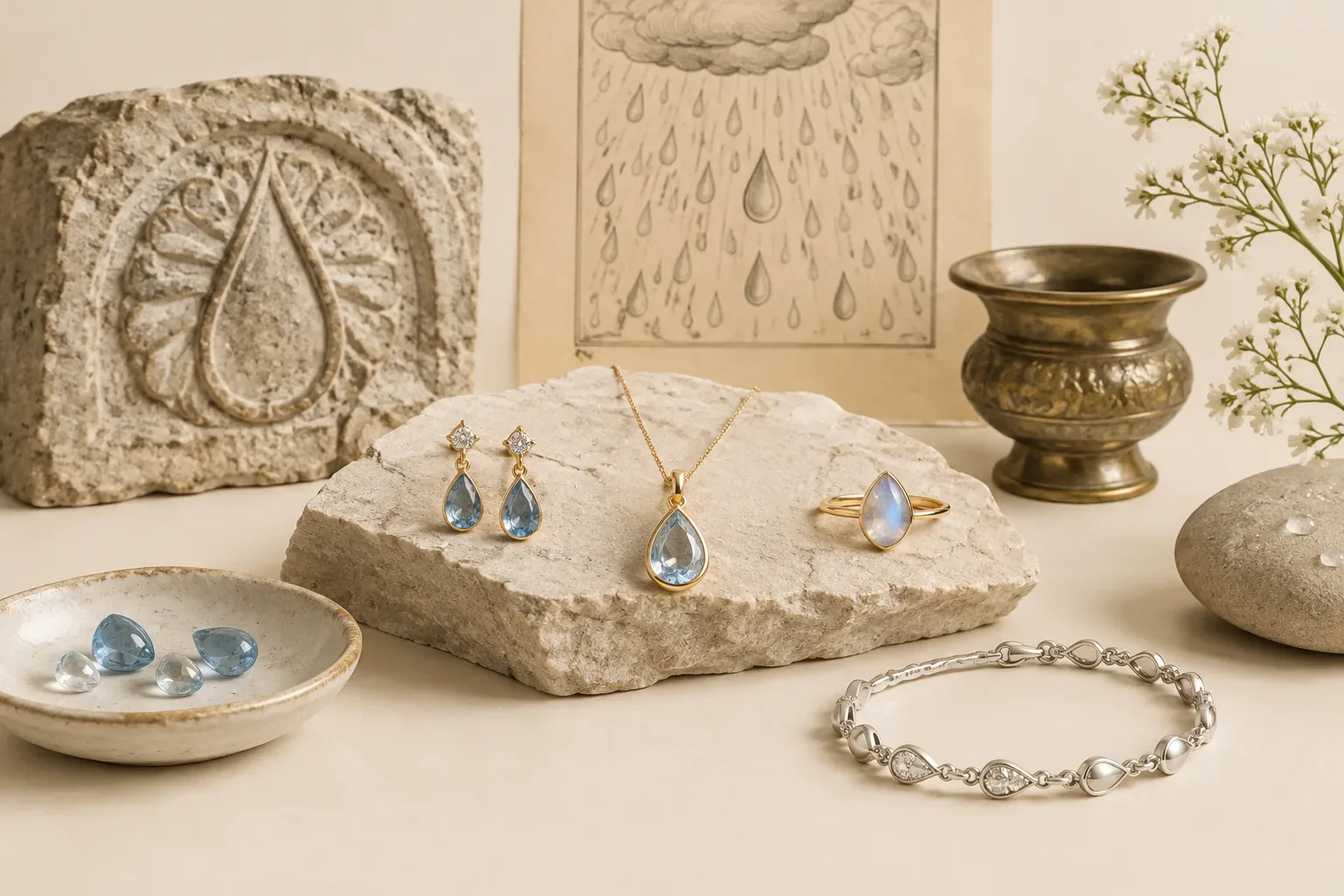
In jewellery design the raindrop idea most commonly appears as a teardrop or pear-shaped motif in settings, pendants, earrings and gemstone cuts. Designers use the elongated, rounded form to create graceful dangling shapes that catch light and move at the wearer’s neckline or ear. Museums and gem guides note that lapidary techniques and fashion influence which gemstones and cuts appear as drops: some stones are fashioned into pear or briolette cuts to suit pendant or earring designs, while other pieces use metalwork alone to suggest a drop.
Gemstones set in drop-shaped designs can range from clear stones that emphasize sparkle to opaque gems whose color and polish give a different visual weight to the motif. The Victoria and Albert Museum's materials on gemstones explain how choice of stone and cut relates to fashion and technique; a drop-shaped gem in a high-quality cut may have been a fashionable display of technical skill or wealth in a particular period, while a simpler, metal-formed raindrop could be a more affordable decorative choice.
Modern personal meanings and contemporary design trends
Contemporary jewellery makers and wearers often adopt the raindrop motif for personal symbolism: some choose it to represent renewal, emotional expression, fertility or a connection to nature. Other designers use the form purely for its aesthetic qualities — its movement, elongation and light-catching potential. These current meanings are legitimate personal or artistic choices, but they should be presented as modern interpretations rather than as direct continuations of a single historical meaning.
Designers also combine the raindrop motif with particular gemstones to add layers of meaning: for example, setting a blue sapphire or aquamarine in a drop can suggest water visually, while a pearl or moonstone might evoke softer, organic associations. These pairings are contemporary conventions or stylistic choices rather than fixed symbolic rules.
Practical, respectful guidance for selecting or gifting raindrop jewellery
When choosing a raindrop piece for yourself or someone else, start by considering what the shape means to the intended wearer. Ask whether the recipient prefers obvious symbolic statements, subtle design, or purely aesthetic jewellery. If the gift is meant to carry a particular sentiment, explain that the meaning is a modern, personal one rather than claiming a universal historical reading.
From a materials and purchase perspective, follow best-practice buying guidance for gemstones and fine jewellery. The Federal Trade Commission advises consumers to ask about treatments, enhancements and imitation materials, and to insist on clear disclosure of what they are buying. Confirm whether a gemstone has been heat-treated, dyed, coated or is an imitation and request any available documentation or a reputable seller’s written statement. For larger purchases, consider a professional appraisal or laboratory certificate.
Consider scale, setting and wearability. Raindrop pendants and long teardrop earrings suit different lifestyles: a delicate drop may be versatile for daily wear while a large, dangling briolette can be more of an occasion piece. Think about metal allergies, the recipient’s wardrobe and how the piece will be cleaned and maintained. If the piece has sentimental intent connected to memory or mourning, choose appropriate materials and present the sentiment privately and respectfully.
Caring for raindrop jewellery and checking authenticity
Caring for drop-shaped settings follows the same principles as other fine jewellery: clean according to the stone and metal type, check prongs and mounts regularly, and store pieces so they cannot scratch against other jewellery. If a piece contains delicate briolette cuts or fragile inclusions, ask a jeweller about recommended cleaning methods.
To check authenticity and value, request documentation and compare information from the seller with independent gemological resources or a qualified appraiser. The FTC resources stress the importance of clear seller disclosure about treatments, synthetic stones and imitation materials. For sentimental pieces, documentation can also preserve provenance for future wearers.
Putting it all together: meaning, evidence and personal choice
The raindrop motif in jewellery combines long-standing formal appeal with a spectrum of modern personal meanings. Museum resources like those from the Victoria and Albert Museum help us understand the motif’s presence in the history of jewellery as a stylistic and technical choice, while contemporary wearers add personal or cultural symbolism that may be meaningful to them.
If you want a piece that carries historical resonance, ask about provenance and whether a museum or published source documents a similar form in a known context. If you want a piece that carries personal meaning, be clear that the symbolism derives from the giver or wearer today. Either approach is valid: the important practice is to distinguish documented historical evidence from later or personal interpretations, and to buy with respect for materials and disclosure.
Frequently asked questions
Does a raindrop-shaped piece of jewellery always mean sadness or mourning?
No. Historical evidence shows that drop shapes have been used for many reasons, including fashion and technical display. While teardrop forms can be used in mourning jewellery in specific documented cases, the shape itself does not universally signify sadness.
Are certain gemstones traditionally used with raindrop motifs?
Museums and gem guides note that designers commonly use pear, briolette and teardrop cuts for transparent stones that catch light, and that metal-only drop forms are also frequent. Choice of gemstone tends to follow fashion, durability and lapidary technique rather than a single symbolic rule.
How can I be sure a gemstone in a raindrop pendant is real and untreated?
Ask the seller for disclosure about treatments, enhancements and whether the stone is natural, synthetic or an imitation. The Federal Trade Commission recommends that buyers request written statements and documentation and consider independent appraisal or laboratory certificates for high-value purchases.
Is it appropriate to gift raindrop jewellery with emotional meaning?
Yes, provided you present the meaning as a personal or contemporary sentiment rather than a universal historical fact. Consider the recipient’s tastes and the privacy of any strong emotional associations.
How should I care for delicate raindrop settings like briolettes or long pendants?
Care depends on stone and setting. Have prongs and mounts checked regularly, clean according to the stone’s requirements, and store pieces to avoid scratching. Ask a jeweller for cleaning guidance specific to the material.
Sources and further reading
- Bedazzled: A History of Jewellery — Victoria and Albert Museum
- An A-Z of Gemstones — Victoria and Albert Museum
- Buying Gemstones, Diamonds, and Pearls — Federal Trade Commission