Meaning at a glance
This article explains the documented history and changing contexts of the snowflake motif, distinguishes cultural and historical evidence from modern personal interpretations, and offers practical guidance for choosing and wearing snowflake jewelry.
Quick answer
The snowflake jewelry meaning is best described as a modern set of associations—uniqueness, transience, and wintertime identity—built on nature-inspired decorative traditions rather than a single, longstanding symbolic use across cultures. Museums that document jewellery history show that motifs drawn from nature have circulated and changed meaning through time, while the specific, widely shared symbolic language attached to the snowflake as a metaphor for individuality and purity is largely a recent development and a matter of personal or commercial interpretation.
What the historical record actually shows
Direct, well-documented evidence that a distinct "snowflake" motif carried fixed symbolic meaning in ancient or medieval jewelry is limited. The Victoria and Albert Museum (V&A) catalogs and exhibitions on jewelry history emphasize that jewelers have long borrowed forms and patterns from nature—flowers, leaves, stars and other geometric motifs—to decorate objects and to meet changing tastes and technologies, but they do not present the snowflake as a single continuous symbol with a consistent meaning across different ages or cultures.
What the museum material does make clear is that jewelry designs and their meanings change with social context, technology, and fashion. For example, the V&A's broader work on jewelry documents how innovations in cutting, setting, and ornamental techniques created new possibilities for depicting fine geometric detail and natural forms. Those technical changes made it easier in the modern era to reproduce delicate, symmetric designs that can be read as snowflake-like, and such designs became popular as decorative motifs rather than as fixed cultural emblems.
In short, museum-based histories show that nature-inspired motifs are common and mutable in jewelry, and that the snowflake form as a decorative or commemorative motif has emerged mostly in modern contexts where artisans and consumers wanted to evoke winter, a crystalline geometry, or the sensation of uniqueness.
Documented meanings versus modern interpretations
When discussing the snowflake jewelry meaning, it is important to separate documented historical meanings from modern interpretations. Documented historical meaning requires evidence from museum records, inventories, or period texts that explicitly link a motif to a belief or ritual. The available museum literature characterizes snowflake-like designs more as stylistic choices within changing decorative programs than as a symbol with an enduring ritual or religious significance.
Modern interpretations—those you see on gift tags, in advertising copy, or in personal dedications—tend to emphasize a few recurring themes: that each snowflake is unique, that snow suggests purity or stillness, and that snowflakes recall winter holidays, renewal, or a fleeting beauty. These associations have become widespread because they resonate emotionally and are easy to express visually, but they are contemporary meanings layered onto a motif rather than a continuity of ancient symbolic use. They are valid as personal or cultural expressions today but should not be presented as universal or historically continuous facts.
How the snowflake motif, gemstones, and techniques appear in jewelry
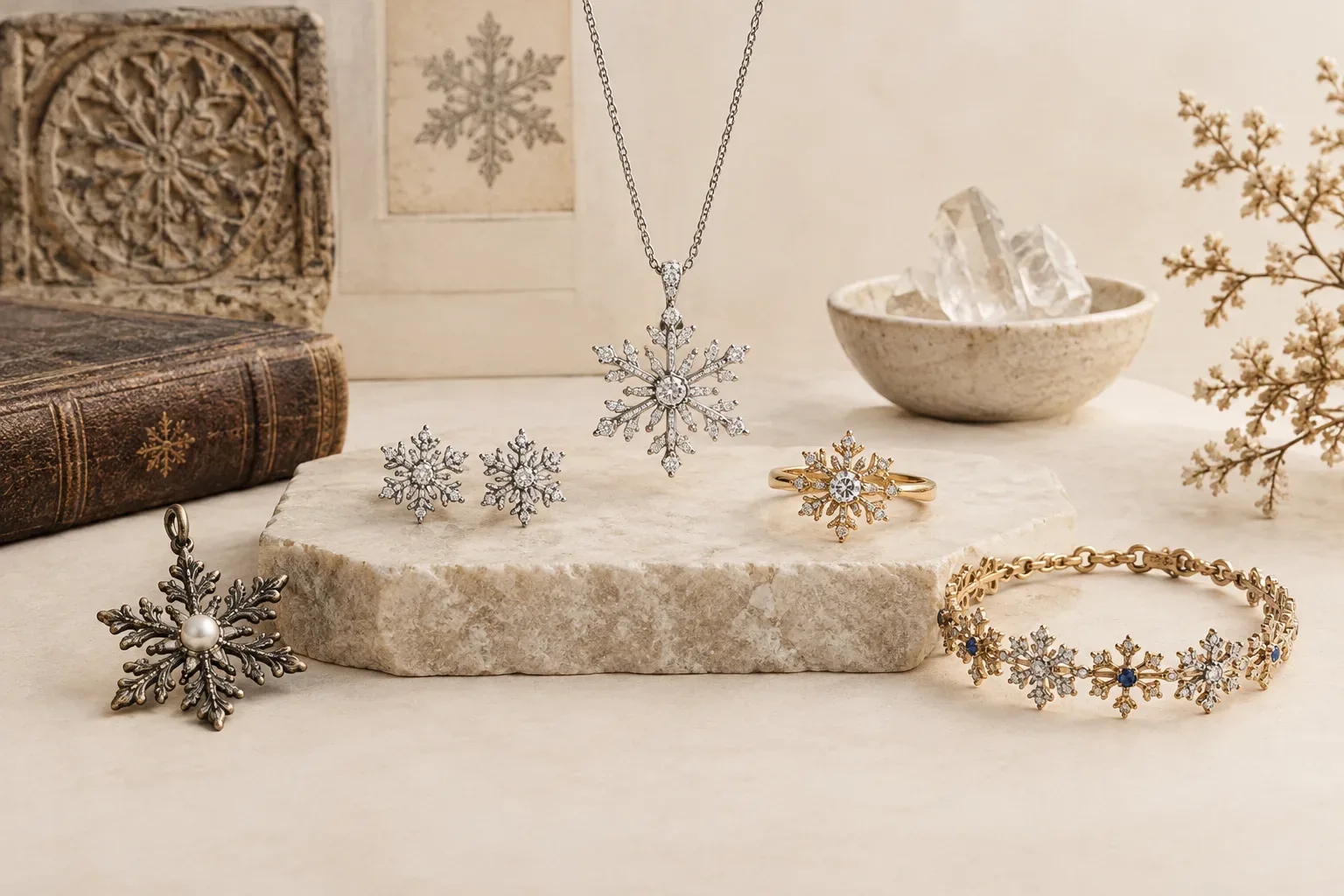
In modern jewelry, the snowflake motif appears in many ways: openwork pendants and brooches that mimic radial symmetry, small charm designs stamped or cast into metal, and pavé-style arrangements of small stones that suggest ice or sparkle. Jewelers use filigree, pierced metalwork, and geometric engraving to reproduce the delicate arms and central symmetry that make a motif read as a snowflake.
Gemstones are often used to reinforce the wintry associations of the motif. Cool-hued gems such as diamonds, white sapphires, and blue topaz are common choices because their sparkle and color evoke ice and snow. The Victoria and Albert Museum's account of gemstones explains how different stones have been selected and set for appearance and hardness, and how lapidary techniques affect a gem's brilliance and suitability for certain decorative uses. Because small accent stones are frequently employed to create the scintillating effect of snow, clusters of melee diamonds or simulated stones are popular in snowflake designs.
Techniques range from high-jewellery interpretations—where precise cutting, exact symmetry, and high-quality stones are used—to costume and fashion jewelry where rhodium plating, cubic zirconia, metal stamping, and enameling simulate the look at lower cost. Regardless of technique, the motif is often adapted to the scale and purpose of the piece, appearing on rings, earrings, necklaces, brooches, and charms.
Practical guidance for selecting or gifting snowflake jewelry
First, match the piece to the intended meaning you want to communicate. If your goal is to evoke the modern idea of individuality or a personal milestone, a single, distinctive snowflake pendant with a chosen birthstone may convey that intent. If you want to reference seasonal celebration, choose a design that reads intentionally festive without implying religious meaning unless the recipient would welcome that association.
Second, consider style and lifetime use. A highly detailed, delicate piece can be visually striking but may be fragile; heavier silhouettes or closed-back settings are more durable for everyday wear. Think about whether the recipient prefers subtle or statement jewelry, and whether they will wear the item casually or reserve it for special occasions.
Third, check materials and gemstone disclosures. The Federal Trade Commission advises consumers to confirm whether stones are natural, treated, synthetic, or imitations, and to ask about metal fineness and plating durability. If you are purchasing gemstones for their lasting value or emotional significance, ask for written information on treatments and origin when available.
Fourth, be culturally and personally respectful. The snowflake motif is typically secular and broadly acceptable, but any symbolism you attribute should reflect the recipient's tastes and beliefs. Avoid assuming that a motif has the same meaning for everyone; instead, explain why you chose the design when giving it as a gift so the recipient understands your intent.
Buying, care, and authentication tips
When buying snowflake jewelry, ask detailed questions about construction. For gemstone settings, inquire about prong strength, how stones are secured, and whether the piece is designed for frequent wear. If the piece includes accent stones rather than a single center gem, examine the uniformity of cuts and the security of the setting.
For gemstones and treatments, follow FTC guidance about disclosure. Reputable sellers should tell you whether stones are natural, heated, irradiated, lab-grown, or simulants. Such disclosures matter for value, care, and long-term expectations. For example, softer gem materials or surface-treated stones may require more careful handling and occasional professional maintenance.
For care, treat snowflake jewelry like you would any delicate or stone-set item: clean gently with a soft brush and mild soap, avoid harsh chemicals or ultrasonic cleaners for certain treated stones, and store pieces where they will not catch or be abraded. For plated or lower-cost fashion pieces, minimize exposure to moisture and perfumes to preserve finishes.
Respectful personalization and meaningful presentation
If you personalize a snowflake piece—by adding a birthstone, engraving a date, or choosing a metal finish—consider what that personalization will mean to the wearer in years to come. A birthstone addition ties the motif to identity and can make the piece feel more personal, while an engraved message clarifies the giver's intent. When presenting the gift, a short note explaining why you found the snowflake meaningful for this person will usually be better received than a vague symbolic statement.
Finally, consider the context of the gift. Snowflake jewelry is often given for winter birthdays, anniversaries, holiday gifts, or as a token of remembrance. Choose packaging and words that are sincere and appropriate to the relationship rather than leaning on marketing language that inflates cultural claims about the motif's ancient or universal meaning.
Closing thoughts
The snowflake jewelry meaning today rests largely on modern cultural associations and personal narratives layered onto a decorative tradition of nature-inspired motifs. Museum documentation underscores that design meanings shift with time and context, and that the snowflake form, while visually resonant, does not carry a single ancient or cross-cultural symbolism documented in major collections.
Treat snowflake designs as versatile and emotionally flexible motifs. Use them to celebrate uniqueness, mark seasonal memories, or offer a delicate aesthetic nod to winter, while attending to quality, disclosure, and the recipient's personal taste when buying or gifting.
Frequently asked questions
Does the snowflake motif have an ancient symbolic meaning?
There is limited evidence that the snowflake carried a single, consistent symbolic meaning in ancient or medieval jewelry. Museum documentation shows nature-inspired motifs were widely used as decorative forms, and the specific, widespread symbolic language attached to the snowflake is largely a modern interpretation rather than an enduring ancient symbol.
What does snowflake jewelry usually symbolize today?
Today, snowflake jewelry commonly symbolizes uniqueness, fleeting beauty, purity, or a connection to winter and seasonal memory. These are contemporary associations popularized in modern culture, marketing, and personal use rather than universal historical meanings.
Which gemstones work well with snowflake designs?
Cool-toned and highly brilliant stones such as diamonds, white sapphires, and blue topaz are frequent choices because they evoke ice and sparkle. Costume pieces may use cubic zirconia or simulated stones to achieve a similar visual effect.
How can I ensure the stones and materials are fairly described when buying snowflake jewelry?
Follow the Federal Trade Commission's guidance: ask sellers to disclose whether gems are natural, treated, lab-grown, or simulants, and request information on metal fineness or plating. Reputable vendors will provide written details about treatments and materials.
Is snowflake jewelry appropriate as a sympathy or memorial gift?
Snowflake imagery can be appropriate for sympathy or memorial contexts because of associations with transience and remembrance, but it depends on the recipient's preferences. Choose a design and inscription that reflect the relationship and explain your intent when presenting the gift.
How should I care for delicate snowflake pieces?
Clean gently with mild soap and a soft brush, avoid harsh chemicals and rough handling, and store where the piece cannot snag. For plated or lower-cost fashion items, avoid prolonged exposure to moisture and perfumes to preserve the finish.
Sources and further reading
- Bedazzled: A History of Jewellery — Victoria and Albert Museum
- An A-Z of Gemstones — Victoria and Albert Museum
- Buying Gemstones, Diamonds, and Pearls — Federal Trade Commission