Meaning at a glance
Cactus jewelry meaning today is best understood as a largely modern set of personal and regional associations—resilience, protection, and connection to arid landscapes—while museum records show only limited historical use of cactus-specific motifs in older European and global jewelry; this article separates documented history from later interpretations, describes how the motif appears in pieces, and offers practical guidance for selecting and gifting.
Quick answer
Concise answer: cactus jewelry meaning in contemporary use is most often a modern symbolic language—people choose cactus motifs to suggest resilience, endurance, protection, or an affinity for desert landscapes—whereas museum documentation does not support a continuous, universal historical or religious meaning for the cactus motif across cultures. This article explains documented museum evidence about plant motifs, distinguishes verifiable historical claims from later popular interpretations, and offers guidance for choosing and gifting cactus-themed pieces.
What historical evidence exists, and which cultures or periods are documented?
Major museum surveys of jewellery make clear that plant and floral motifs have been used across many cultures and periods for a wide range of meanings—from ornament and status to memory and sentiment. The Victoria and Albert Museum (V&A) sets out how styles and symbolic uses of plant and nature motifs changed with fashion, technology, and cultural taste, and how jewellery objects must be read in their changing social contexts rather than assumed to carry one fixed meaning.
However, the V&A’s work on jewellery history shows that a general history of botanical ornament is not the same as clear, documented evidence for the cactus motif specifically. There is limited museum documentation that treats the cactus as a continuous, widely shared symbolic image in premodern European or global court and religious jewellery in the way roses, laurel, or oak sometimes appear in historical record. In other words, plant motifs are well documented in jewellery history, but museum records do not support claiming a single, ancient, cross-cultural symbolic meaning for the cactus itself.
Where cactus imagery has stronger cultural presence, it is often regionally linked to places where cacti are native and to more recent historical periods. In those contexts the motif can carry locally specific cultural, ecological, or folkloric associations; those associations should be traced to local records, oral history, or ethnographic study rather than assumed to be universal. The V&A’s approach to jewellery history is useful here: look for documented provenance, maker, and context when assessing claims about a motif’s past meanings.
Documented historical meanings versus modern personal interpretations
Documented historical meanings in jewellery are most robust where there is solid provenance and contextual evidence: for example, floral motifs in Victorian sentimental jewellery often had codified meanings recorded in contemporary sources, a pattern of evidence that museums such as the V&A discuss when they catalogue collections. By contrast, explicit historical documentation that the cactus held a particular religious or courtly meaning in older global jewellery traditions is sparse in major museum literature.
Modern personal and commercial interpretations—by contrast—are explicit and widespread. Contemporary designers and wearers frequently treat cactus imagery as shorthand for resilience, protection, self-reliance, or desert identity. These are reasonable and meaningful modern readings, but they are contemporary cultural creations rather than conclusions drawn from long-standing, universally documented symbolism. Where regional or indigenous groups do attach deeper traditional meanings to cacti, those meanings should be sourced directly from those groups’ records and scholars; general museum histories do not substitute for community-specific evidence.
When you encounter claims that a cactus motif has a single ancient meaning, treat them with caution. Ask for provenance, documented cultural source, or academic reference. The V&A’s emphasis on context—maker, date, owner, and use—offers a model for distinguishing well-documented historical meanings from later or popular interpretations.
How the cactus motif appears in jewellery
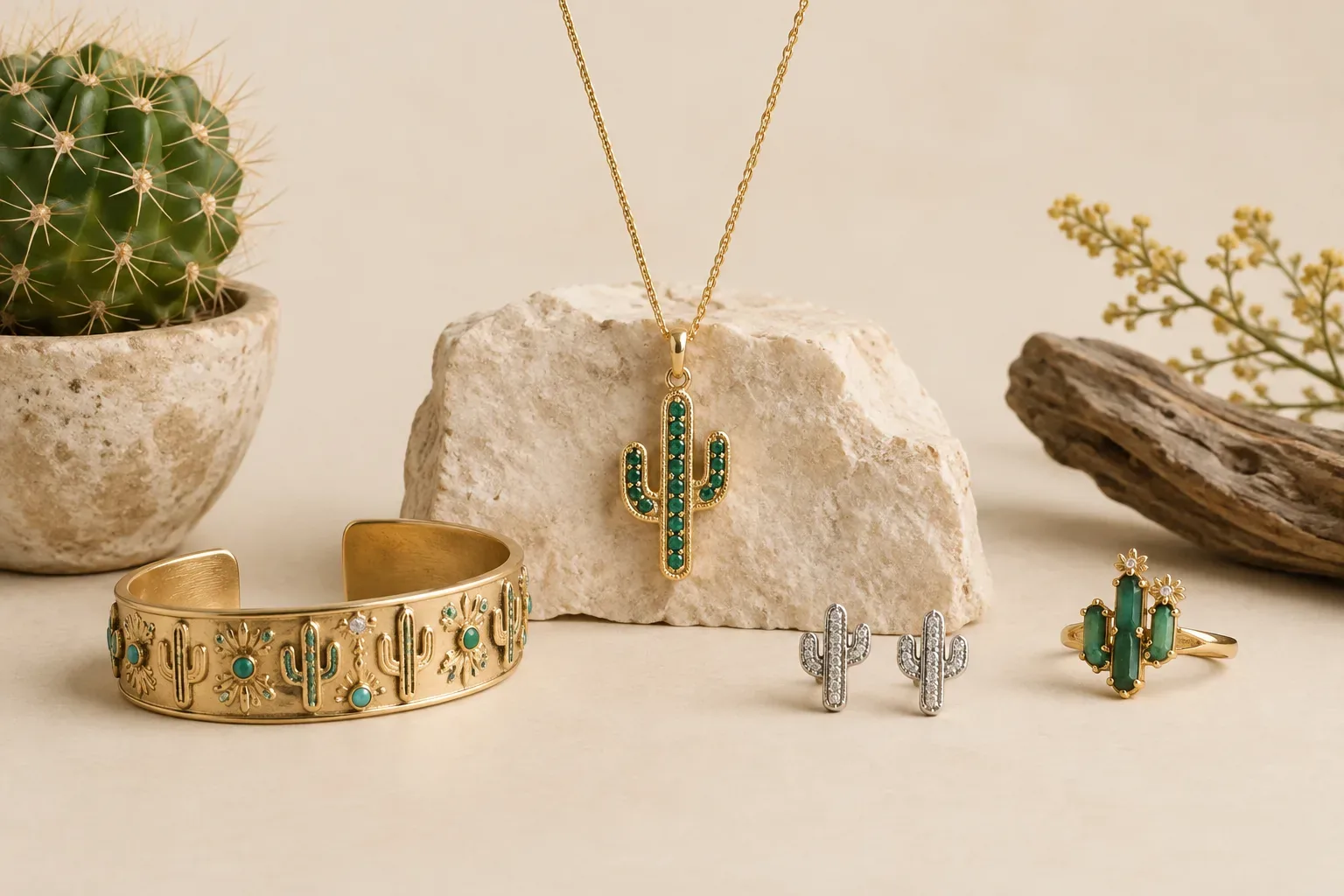
In contemporary jewellery the cactus motif appears in many forms: small silver or gold charms and pendants, enamelled brooches and pins, laser-cut or cast silhouettes, and stylized motifs in chain or earring designs. Designers often use green tones in stones or enamel to evoke the look of a succulent, though many cactus pieces are intentionally graphic or minimalist rather than realistic.
Designers sometimes choose gemstones and materials for color, durability, or cultural resonance. Green gemstones such as emerald, peridot, jade, or green onyx may be used to suggest foliage, while turquoise and silver are popular materials in Southwestern and Mexican-inspired jewellery due to historical craft traditions in those regions. For identifying and understanding gemstones, the V&A’s 'An A–Z of Gemstones' is a helpful starting point for historical and material context.
Technical approaches vary: cast metal allows small, affordable cactus charms; hand-engraving and enamelling permit more detailed, colourful representations; stone carving or inlay can create sculptural miniature cacti. Because modern cactus jewellery is largely a fashion and personal-symbol choice, it appears across price points—from mass-produced fashion charms to studio jewellery and bespoke pieces—so material disclosure and maker provenance become important for buyers.
Material honesty and what to ask about gemstones
When material authenticity matters—if you want a natural gemstone or a particular metal—ask the seller for clear information and documentation. U.S. federal consumer guidance highlights the importance of disclosure for gemstones, diamonds, and pearls: sellers should be transparent about treatments, synthetics, and substitutes, and consumers have the right to accurate descriptions. The Federal Trade Commission’s guidance is a useful reference for questions to ask about treatments, origin, and lab reports.
If a cactus piece uses green stones to evoke the plant, check whether those stones are natural, treated, dyed, or assembled. Treatments and imitations are common in the jewellery market; responsible dealers will explain what you are buying and provide certification or testing information on request. For repairs or future resale, prefer sturdy metals and settings and ask whether stones are glued, bezel-set, or prong-set, since construction affects durability.
Practical and respectful selection or gifting guidance
Choose a cactus piece that matches the recipient’s relationship to the motif. If the wearer associates cactus imagery with resilience, a small pendant or charm can be a quiet, daily reminder. For someone who appreciates regional craft traditions, select pieces by makers working in the relevant style and ask about provenance rather than buying generalized ‘ethnic’ designs that flatten local meaning. If you want a statement piece, consider scale and how it fits with the wearer’s style.
Be mindful of cultural sensitivity. If a design incorporates motifs or materials that have specific cultural, ceremonial, or sacred meaning in a particular community, seek makers from that community or confirm that the design is not appropriating a sacred symbol. Gifting thoughtfully also means being transparent about materials and care: indicate whether stones are natural or treated, what metals are used, and provide basic cleaning and storage advice.
For longevity, prefer well-made pieces: solid soldered jump rings, secure closures, and metals suited to the wearer’s skin (hypoallergenic options if needed). If budget is a concern, consider sterling silver designs or vermeil for a durable look without the premium of solid gold. Finally, pair a cactus gift with a short note explaining the meaning you intend—this personal context helps avoid misunderstanding and makes the gift more meaningful.
Final thoughts
Cactus jewellery meaning today is driven primarily by contemporary symbolism and personal connection, while documented historical evidence for the cactus as a long-standing jewellery symbol is limited in broad museum records. Use museum guidance about context and provenance when assessing historical claims, rely on consumer protections for material honesty, and choose or gift cactus jewellery with attention to craft, materials, and cultural respect.
If you want to research specific pieces, follow museum practices: confirm maker, date, and provenance, and consult community sources where the motif may have distinct local meanings. For practical tips on choosing meaningful jewellery and studying symbols, see our guides on selecting meaningful pieces and researching jewellery symbols.
Frequently asked questions
What is the basic meaning of cactus jewelry?
Cactus jewellery meaning today is most commonly a modern symbol of resilience, endurance, protection, or a connection to desert landscapes; these are contemporary associations rather than a single universally documented historical meaning.
Is cactus imagery historically documented in jewellery collections?
Museum surveys show that plant motifs are widely documented, but there is limited specific museum documentation for the cactus motif as a continuous symbolic element in older jewellery; always check provenance and context for historical claims.
Are there cultural sensitivities I should consider when gifting cactus jewellery?
Yes: if a design references a specific cultural or ceremonial tradition, seek pieces by makers from that community or verify that the motif is used respectfully and with permission to avoid cultural appropriation.
What gemstones pair well with cactus motifs?
Designers often use green or turquoise tones to evoke succulents—stones such as emerald, peridot, jade, or turquoise are common choices—but confirm whether stones are natural, treated, or imitations before you buy.
How can I verify gemstone authenticity and treatments?
Ask the seller for certification, lab reports, or clear disclosure about treatments and synthetics; U.S. consumer guidance (FTC) recommends sellers disclose treatments, and reputable dealers will provide testing or documentation on request.
How should I care for cactus-themed jewellery?
Care depends on materials: clean precious metals with appropriate cloths, avoid harsh chemicals with porous stones, and store pieces separately to prevent scratches; ask the maker for any stone-specific care instructions.
Sources and further reading
- Bedazzled: A History of Jewellery — Victoria and Albert Museum
- An A-Z of Gemstones — Victoria and Albert Museum
- Buying Gemstones, Diamonds, and Pearls — Federal Trade Commission