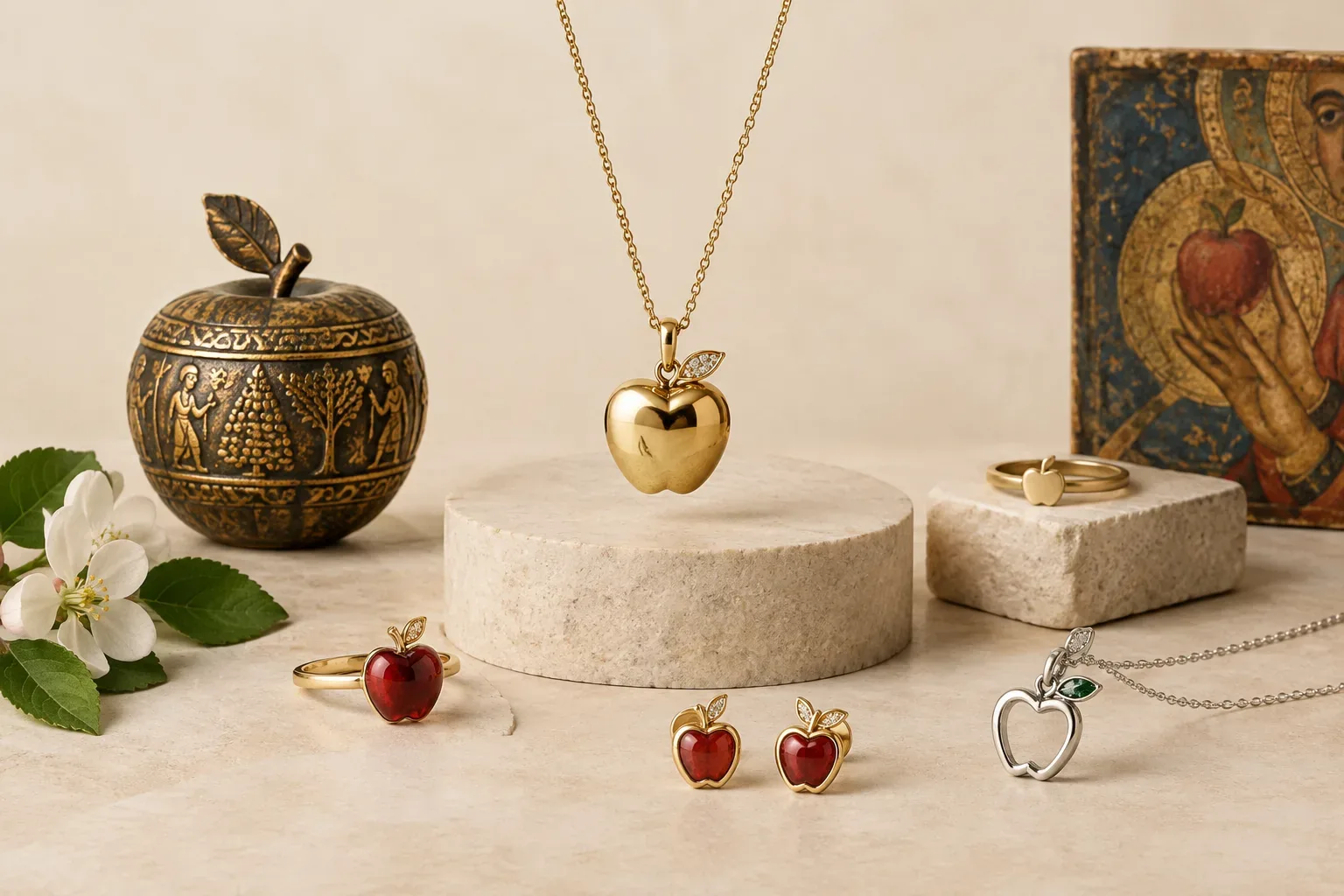
Meaning at a glance
Explain the documented history and changing contexts of the apple motif, separate cultural or religious evidence from later popular interpretations, and give practical guidance for choosing and wearing the motif in modern jewelry.
What the historical evidence shows
The strongest, documented evidence for the apple motif in jewellery is archival and object-based rather than an unbroken symbolic lineage. Surveying jewellery history and the social uses of ornament helps us see when fruit motifs were common and why. The Victoria and Albert Museum’s exhibition materials and overview of jewellery history describe how motifs, materials and social meanings change across periods; curators use objects to trace those changing contexts rather than to assert single, universal symbols (Victoria and Albert Museum).
In European decorative jewellery, especially in the 18th and 19th centuries, craftsmen used small carved forms, enamel and seed pearls to create floral and fruit motifs as part of sentimental and domestic ornament. The V&A’s general history of jewellery documents how these visual motifs circulated in fashion and how meanings—like love, memory or domesticity—were often attached later by wearers, artists and retailers rather than being inherent in a single image (Victoria and Albert Museum).
Material evidence about how jewellers have made small sculptural motifs is found in museum gemstone and materials descriptions. The V&A’s A–Z of Gemstones and related curatorial resources explain which materials and techniques (enamel, carved hardstone, seed pearls, goldwork) were traditionally used to render small fruit forms, which affects how a motif survives and how collectors identify it today (Victoria and Albert Museum).
Separating documented meanings from modern interpretations
Documented meanings are those explicitly recorded by makers, owners or contemporaneous commentators, or that can be inferred from consistent use in a cultural moment. The V&A’s surveys of jewellery history show that Victorian and late Georgian jewellery often used naturalistic fruit and flower motifs in sentimental pieces; in those cases the objects and cataloguing notes provide clear evidence of social use and intent (Victoria and Albert Museum).
By contrast, many meanings commonly attached to apples today are later or popular interpretations. For example, the apple’s association in modern Western culture with teachers and education is a relatively recent convention rather than an ancient, documented jewellery symbolism. Similarly, readings that present the apple as a single emblem of temptation, fertility, love or knowledge often mix religious, mythological and popular culture strands; those are valid personal or cultural interpretations but they are not universally documented across jewellery history.
Put another way: museum documentation supports that fruit imagery was fashionable and carried sentimental value in certain European periods. It does not support any single universal symbolic reading. When you encounter claims about ancient mythic associations or fixed religious meanings on a piece of jewellery, treat them as interpretive unless an object’s provenance or maker’s notes provide direct evidence.
How the apple motif, gemstones and techniques appear in jewellery
Apple motifs show up in jewellery in several practical ways: as small cast or carved pendants, enamelled brooches, charm-like add-ons on chains and bracelets, or as decorative elements on rings and lockets. The physical form—solid carved hardstone, hollow gold casting, enamel over copper, or composed from seed pearls—changes how the motif reads and wears.
The types of gemstones and materials historically used to render fruit motifs are described in the V&A’s A–Z of Gemstones. Craftspeople have used hardstones (such as carnelian or chalcedony) for carving, enamel for coloured surfaces, and seed pearls or small stones to create highlights and texture. Contemporary makers may use modern alternatives—resin, glass, plated metals or simulated gemstones—to achieve similar visual effects.
Technique matters for meaning and care. A hand-carved hardstone apple pendant has different conservation needs and market implications than a mass-produced plated charm. Museum descriptions and catalogues emphasize technique because it helps date an object and explain how it circulated socially (Victoria and Albert Museum).
Choosing and gifting apple jewellery: practical and respectful guidance
Match context to meaning. If you want the piece to carry a documented historical reference—sentimentality, domestic memory, or a specific Victorian style—select pieces whose provenance or maker’s notes support that context. Museum cataloguing practices show how provenance and technique anchor meaning (Victoria and Albert Museum). If the goal is a modern, personal symbol—gratitude for a teacher, a token of romance, or a nod to health and abundance—choose a contemporary design whose maker markets that intention.
Check materials and disclosures. When buying gemstone or precious-metal pieces, ask about treatments, imitations and metal quality. The U.S. Federal Trade Commission recommends that sellers disclose treatments and imitations, and notes that consumers should ask questions about origins, treatment, and certification when buying gemstones or diamonds (Federal Trade Commission). This is also practical for everyday wear: metals with low nickel content or known hallmarks reduce allergic reactions; solid precious metals will last longer than plated costume pieces.
Respect personal and cultural sensitivities. Because the apple has layered meanings in religious and literary traditions, avoid assuming a single interpretation. If you are gifting across religious or cultural boundaries, ask about preferences or choose a neutral design—a simple enamel pendant or a small gold charm—accompanied by a note that explains your intended meaning but leaves room for the recipient’s reading.
Care and longevity. Choose techniques and materials suited to intended use. Solid or well-made pieces are better for daily wear; painted or intricate enamel surfaces need more careful handling. For advice on assessing durability and care, consult seller documentation and follow basic jewellery care principles recommended by museum conservation departments and responsible retailers (Victoria and Albert Museum; Federal Trade Commission).
Wearing apple jewellery today
Contemporary wearers treat apple jewellery as an accessible motif with many possible personal readings. It can be playful, symbolic, professional or purely decorative depending on scale and context. A small apple pendant can work as a daily talisman or a subtle gift; a large enamel brooch reads more fashion-forward or statement-making.
Layering and pairing affect the communicated meaning. Worn with lockets or portrait pieces, an apple motif might read as sentimental or commemorative; paired with educational-themed charms, it will likely read as a celebration of teaching or learning. For collectors and wearers interested in historical continuity, choosing pieces that replicate museum techniques or motifs can intentionally reference documented periods of use (Victoria and Albert Museum).
Final thought
Apple jewellery meaning lives between documented historical uses and present-day personal interpretations. If you want a piece that carries historic weight, rely on provenance and technique. If your priority is a contemporary, personal message, choose a design and material that express that intention and be explicit about it when gifting. Either way, clarity about materials and a respectful approach to the recipient’s beliefs and tastes will help the piece communicate what you intend.
Frequently asked questions
Does apple jewellery always symbolize temptation or sin?
No. While the apple appears in some Western religious and literary iconography, jewellery meanings are not fixed. Museum documentation shows apple and fruit motifs were often decorative or sentimental in European jewellery history rather than carrying a single religious meaning (Victoria and Albert Museum). Contemporary wearers may choose the apple to mean temptation, love, knowledge, gratitude or simply aesthetic appeal.
Is an apple motif an appropriate gift for a teacher?
Yes—many people now use apple motifs as a symbol of education or gratitude in modern contexts. If you want that specific meaning to be clear, choose a contemporary design marketed for educators or accompany the gift with a note that explains your intent. A product example can be found in current jewellery offerings such as a teacher apple necklace.
How can I tell if an apple-shaped gem pendant is a genuine carved stone or a modern imitation?
Ask the seller for information about the material, treatments and origin. Museum gemstone guides note the differences in materials and techniques used historically and today (Victoria and Albert Museum). The Federal Trade Commission advises buyers to request disclosures about treatments and imitations when purchasing gemstones (Federal Trade Commission).
What materials and techniques should I look for if I want a historically styled apple piece?
Historically styled pieces often use techniques such as hardstone carving, enamel work and seed-pearl decoration. Museum collections and the V&A’s A–Z of Gemstones explain which materials and processes were used in different periods, and examining these details helps identify a piece’s stylistic reference (Victoria and Albert Museum).
Are there special care needs for apple jewellery with enamel or pearls?
Yes. Enamel and pearls are more delicate than solid metal or hardstone. Enamel can chip if knocked; pearls can be damaged by chemicals and should be stored away from abrasive materials. For long-term care, follow seller guidance and museum-conservation best practices when available (Victoria and Albert Museum).
How should I research the meaning of a specific apple pendant I inherited?
Begin with any maker’s marks, hallmarks or provenance documents. Consult museum catalogues or curators for similar objects and styles; the V&A’s resources on jewellery history can provide contextual comparisons. If the piece has gemstone elements, ask for a gemstone report and disclosure of treatments as recommended by consumer guidance (Victoria and Albert Museum; Federal Trade Commission).
Sources and further reading
- Bedazzled: A History of Jewellery — Victoria and Albert Museum
- An A-Z of Gemstones — Victoria and Albert Museum
- Buying Gemstones, Diamonds, and Pearls — Federal Trade Commission